Qimonda marks breakthrough in trench DRAM technology via introduction of Buried Worldline
On the sideline of Nanya and Micron’s announcement of a joint venture on 50nm and below DRAM technology, Qimonda has also introduced its latest stack DRAM technology – Buried Worldline. The introduction of Buried Worldline, at the meantime, marks a farewell to trench technology on 58nm and implies that trench DRAM technology has meet its limit with sub 58nm node to all transit to stack DRAM technology.
In contrast to general stack DRAM technology, Buried Worldline technology buries wordline under wafer surface, instead of stacking it above. This design results in a more condense lineup of circuitry and more gross dies on the same piece of wafer as compare with conventional stack DRAM technology.
While Qimonda is gearing up for the production of new DRAM, corresponding equipment makers are also working on adjusting present equipment to cope with the new technology. Noted that only Qimonda and a few DRAM makers house equipments that support Buried Worldline DRAM production, implying that how the equipment cost could be passed on via inviting more supporters as a big issue.
DDR2 eTT 1Gb price surge not driven by demand warm-up; 2HMar contract price stays flat
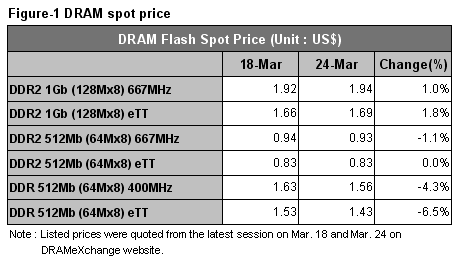
In the week Mar 18-24, price of DDR2 eTT 1Gb led the growth with a sequential gain of 5.6% during Mar 17-21, where other parts have their prices maintained stable with price fluctuation recorded within 1% range. Price of DDR2 eTT 512Mb stayed flat at US$0.83 and 1Gb up 1.8% to US$1.69 last week, where DDR2 667MHz 512Mb and 1Gb each up 1.1% and 1.0% to US$0.93 and US$1.94.
DRAMeXchange regards the surge of DDR2 eTT 1Gb more as a price correction to normality, as the price has been dropped too much in March. Prices of both eTT and branded chips are still hovering in the low range. Despite seeing a stabilizing price trend, seasonality downturn lulls transaction in spot market and memory module industry. Any price rebound does not necessary imply a backflow of demand in our view.
In the contract market, DRAM contract price stays flat in 2HMar, with price of DDR2 667MHz 1GB DIMM averages at US$17.50. As OEMs are expected to introduce SP1 to their Vista systems in May, and that the 32bit Vista OS may possibly support 4GB memory, we believe this means a boost to 4GB DIMM penetration. Oversupply is likely to be eased accordingly.
SDHC to be mainstream memory card in digital camera and smartphone
Extending penetration of digital camera and brisk growth of PND (personal navigation device) help spurring corresponding demand for high-density memory card. Thanks to consistent technology advancement, shrinking production cost of NAND Flash results in a gradual migration of SD 1.0 memory card to SDHC (Secure Digital High Capacity or SD 2.0), being the mainstream memory card for digital cameras. In contrast to other types of memory cards, SD class memory card is the one that is widely applied in digital cameras and other devices. Other major memory card standards include CF, xD and Sony’s proprietary MS card series.
In compare with SD 1.0, SDHC not only features higher memory density, but also enhanced data execution power. The advanced functionality is likely to prompt it to be the next mainstream memory card standard. Most SD cards in 4GB and 8GB memory density supports SDHC standard, with SD 1.0 memory cards mostly feature memory density of 2GB and below. As it is an inevitable trend to see shrinking NAND Flash price, the price gap between 2GB SD 1.0 and 4GB SDHC is also narrowing down.
In the US retail market, price of 2GB SD 1.0 averages at US$25-40, where price of 4GB SDHC at US$35-60, with prices of the two types of memory cards overlapped with each other. In the Taiwan market, the overlapped price range is even larger, as price of the former averages at NT$300-600 (US$10-20) and the later NT$500-700 (US$17-25). As the price ranges of the most expensive and cheapest cards are small, easier replacement of each other is seen.
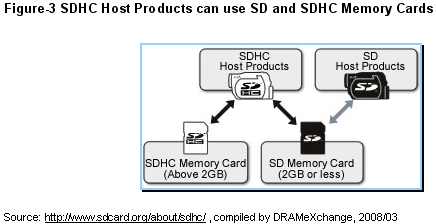
SDHC standard was established by the SDA (Secure Digital Association) in May 2006. All SDHC cards must support FAT32 file system, with memory density of 2GB to 32GB. Any memory card supports memory density in this range must have a clear SDHC logo printed. Several data transmission standards are also defined, such as Class 2, Class 4 and Class 6. Note that consumer electronics that supports SDHC is backward compatible with SD, but vice versa is not applicable.
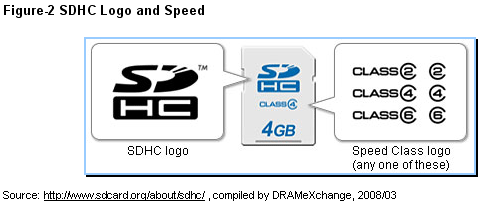
Among the different SDHC data transmission classes as defined by SDA, Class 2 (RW: 2MB/s) is capable to meet data storage for playing general SDTV (standard definition TV), DV and MPEG movie; Class 4 (RW: 4MB/s) is suitable for digital camera’s continuous shooting and playing HDTV content; and Class 6 (RW: 6MB/s) is designed for professional cameras’ continuous shooting.
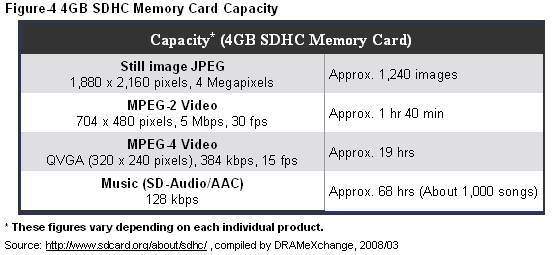
Most leading Japanese digital camera vendors such as Canon, Fujifilm, Nikon , Panasonic and Casio have all their cameras support SHDC, except Sony still insisting to use its proprietary MS Duo and MS Pro Duo. Korean vendors such as Samsung have also joined the league. Besides digital camera makers’ support, more high-end smartphones also feature SDHC, implying a substantial business potential ahead.
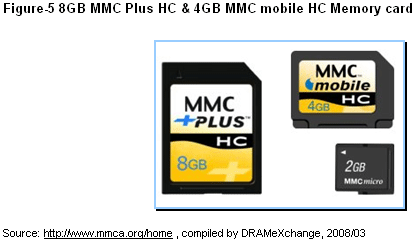
For other memory card standards, MMCA (MultimediaCard Assoication) has worked with JEDEC to establish the new eMMC 4.3 standard in attempt to make high-density NAND Flash interface to be directly embedded with system. Leading chipmakers include Micron, Samsung, Spansion, STMicroelectronics and Toshiba have all introduce eMMC in their new products. Where for handset and GPS vendors, they have also start introducing products in eMMC 4.3 standard.
Despite most memory cards for handsets are still having memory density in 1-2GB range, as more functions are equipped in handsets, and that penetration of digital camera is consistently expanding, the narrowing down price gap between 4GB SDHC and 2GB SD 1.0, prompt us believing that 4GB memory card will soon become the mainstream memory card density.
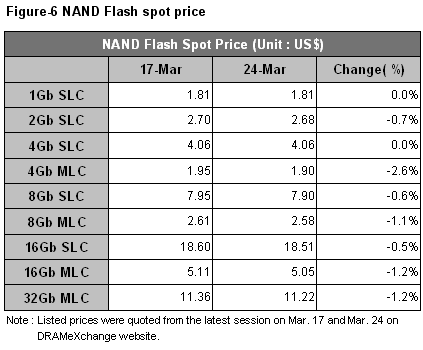
NAND Flash spot price recap, Mar. 17-24
In the SLC segment, price of 1Gb stayed flat at US$1.81; 2GB dropped by 0.7% to US$2.68; 4Gb stayed flat at US$4.06; 8Gb dropped by 0.6% to US$7.90 and 16Gb dropped by 0.5% to US$18.51. In the MLC segment, 4Gb dropped by 2.6% to US$1.90; 8Gb dropped by 1.1% to US$.58; 16Gb dropped by 1.2% to US$5.05 and 32Gb dropped by 1.2% to US$11.22.

The memory market watcher
DRAMeXchange is a global primary provider of future intelligences, in-depth analysis reports and advisory services on DRAM and Flash memory industry with coverage including current business, spot trading prices, and market trends, capital spending and wafer capacity trends, the impact of DRAM/flash memory products on the market, and other relevant PC industry information.
© DRAMeXchange ® Tech.Inc. All rights reserved.