Short-term DRAM spot price drop accelerates, but overall stability not to be affected
DRAM transaction in the spot market was weak last week in terms of both pricing and trading volume, primarily due to weak demand. While for the contract market, DRAM supply-demand status suggests that quotes should stay flat in 2H Feb with less opportunity to see upward price trend in near term.
February is usually a slow season for DRAM and that meaningful demand is rarely seen this year. Most of the transactions made last week were focus on 512Mb eTT component where trading volume for 1Gb eTT parts was down further.
When those transactions that were spurred by speculation gradually lull, prices of eTT parts posted a 10% sequential decline accordingly. As price of DDR2 512Mb eTT part has long been a key price indicator, when its price felt below US$0.90 mark, speculation activities are encouraged. The more severe the price drop is then resulted in a stronger consumption inventive. Thus, the 512Mb eTT chip price will unlikely fall past the previous low.
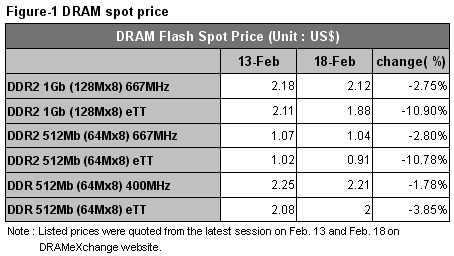
During the week Feb 13-18, prices of 512Mb and 1Gb eTT DDR2 chips have been dropped by a respective 10.78% and 10.9% and closed at US$0.91 and US$1.88. Prices of branded 512Mb chips were mostly closed at US$1 range.
As most chipmakers are having their 70nm migration on track, with some even seeing yields hitting 90% in February, this implies output is consistently expanding. Demand, on the contrary, is sluggish in both spot (including channels and memory module makers) and contract market. PC shipments in February are expected to decline by 2.25% on month to 21,451k units, meaning OEMs should have limited consumption incentive in the later part of the month and DRAM contract prices will likely to stay flat.
Apple introduce new iPhone and iPod Touch with more memory
Apple introduced its 16GB iPhone and 32GB iPod Touch on February 5. Since the launch was not scheduled during the previous Macworld Conference & Expo, it did not draw much attention as the launch of the previous generation iPod Touch and iPhone. According to revealed figures from company website, iPhone supports two memory densities, i.e. 8GB and 16GB, with prices being set at US$399 and US$499, respectively. iPod Touch is available in three different memory densities, i.e. 8GB, 16GB and 32GB, with prices being set at US$299, US$399 and US$499. The latest product launch is expected to further encourage Apple fans in opening their wallets.
For general smartphone and MP3/PMP users, memory density of 2-4GB may be good enough to meet the storage need for photo, music and AV content. But for feature-rich gadgets such as iPhone and iPod Touch, more memory is required to store applications/software. The specifications of iPhone and iPod Touch show that these two devices could be categorized as a high-end PDA device. Users not only use these devices for multimedia content playback, but also power the devices with stronger value-added services via available service download from Apple’s website. Consumers are able to launch popular softwares such as Google Maps or YouTube on these devices.
Apple is not the first MP3/PMP player in launching a high-density (32GB) device. Rivals including Creative and SanDisk have both previously introduced their respective Zen and Sansa View that also support 32GB of density. Yet, the introduction of iPod Touch does indeed bring a catalyst to other MP3/PMP players in the migration to 16GB or above density products.
Besides fellow MP3/PMP players, leading handset vendor such as Nokia, is also being affected. During the recent 3GSM congress, Nokia introduced the N96 mobile phone that featured a built-in memory of 16GB. As the introduction of iPhone and iPod Touch will spur demand for feature-phones, DRAMeXchange anticipates seeing more handheld devices to employ higher density of memory in 2008, implying a positive demand driver for NAND Flash.
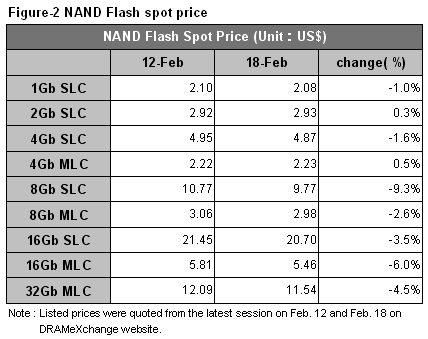
NAND Flash price recap, Feb 12-18
In the SLC segment, 1Gb dropped 1% to US$2.08; 2Gb maintained flat at US$2.93; 4Gb dropped 1.6% to US$4.87; 8Gb dropped 9.3% to US$9.77 and 16Gb dropped 3.5% to US$20.70. In the MLC segment, 4Gb maintained flat at US$2.23; 8Gb dropped 2.6% to US$2.98; 16Gb dropped 6% to US$5.46 and 32Gb dropped 4.5% to US$11.54.

The memory market watcher
DRAMeXchange is a global primary provider of future intelligences, in-depth analysis reports and advisory services on DRAM and Flash memory industry with coverage including current business, spot trading prices, and market trends, capital spending and wafer capacity trends, the impact of DRAM/flash memory products on the market, and other relevant PC industry information.
© DRAMeXchange ® Tech.Inc. All rights reserved.