DDR2 512Mb price to stabilize at US$1 level
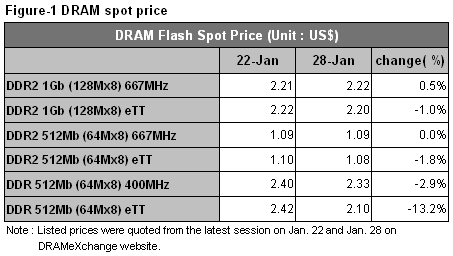
After experiencing a weeks’ noticeable appreciation of 15.6%, DRAM spot prices stabilized in the week Jan 21-25. DRAMeXchange observes that DRAM spot prices have posted consistent appreciation over the past month amid some DRAM makers’ announced fab maintenance plans and signs of price bottoming. While price negotiation with contract customers is still underway, some DRAM makers have expressed wishes to raise quotes in light of the recent spot price trend.
DDR2 512Mb eTT and DDR2 1Gb eTT both posted a mild sequential drop of only 1% and closed at US$1.10 and US$2.20 respectively last week. The price gap between eTT and branded parts has been narrowed down also, reflecting that marketers are still optimistic about ongoing price trend, especially when most DRAM makers guide that prices should hit bottom in 1Q with rebound likely to follow in March.
A recent price comparison shows that DDR2 eTT prices are consistently trending upward. Prices of DDR2 512Mb and 1Gb eTT have grown by a respective 39.3% (from US$0.84 to US$1.17) and 35.5% (from US$1.72 to US$2.33) from the lowest to the highest level in Jan. Where comparing average prices on a monthly basis, a 15.7% and 10.9% growth for 512Mb (from US$ 0.83 to US$0.96) and 1Gb parts (from US$1.75 to US$1.94) has been observed also.
In the contract market, DRAM contract price negotiation for 1HFeb is still underway. Since DRAM spot prices saw sharp growth over the recent month, DRAM makers tend to propose a raise of 3-5%. In light of the over 20% price premium that spot market delivers, some DRAM makers plan to grow their supply to spot market in attempts to generate better profit and reduce supply to contract customers, and in turn grow their price bargaining power. Impacts of their strategies are yet to be seen.
Effect from iPod and iPhone on NAND Flash industry to maintain in 2008
Despite NAND Flash demand by consumption shows that memory card and USB Flash drive (UFD) as the biggest chip consumers, the role of Apple’s iPod and iPhone in the entire NAND Flash equilibrium and pricing proved to be more influential. Built on the buoyant sales record in 2007, DRAMeXchange believes that these two gadgets will continue to exercise a meaningful impact over the industry in 2008 if the strong sales record is sustainable.
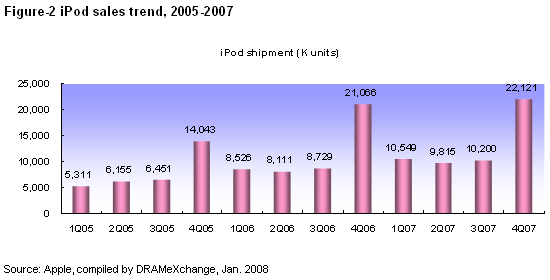
According to the revealed 4Q07 earnings figures, Apple sold a total of 22.12mn of iPod, 2.32mn of iPhone and 2.32mn of Macintosh PC, in 4Q07 – a result that is very much in line with expectation. This sales record translates to a NAND Flash demand of 23% in the quarter.
Accumulated sales of iPod and iPhone are 52.69mn and 3.70mn units in 2007. Corresponding NAND Flash consumed a total of 2000mn Gb, accounting for about 16% of total NAND Flash demand.
Despite the fact that memory card and UFD, which jointly account for 60% of NAND Flash bit demand, is the largest NAND Flash consumer, sometimes their impacts over the entire NAND Flash market is less than iPod and iPhone.
Given that memory card is a standardized product with many manufacturers and is broadly applied into a wide range of consumer electronics (handset, digital camera, etc.) in external form, the complicated market dynamics, thus, whittles down its corresponding impacts.
iPod and iPhone, on the contrary, are solely manufactured by Apple with NAND Flash being equipped in embedded form. This implies that Apple’s NAND Flash procurement amount in each quarter will exercise a structural impact over the entire industry and pricing, as evidenced in the NAND Flash supply status and corresponding price trend observed last year.
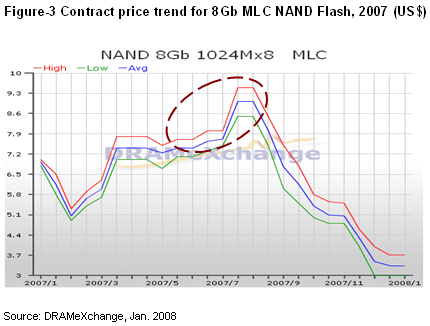
Reviewing iPod’s sales trend over the past three years, we observe that 4Qs are the high season. Since Apple usually requires 1-2 quarters’ time for component procurement, its procurement had put the entire NAND Flash supply on a strain during June to August last year, spurring price of the mainstream 8Gb MLC trending upward (Figure 3).
If Apple is capable to sustain the strong sales record of iPod and iPhone, it is not surprising to project that these two gadgets will continue to serve as two of the most influential devices in judging the NAND Flash equilibrium and pricing in 2008. NAND Flash price trend may float along with the procurement pattern of Apple from mid-2Q08 onwards as what we observed last year. Yet, the sharp price cuts of memory card and UFD in 4Q07, which resulted in a stable demand growth, may prompt these devices to be the very key NAND Flash demand drivers prior to any structural change that Apple may pose to the market in 1H08.
NAND Flash price recap, Jan 21-28
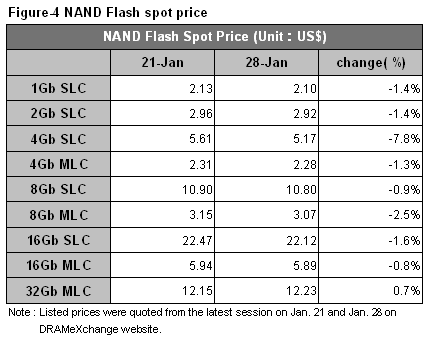
In the SLG segment, 1Gb dropped by 1.4% to US$2.10; 2Gb dropped by 1.4% to US$2.92; 4Gb dropped by 7.8% to US$5.17; 8Gb dropped by 0.9% to US$10.80 and 16Gb dropped by 1.6% to US$22.12. In the MLC segment, 4Gb dropped by 1.3% to US$2.28; 8Gb dropped by 2.5% to US$3.07; 16Gb dropped by 0.8% to US$5.89 and 32Gb up 0.7% to US$12.23.

The memory market watcher
DRAMeXchange is a global primary provider of future intelligences, in-depth analysis reports and advisory services on DRAM and Flash memory industry with coverage including current business, spot trading prices, and market trends, capital spending and wafer capacity trends, the impact of DRAM/flash memory products on the market, and other relevant PC industry information.
© DRAMeXchange ® Tech.Inc. All rights reserved.