Christmas not a joyful season for DRAM; price rebound likely in 1Q08 on equipment maintenance in Taiwan
Weak DRAM pricing trend in both spot and contract market persisted in the week Dec 10-17 amid generally soft demand. The downhill price trend in both market places is believed to maintain through the end of 2007. But for longer term prospect, DRAMeXchange foresees a possible price rebound in 1Q08 as some suppliers in Taiwan are expected to undergo annual equipment maintenance in this period.
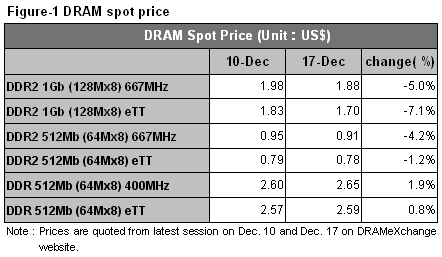
Although price of DDR2 512Mb eTT stayed flat last week, the overall weakness is still maintained. Price of DDR2 512Mb eTT dropped by 1.2% on last week to US$0.78 and DDR2 1Gb eTT 7.1% to US$1.70 in the same period. In the branded chip segment, price of DDR2 512Mb fell by 4.2% to US$0.91 and the DDR2 1Gb fell by 5% to US$1.88.
Since demand for memory at Europe and the US will temporarily put on hold as Christmas approaches, and that memory inventory level at spot market is still relatively high, DRAMeXchange expects the downhill price of DDR2 512Mb eTT to maintain in the coming week, especially when marketers are still delivering pessimistic outlook.
In the contract market, price negotiation for 2H Dec is still underway. As prices of some DDR2 677 1GB branded modules are already quoted at US$17 level, this should weaken bargaining power for some suppliers. On the demand side, consumption that is believed to be suppressed by OEMs’ quarterly/annual inventory pressures, prompted us believing that sequential drop is likely.
Recalling expansion plan among major players, none of them has announce any output trim except Qimonda (only for production in Europe). But some Taiwan suppliers are expected to have their output to trim by 10-25% during February (Chinese New Year) as they usually plan for an average of 3-7 days of equipment maintenance during this period. DRAMeXchange regards this as a possible catalyst for a price rebound in near term.
But for longer term, only output trim at leading players will bring a meaningful price improvement in our view. Windows Vista’s launch of SP1 in 1Q08 is believed to spur possible system upgrade demand. And the rising penetration of low-cost PC at emerging regions is also expected to help accelerating inventory consumption.
Adoption of MLC NAND Flash in SSD determines take-off time of SSD
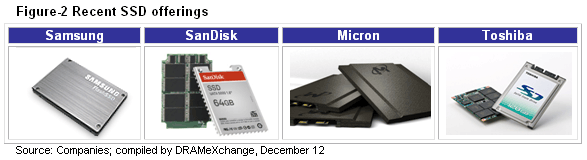
The recent launch of new SSDs from leading NAND Flash makers including Micron and Toshiba, again, lists the platform curtain for the so-called next killer application of NAND Flash. SSD is actually not a new concept in storage devices for the fields of military and industry. But the price premium prevented its penetration to PC until 2006 – the time that Samsung introduced a HDD-like SSD in 32GB of memory density. Spotlight has been drawn about a feasible replacement of SSD to HDD in PC thereafter.
Except Hynix, all major NAND Flash makers including Samsung, Toshiba-SanDisk, Intel-Micron, have all introduced their respective SSDs in a wide-range of memory density. HDD makers including Seagate, Fujitsu and Hitachi, are also planning to join the lineup in the coming 1-2 years, in order to sustain their secured competitive edges in PC storage media segment. Although a handful of industry players are trying to get a bite of the cake, marketers generally believe that two critical criteria to win in this race will be the adoption of MLC NAND Flash in SSD and SATA-compatible controller.
NAND Flash in MLC structure is a must to drive the replacement of SSD with HDD in PC in terms of cost. Yet, MLC is still lagging behind of SLC in terms of data execution life cycle, performance and stability. To address these issues, controller plays a vital role. Present SSD controllers generally employ MLC-specific management includes bad-block management, error-correcting code and wear leveling to extend life cycle of MLC chips in SSD.
Interface is another key issue beside NAND Flash architecture that needs to be addressed in SSD deployment. Currently, Samsung, SanDisk, Micron and Toshiba have all rolled out respective SSD that supports SATA interface, with some even support SATA II. While upstream players are striving hard by boosting interface transmittance performance, some downstream memory card makers still lack SATA-support controller. This implies that SSD market deployment will be still dominated by upstream players in 2008.
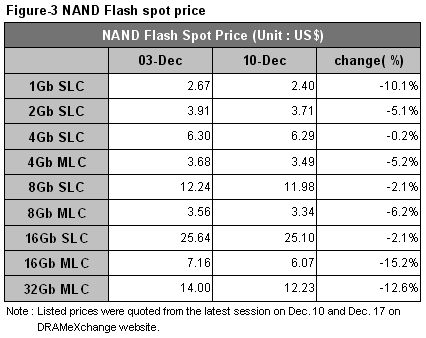
Sequential price fall across the board persisted last week. In the SLC segment, 1Gb price dropped by 10.1% to US$2.40. 2Gb price fell by 5.1% to US$3.71. 4Gb price fell by 0.2% to US$6.29. 8Gb price dropped by 2.1% to US$11.98 and 16Gb by 2.1% to US$25.10. In the MLC segment, 4Gb price dropped by 5.2% to US$3.49; 8Gb fell by 6.2% to US$3.34; 16Gb fell by 15.2% to US$6.07 and 32Gb fell to US$12.23, a drop of 12.6%.

The memory market watcher
DRAMeXchange is a global primary provider of future intelligences, in-depth analysis reports and advisory services on DRAM and Flash memory industry with coverage including current business, spot trading prices, and market trends, capital spending and wafer capacity trends, the impact of DRAM/flash memory products on the market, and other relevant PC industry information.
© DRAMeXchange ® Tech.Inc. All rights reserved.