DDR2 eTT 1Gb chips demand increases with a price increase of roughly 10%, DRAM Fabs plan to reduce production slowly takes effect.
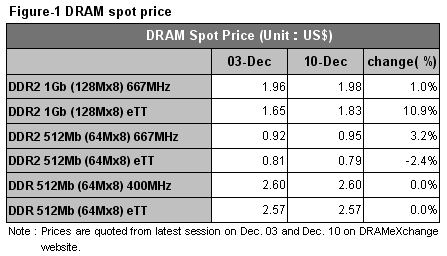
Spot market saw a rare price fluctuating scene last week. Although DDR2 512Mb eTT price once rose to US$0.83, closing price still fell from US$0.81 on 12/03 to US$0.79 on 12/10, a decrease of roughly 2.4%. Meanwhile DDR2 1Gb eTT saw the most rise this week with an increase in closing price from US$1.65 on 12/03 to US$1.83 on 12/10, an increase of roughly 10.9%. Branded chip price was relatively calmer compared to eTT price. DDR2 512Mb price rose from US$0.92 on 12/03 to US$0.95 on 12/10, an increase of roughly 3.2%. DDR2 1Gb price rose from US$1.96 on 12/03 to US$1.98 on 12/10, an increase of roughly 1.0%. From a market perspective, with current spot market inventory continuing at a high level and the fact that we are now entering traditional slow season, DRAMeXchange expects DDR2 512Mb eTT price to continue its decline this week. From last week’s price, although 512Mb dies continue to be main stream, because the growing demand for single 2GB modules and the relative cost advantage of 2GB modules over 1GB modules that are manufactured with 512Mb dies, it is easy to see that 1Gb dies is gradually becoming the mainstream market standard. This trend is more evident with the price fluctuation of DDR2 512Mb price and the increase of DDR2 1Gb price this week.
On the contract market, DDR2 667 1GB module price close at roughly US$19 in early December, a rough decrease of 10% comparing to the contract price in late November – a relatively cooler market compared with last week’s spot market in which price actually rose at one time. Main reason is the coming end of Christmas holiday shopping season. Moreover, because of the traditional slow shipping month in December and because of the common lack of buying interest among OEM vendors, we expect contract price to continue its decline in the second half of December.
With the rise of DDR2 eTT 1Gb price last week, DRAM Fabs’ plan for reducing production has again become a focal point of discussion. One by one, beginning from investor conferences in Q3 this year, Taiwanese DRAM Fabs announced plans of reducing capital expenditure next year. Most recently, Qimonda has also announced its plan to reduce production in its European operation so production output from its European operation will reduce to 30% of total production from 40% currently. Additionally, with the slowdown in 12” wafer capacity expansion and continued decrease in 8” wafer production capacity, coupled with the projected decrease in DRAM bit growth from 92% to 57%, DRAMeXchange expects all of the above factors to come in play and help DRAM price to stabilize or even rebound in the coming year. From a market perspective, if price continues to following its current downtrend, once it falls below variable cost, it becomes highly possible for larger DRAM Fabs to also follow the smaller players and to consider reducing production. In 2008, when and if price has fallen to such low levels that Samsung and Hynix, who in combination own nearly 50% of the global DRAM market, or other large DRAM Fabs decide to reduce production, we will then see a chance for DRAM market to reach a balance between supply and demand next year and potentially a rise in DRAM chip price instead.
Strategic NAND Flash price reduction to stimulate demand prior to Year-end sales season; Contract price slips by 5-20% in 1H December.
After the strong North American Thanksgiving and Black Friday sales activities in the last week of November, end market for NAND Flash products is gradually entering the Year-end sales season. For downstream vendors, the sales activities should peak this month and continue into the Chinese lunar new-year holidays. As most NAND Flash suppliers have transitioned their primary process technologies to 5X nm starting this December, NAND Flash production in Q1, 2008, should increase compared to Q4, 2007.
Expecting an oversupply of NAND Flash in Q1, 2008, upstream suppliers have begun to lower their prices in hope of stimulating demand from downstream vendors in order to lessen potential inventory pressure in Q1, 2008. Alternately, some upstream suppliers are also consuming some of their own NAND Flash for the production of memory cards or SSD as the additional marketing channels in further cleaning away any excess inventory to help stabilize the NAND Flash chip market prices.
Due to suppliers’ strategic price-cut move, NAND Flash contract price roughly declined by 5-20% in 1H Dec. The development is attributed to two main reasons: First, the NAND Flash chip output based on 5X nm process technologies will significantly increase for most NAND Flash suppliers starting from Dec. Second, NAND Flash suppliers are using a strategic price-cut move to coincide with the promotion plans of their downstream clients during the upcoming year-end holiday season. By doing so, NAND Flash suppliers hope that the move can help stimulate the demand for NAND Flash end-products. It also can help motivate downstream makers to purchase more NAND Flash chips in the near future. If the NAND Flash related products enjoy strong sales during the year-end holiday (from Christmas through Chinese lunar new-year), it can help ease the price drop of NAND Flash in the coming traditional slow season.
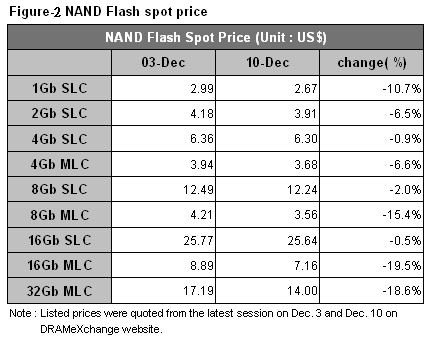
Finally, DRAMeXchange compares the closing spot price of NAND Flash chips categorized by their density from 12/3 to 12/10. 1Gb SLC price fell from US$2.99 to US$2.67, a drop of 10.7%. 2Gb SLC fell from US$4.18 to US$3.91, a drop of 6.5%. 4Gb SLC fell slightly from US$6.36 to US$6.30, a drop of 0.9%. 4Gb MLC fell from US$3.94 to US$3.68, a drop of 6.6%. 8Gb SLC fell from US$12.49 to US$12.24, a drop of 2%. 8Gb MLC price fell from US$4.21 to US$3.56, a drop of 15.4%. 16Gb SLC price fell slightly from US$25.77 to US$25.64, a drop of 0.5%. 16Gb MLC fell from US$8.89 to US$7.16, a drop of 19.5%. 32Gb MLC fell from US$17.19 to US$14, a drop of 18.6%.

The memory market watcher
DRAMeXchange is a global primary provider of future intelligences, in-depth analysis reports and advisory services on DRAM and Flash memory industry with coverage including current business, spot trading prices, and market trends, capital spending and wafer capacity trends, the impact of DRAM/flash memory products on the market, and other relevant PC industry information.
© DRAMeXchange ® Tech.Inc. All rights reserved.