DRAM prices sink further amid poor demand and market oversupply
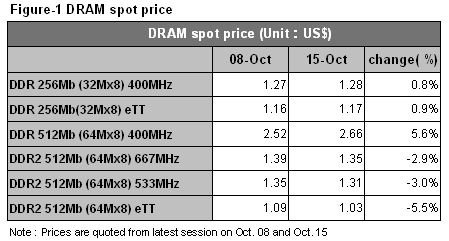
Similar to last week, the DDR2 price continued to spiral downwards, while for the DDR, prices slightly edged up, due to a DDR shortage. After slipping to USD 1, the DDR2 512Mb eTT rebounded slightly, hovering between the USD 1.02~1.05 level. On Oct/15, the DDR2 512Mb 667Hz closed at USD 1.35, down by 2.9% from USD 1.39 on Oct/8. Separately, the DDR2 512Mb eTT declined from USD 1.09 to USD 1.03, down by 5.5%. In the DDR1 market, in light of a supply shortfall in the spot market, prices climbed slightly higher. The average price of the DDR 512Mb 400MHz closed at USD 2.66 on 10/15, up by 5.6% WoW. With the momentum behind a spot market rebound remaining weak, the trend is expected to continue for next week.
Amid sluggish demand, OEM buying in the contract market has been weak. If prices are not expected to rebound in November, some OEMs won’t have urge to buy in the 2H of Oct. Up until now, a handful of OEMs have refrained from any chip buying. In contrast to September, this marks a significant downfall in transactions volume.
Although China's National Day holidays have come to an end, trading in the spot market saw no notable volume increase. In general, the demand in October, which is typically stronger, has not been evident. Coupled by the sufficient inventory levels of major module houses, 2nd tier module houses tend not to buy DRAMs, unless the items can be sold quickly and easily. Thus, with bare "buffer zone" in the spot market, prices have become more "sensitive."Although the DDR2 512Mb eTT prices slipped to the USD 1 level last week, the limited transactions volume and sensitive prices had little effect on the price rebound momentum. The selling pressure still remained high. Whether in the spot market or contract market, DDR2 trading has been in the doldrums. With buyers showing little interest, regardless any good market news.
ASUS Eee PC brings new opportunities for SSD vendors; 1HOct NAND Flash contract price declines by 0~10%
First showcased during the 2006 Computex show, Taiwan NB maker Asus will officially begin shipping its Eee PC in Oct07. Following the OLPC and Classmate PC, the Eee PC is the third of the so-called low priced NBs that has been developed for emerging markets. At the moment, the retail price ranges between USD199~299. Like the previous two budget NBs, the Eee PC must also strike a fine balance between the manufacturing costs and profit making. Thus, low-density SSD storage has been used in replacement of the traditional HDD. However, unlike the OLPC and Classmate PC, which employs 1~2GB of Flash, the SSD in the Eee PC contains 2, 4, or 8GB of Flash memory.
Needless to say, a lot of people are curious about how the new Eee PC will perform in the NB market. According to Asus's own projections, it hopes to ship 200 thousand ~300 thousand units in 2007, and more than 3 million for 2008. Still, as the market reaction to the new product has yet to be determined, it is difficult to accurately predict the 2007 and 2008 shipment figures. The launch of the Eee PC will no doubt be closely monitored by NAND Flash vendors, where many SSD manufacturers have already approached Asus for possible business collaborations. DRAMeXchange believes if a deal can be struck with Asus, it will not only provide a boost to the SSD maker's sales revenue, it will also consume a significant portion of the NAND Flash output.

For 1HOct, the average NAND Flash contract price declined between 0~10%, where the most notable was seen in the MLC segment. Due to new manufacturing nodes, the larger MLC production output will begin to surface during 4Q07. However, for the low density SLC, the smaller output has instead slightly propped up prices. Although NAND Flash prices have largely declined since September, the cost down effect will gradually be reflected in the end product price during 2HOct~Nov. Thus, DRAMeXchange believes the NAND Flash contract price could portray a more relatively stable trend in the near term.
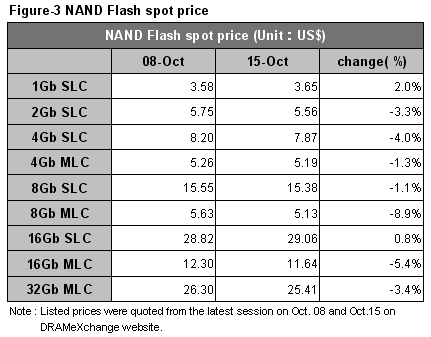
Finally, a comparison of the listed NAND Flash prices from the last session on October 8 and October 15 is shown below. Spot prices of the 1Gb SLC chip rose from US$3.58 to US$3.65, a 2% increase. For 2Gb SLC, they fell 3.3% to US$5.56; 4G SLC down 4.0% to US$7.87; 4Gb MLC down 1.3% to US$5.19; 8Gb SLC down 1.1% to US$15.38. Meanwhile, the 8Gb MLC dropped from US$5.63 to US$5.13, down by 8.9%. The 16Gb SLC was up 0.8% to US$29.06; 16Gb MLC down 5.4% to US$11.64; 32Gb MLC down 3.4% to US$25.41.

The memory market watcher
DRAMeXchange is a global primary provider of future intelligences, in-depth analysis reports and advisory services on DRAM and Flash memory industry with coverage including current business, spot trading prices, and market trends, capital spending and wafer capacity trends, the impact of DRAM/flash memory products on the market, and other relevant PC industry information.
© DRAMeXchange ® Tech.Inc. All rights reserved.