Sluggish Spot market trading during China National Day holidays; 1HOct contract prices drop by 20%
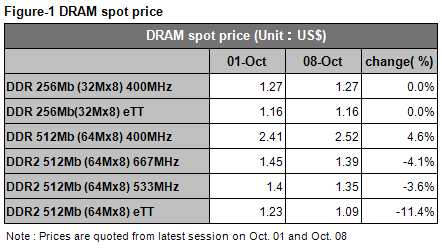
Due to China's National Day holidays and persisting weak demand, trading in the spot market remained sluggish, which further drove down prices. On Oct/8, the DDR2 512Mb 667MHz closed at USD 1.39, down by 4.1% from USD 1.45 on Oct/1. Meanwhile, the DDR2 512Mb eTT declined from USD 1.23 to USD 1.09, down by 11.4%. As stated during last week's report, the small rebound in the spot price did not last long. Although the inventory levels of traders remain healthy, with contract prices still falling, and the relatively high level of inventory in the overall market players, the intention of buying is weak.
In the contract market, certain special deal of the 1GB module was closed at 25 USD at the end of September, PC OEMs targeting at 25 USD for 1H October contract price. For 1HOct, the 1GB module price was settled between USD 26~28, but volume was limited. In contract market, generally the market activity during the first half is not as strong as the second half. Yet, PC OEMs currently own a fairly sufficient amount of inventory. In the wake of the declining prices and arrival of financial quarterly end for certain OEMs, the willingness of buying is weak.
During the PC shipment upturn, DRAM sales during October are usually strong. For example, during 2006, spot prices experienced very sharp price increases. However, in this October, trading in the spot market has been very weak. Buyers are in no hurry of buying more chips. In terms of supply, the chip output has grown much higher when compared to last year. The current market oversupply has been an impediment for sustainable price increases. Although various Tier 1 DRAM makers have subsequently indicated they would stop supplying chips to the spot market, it has provided little help it stopping the continuing price decline. In general, sales have been much weaker in the typically strong October. Due to the current high inventory levels, the pull-in effect has been weak. In addition, with PC OEMs nearing the financial quarter end again, they are also aggressive in clearing out inventory. It remains to be seen whether or not DRAM makers will reduce production in the future. But needless to say, they will face a lot of pressure in deciding on the contract prices for 2HOct.
10 megapixel Digital Cameras steadily become market mainstream; 2GB memory cards become prime choice
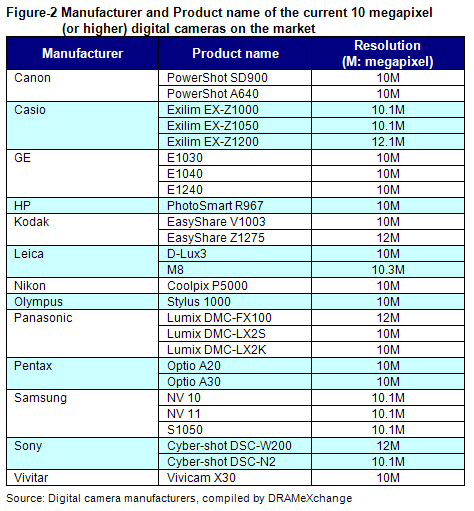
Digital camera sales have been much stronger than expected for 2007. Aggregated shipments from January to August were up by 28% YoY, where sales of the 8 megapixel camera accounted for a whopping 37%. As digital camera manufacturers continue to introduce devices packed with even more pixels, it has significantly boosted the market penetration of high resolution cameras. Compiled by DRAMeXchange, Table 1 provides a list of the current manufacturers and products that sport 10 megapixels (or even higher) resolution. By the end of 2007, we believe it will officially herald the arrival of the 10 million megapixel era, as the shipment ratio of digital cameras with more than 8 million pixels are expected to reach 50%.
According to DRAMeXchange's survey, the1GB SD memory card formed the bulk of the memory card shipment in 1H07. However, the gap in the shipment ratio between the 2GB and 1GB had already grown much closer in 2Q07. Thus, we believe the 2G will gradually rise to become the mainstream density in 2H07. A main reason behind its growing popularity stems from the fact that prices have already fallen to the USD 20 level, an acceptable price range for users who wish to buy an additional memory card. For cameras sporting 8~10 million pixels, the 2GB memory card is capable of storing roughly 300~400 images. Excluding amateur or professional photographers, this is considered sufficient for the average user. All in all, it is projected that in the forthcoming year, the 2GB SD card is set to become the prime choice for many digital camera users.
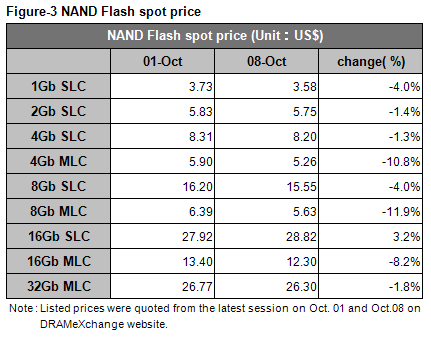
Finally, a comparison of the listed NAND Flash prices from the last session on October 1 and October 8 is shown below. Spot prices of the 1Gb SLC chip slipped from US$3.73 to US$3.58, a 4% decline. For 2Gb SLC, they fell 1.4% to US$5.75; 4G SLC down 1.3% to US$8.20; 4Gb MLC down 10.8% to US$5.26; 8Gb SLC down 4.0% to US$15.55. Meanwhile, the 8Gb MLC dropped from US$6.39 to US$5.63, down by 11.9%. The 16Gb SLC was up 3.2% to US$28.82; 16Gb MLC down 8.2% to US$12.30; 32Gb MLC down 1.8% to US$26.30.

The memory market watcher
DRAMeXchange is a global primary provider of future intelligences, in-depth analysis reports and advisory services on DRAM and Flash memory industry with coverage including current business, spot trading prices, and market trends, capital spending and wafer capacity trends, the impact of DRAM/flash memory products on the market, and other relevant PC industry information.
© DRAMeXchange ® Tech.Inc. All rights reserved.