DRAM contract price expected to slip 10% in 2HSep; cash flow level will decide how well manufacturers weather the market downturn
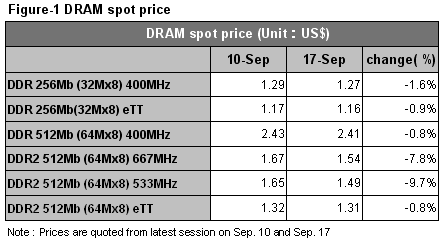
Amid the weak DRAM spot market, prices continued to slump. The DDR2 512Mb 667MHz declined to USD 1.54, a drop of 7.8%. The same downward price pressure could be seen in other chip densities, where the DDR2 eTT slipped to USD 1.31. Prices have been on a declining trend since August, due to sluggish market demand, and a wait and see attitude from both buyers and sellers. However, after the DDR2 eTT fell through the low point experienced in May, some retailers and module houses have begun to increase their inventory levels. This helped bring up the spot prices last Thursday, which also indirectly improved the overall market buying.
Amid the rapid descent in the spot price, and with inventory levels of PC OEMS already sufficient for the hot selling season, some OEMs have started to cut the number of orders that were agreed upon during 1HSep. According to DRAMeXchange's survey, contract prices have mostly been finalized at USD 16~17 in 2HSep, a 10% drop over 1HSep. But as DRAM makers continue to increase their production output, the unsold chips will most likely end up in the spot market, which will most definitely further impact the spot market.
The plummeting DRAM prices have further widened the losses of relevant DRAM players. Although the capacity output of the new DRAM fabs remain unchanged, the diminishing cash flow caused by the persisting losses have rendered DRAM vendors unable to afford any new plant constructions. According to DRAMeXchange's 2Q07 survey, Samsung topped the list in terms of cash flow. Powerchip was ranked No.1 among Taiwan manufacturers, due to its GDR issuance in 2006. Micron also raised USD 1.1 billion worth of convertible senior notes, increasing its cash flow to USD 2.9 billion. Thus, to weather the market downturn, DRAM manufacturers must not only further enhance their manufacturing process, the securing of a sufficient amount of cash flow is just as important.

JEDEC creates next-generation Flash spec; contract prices dip by 5~15% in 1HSep
The Joint Electronic Device Engineering Council (JEDEC) announced on August 29th that it will create the new Universal Flash Storage (UFS) specification, which will be used for Flash storage devices. In the wake of the announcement, 7 major cell phone and semiconductor manufacturers, which included Nokia, Samsung, SonyEricsson, Micron, Spansion, STMicroelectronics and Texas Instrument, stated they would support and devote resources in developing the new industry format. According to the JEDEC news release, adoption of the standard by removable memory card and embedded memory solutions will enable cell phones, digital cameras and PCs to more conveniently share data under a single framework.
As stated above, both cell phone and semiconductor makers have thrown their weight behind JEDEC's new UFS specification. At the moment, there are several different standards in the memory card market. In order to transfer data between memory devices that follow different formats, an adapter, such as a memory card reader, is required. For example, the Memory Stick can not be used by cameras that use an SD memory card. In addition to compatibility issues, the high speed transfer rate of the UFS is also a key attraction. The minimal 2Gbps data transfer rate is faster than all other removable memory devices. For instance, it currently takes roughly 3 minutes to transfer a 90 minute hi-definition movie into a cell phone's memory card. However, under the UFS standard, it only requires a few seconds. JEDEC indicated the new UFS specification will be completed by 1H09. Although details have not been entirely finalized, DRAMeXchange believes it will become a mainstream standard in the Flash-based memory industry in the future.
Last week, Flash contract prices were 5-15% lower than during August. Although September and October usually marks a period when downstream vendors stock up on more inventory, DRAMeXchange believes amid improvements of the 5X nm manufacturing node, the market supply shortage seen during June-August should ease during October. To reflect the cost-down benefits, NAND Flash makers have cut the prices of their Flash chips. They hope that through the price drop, they can stimulate more chip buying, as clients prepare for the hot 4Q07 sales promotion. In 1HSep, the contract price has already slipped by 5-15%. DRAMeXchange projects prices will continue to gradually trend downwards until the year-end.
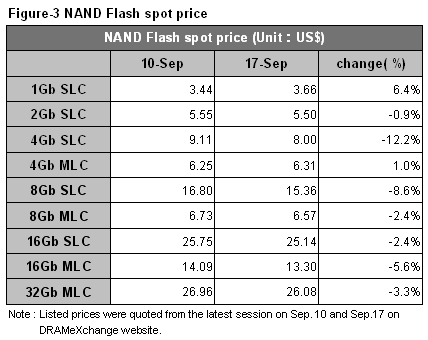
Finally, a comparison of the listed NAND Flash prices from the last session on September 10 and September 17 is shown below. Spot prices of the 1Gb SLC chip climbed from US$3.44 to US$3.66, a 6.4% increase. For 2Gb SLC, they fell 0.9% to US$5.50; 4G SLC down 12.2% to US$8.00; 4Gb MLC up 1.0% to US$6.31; 8Gb SLC down 8.6% to US$15.36. Meanwhile, the 8Gb MLC dropped from US$6.73 to US$6.57, down by 2.4%. The 16Gb SLC was down 2.4% to US$25.14; 16Gb MLC down 5.6% to US$13.30; 32Gb MLC down 3.3% to US$26.08.

The memory market watcher
DRAMeXchange is a global primary provider of future intelligences, in-depth analysis reports and advisory services on DRAM and Flash memory industry with coverage including current business, spot trading prices, and market trends, capital spending and wafer capacity trends, the impact of DRAM/flash memory products on the market, and other relevant PC industry information.
© DRAMeXchange ® Tech.Inc. All rights reserved.