DRAM contract market demand continues to grow despite limited price increases
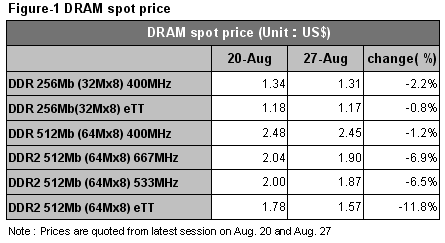
Last week, demand in the DRAM spot market was sluggish, as prices continued to decline. The DDR2 512Mb 667MHz fell to USD 1.9. In the DDR2 512Mb ett segment, many module houses and channels remained hopeful of an upturn in the Europe market after September. As prices plunged to the USD 1.5 level, increased market speculation was seen, propping up prices to USD 1.8 on August 27th. Nevertheless, prices soon began to erode again, finally ending at roughly USD 1.57.
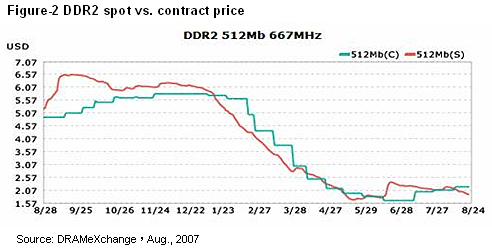
The weak spot market conditions have become a hindrance for further contract price increases. Currently, with PC shipments rising MoM, and PC OEM makers boosting the PC content per box, demand remains strong in the contract market. However, the huge spot price plunges has resulted in a price difference of more than 10% between the contract and spot prices in 2HAug (Figure 2).This has added pressure to DRAM makers in their contract price negotiations with relevant clients. It is projected that prices will begin to weaken after September. Thus, DRAM makers are striving to further bring down their costs by migrating to more advanced manufacturing processes. However, for players who are falling behind in the migration to the below 70nm process, they will be forced to bear higher costs.
Last week Qimonda and SMIC signed a pact regarding the transfer of the 80nm process technology. This follows a similar agreement inked between Qimonda and Winbond. Qimonda, a leader in the DRAM trench technology, has recently become keener in transferring the know-how to its foundry partners. A key reason is the fact that Qimonda hopes to maintain the market share of its trench process technology. In addition, it also hopes to further drive down relevant manufacturing costs. Qimonda has also collaborated with Inotera in upgrading to the 70 process, where by 1H08, the ratio of 70nm chips is expected to increase substantially. On a different note, chips produced via the 80nm trench process technology by its foundry partners are also expected to grow significantly in 1H08.
Weak back to school factor erode NAND Flash chip prices; memory card makers with in-house production enjoy stronger margins
For August, the NAND Flash end demand has been essentially flat. The weaker-than- expected boost from the back to school factor in the US and Europe markets dampened the market trading between upstream suppliers and downstream memory card & USB drive makers. Due to the weaker demand, spot prices have been revising downwards in the past two weeks. Upstream suppliers have also started to slightly adjust the prices for the various NAND Flash specs in hoping to boost the demand from downstream clients.
According to various memory card and USB drive makers, the occurrence of the US subprime mortgage crisis has taken its toll on the consumer market. In the advent of the incident, North America retailers have started to experience sagging sales. More and more people are now having second thoughts on whether or not to purchase a consumer electronic product. It remains unclear how long the effects of the crisis will last. Yet, as the summer vacation in Europe comes to an end, many people will begin returning to their posts beginning from next Monday. In light of this development, DRAMeXchange believes the demand for Flash-based products in the end market will start to increase more evidently in the region.
Amid the tight Flash supply in July and August, memory card makers with in-house production have been gaining an edge. They are capable of offering more flexible prices than their peers, which has significantly helped boost their sales. However, for the majority of memory card makers that need to rely on outside sources, their sales in July and August has not been as good, as they must reflect the incurred costs on their end products.
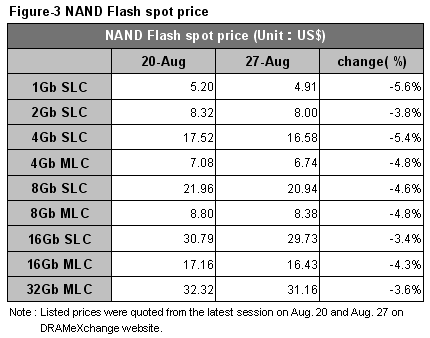
Finally, a comparison of the listed NAND Flash prices from the last session on August 20 and August 27 is shown below. Spot prices of the 1Gb SLC chip slipped from US$5.2 to US$4.91, a 5.6% decline. For 2Gb SLC, they fell 3.8% to US$8; 4G SLC down 5.4% to US$16.58; 4Gb MLC down 4.8% to 6.74; 8Gb SLC down 4.6% to US$20.94. Meanwhile, the 8Gb MLC dropped from US$8.8 to US$8.38, down by 4.8%. The 16Gb SLC was down 3.4% to US$29.73; 16Gb MLC down 4.3% to US$16.43; 32Gb MLC down 3.6% to US$31.16.

The memory market watcher
DRAMeXchange is a global primary provider of future intelligences, in-depth analysis reports and advisory services on DRAM and Flash memory industry with coverage including current business, spot trading prices, and market trends, capital spending and wafer capacity trends, the impact of DRAM/flash memory products on the market, and other relevant PC industry information.
© DRAMeXchange ® Tech.Inc. All rights reserved.