Contract prices stay flat in 2HAug; spot market lacks demand stimulus
Last week, weak demand was witnessed in the spot market. Prices for the DDR1 remained flat, while the DDR2 continued to drop. The DDR2 512Mb 64Mx8 eTT slipped past the US$1.8 level to US$1.78, down by 7%. The DDR2 512Mb 64Mx8 also dropped by 6%, while the DDR2 533/667 declined to the US$2 level.
Despite the arrival of the PC hot selling season in 2HAug, no obvious increase in the end market demand could be seen. The summer promotional sales in China have also been unable to boost the market dynamics. Meanwhile, with the 2GB DRAM content per box of branded PCs on the rise, it has dampened the after-sales demand in the spot market. Amid the sluggishness, some module houses and channels sold off some of their inventory, which prompted spot prices to revise downwards.
In contrast to the weak spot market, demand has been much stronger in the contract market. DRAM shipments and the PC content per box have been on the rise in 3Q07. However, the spot market doldrums appear to have impacted the contract prices in 2HAug, preventing them from repeating the same jumps seen during 1HAug. Prices remained flat or merely edged up. Yet, the increasing ratio of the 2GB DRAM content per box has raised the average system memory per PC to 1.2GB.

NAND Flash contract price projected to stay stable in the short term; end demand a key variable for future price changes; contract prices flat in 2HAug
As the market enters into 2HAug, the NAND Flash price jumps that occurred earlier have started to slow down. Based on DRAMeXchange's survey, memory card and UFD vendors have raised their respective end product prices in reflecting the increased Flash prices. However, amid the price adjustments, downstream retailers have been reluctant in passing along the higher costs to consumers. According to memory card vendors and downstream retailers, the increased end product prices have already dampened the overall market buying.

NAND Flash contract prices have remained relatively flat in 2HAug. With prices already up by 15-25% in 1HAug, due to Samsung's sudden power outage incident, additional rises have been limited. According to DRAMeXchange's observation, upstream suppliers have no intention of adjusting current NAND Flash price levels. Amid the hot selling season, demand has become strong among their MP3 clients. Flash makers are in no hurry of lowering their prices, as the supply to memory card and UFD clients grows tighter. Due to Samsung's sudden power disruption, many memory card, UFD and retail vendors have boosted their respective inventory levels to roughly a month. Therefore, a material shortage will unlikely occur in the near term. Based on the current development, the NAND Flash contract price will stay flat for some time. Until the inventory drops to lower levels will there be a chance for the Flash prices to change accordingly with the demand and supply dynamics of the end market.
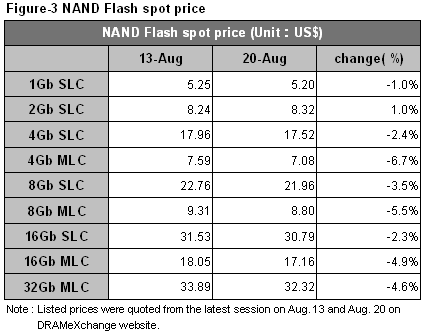
Finally, a comparison of the listed NAND Flash prices from the last session on August 13 and August 20 is shown below. Spot prices of the 1Gb SLC chip slipped from US$5.25 to US$5.2, a 1.0% decline. For 2Gb SLC, they climbed 1.0% to US$8.32; 4G SLC down 2.4% to US$17.52; 4Gb MLC down 6.7% to 7.08; 8Gb SLC down 3.5% to US$21.96. Meanwhile, the 8Gb MLC dropped from US$9.31 to US$8.8, down by 5.5%. The 16Gb SLC was down 2.3% to US$30.79; 16Gb MLC down 4.9% to US$17.16; 32Gb MLC down 4.6% to US$32.32.

The memory market watcher
DRAMeXchange is a global primary provider of future intelligences, in-depth analysis reports and advisory services on DRAM and Flash memory industry with coverage including current business, spot trading prices, and market trends, capital spending and wafer capacity trends, the impact of DRAM/flash memory products on the market, and other relevant PC industry information.
© DRAMeXchange ® Tech.Inc. All rights reserved.