DRAM contract prices advances; spot market expected to improve in Sep or 2HAug when Europe shows stronger demand
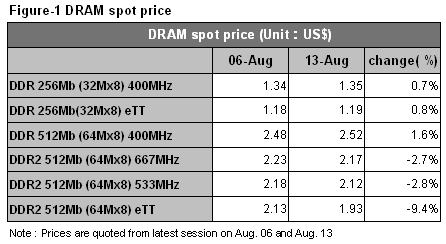
Despite the spot price uptick last week amid Samsung's power outage incident, the momentum was short-lived. Retailers were prompted to clear their excess inventory at much lower prices. The DDR2 eTT once again fell below the US$2 level to US$1.93.
Although the hot PC selling season has arrived, end demand from the spot market has remained relatively weak. A perfect example is the lackluster sales seen in China during July, which traditionally is a period of high demand. Although conditions have improved recently in the spot market when compared to the previous month, prices have not experienced an upswing.
In the contract market, prices rose 3%~5% in 1HAug. In the wake of the upturn in PC sales, the stronger OEM pull-in has helped drive up the prices. DRAMeXchange projects that the aggregated shipment figures of both DTs and NBs will reach 69 million in 3Q07, a QoQ of 15%. After paying visits to several PC OEMs, DRAMeXchange has also found that the mainstream DRAM content per box is by average 1.2~1.4GB--an indication that the contract market demand has been increasing on a QoQ basis.
The price differences seen in the spot and contract markets can be attributed to the following factors: 1. Amid the plunging DRAM prices in Q2, some DRAM and module makers have accumulated a significant amount of inventory. As the actual figures can not be easily calculated, the market prices are often disrupted by reports of DRAM chips being sold at relatively cheap prices. 2. In order to effectively compete with other OEMs in terms of specification, PC OEMs have boosted the DRAM content per box to much higher levels. With PCs equipped with more DRAM memory, it has dampened the requirement for further upgrades. 3. Rising consumer prices have driven away consumers from purchasing PC related products. Some retailers in China have pointed out that the jump in consumer prices was the main culprit behind the sluggish DRAM sales in July.
In the forthcoming months, DRAMeXchange believes the Samsung incident will affect the original DRAM and NAND Flash capacity allocation plans of Korea makers in 2H07. Coupled by the ongoing transition to the 70nm process by relevant manufacturers, DRAM prices are expected to peak in September. Fortunately, the subsequent price downtrend should be softer, as some of the capacity will be switched to NAND Flash.
NAND Flash development expected to sustain for another 7 years, average contract price jumps 15~25% in 1HAug amid Samsung power outage
During the Flash Memory Summit, which has held on August 7~9, 2007 at the US city of Santa Clara, SanDisk, Intel, Samsung, Dell, Seagate and other industrial heavyweights offered their views regarding the development trend and challenges facing the NAND Flash market. Their viewpoints provided an in-depth and forward-looking guide to the path that lies ahead for the industry. Highlights of the various topics covered can be seen below:
From a NAND Flash application standpoint, they are expected to gradually expand from consumer electronics and handsets to data storage and cache memory found in PCs. Continued cost-downs and electronic products sporting higher resolutions will further drive up the NAND Flash demand. It has already become feasible in replacing 1 & 1.8 inch HDDs with NAND Flash based memory products. Meanwhile, they are also expected to gradually begin making inroads in the NB PC segment, where the 2.5 inch HDD is currently the mainstream standard. However, in the DT PC & server area, we expect the HDDs & SSDs to coexist in the future, as HDDs still enjoy a huge cost advantage in the area for high capacity storage.
In terms of NAND Flash manufacturing, the increasing technical and physical challenges will start to hamper future developments in the not-too-distant future. The 32 nm and 20 nm process technologies are considered two key obstacles. Vendors have proposed the use of 3D cell, 3-bit/cell & 4-bit/cell and so forth in solving the problems of limited density & performances stemming from the next level of miniaturization. Current NAND Flash technology should enable continued advancements for another 4~5 generations. However, bottlenecks will begin to surface in roughly 7 years. In response, vendors are also aggressively developing the so-called phase-change memory (PRAM), where they hope to be one of the major storage devices. PRAMs have faster read/write speeds, longer life cycles, smaller die size and lower power consumptions than Flash memory.
Meanwhile, the investment capital in the NAND Flash industry is also a critical issue that faces manufacturers. The capital expenditure required in building a new fab now entails a price tag of roughly US$5 billion. In the next 2 years, NAND Flash makers will need to devote a significant amount of capital expenditures in migrating to new manufacturing processes or in upgrading their 8 inch fabs. Although the newer production lines can bring down the manufacturing costs by 30~45%, the NAND Flash prices have slumped by a whopping 60% in the past 2 years. If costs are reduced only by 40%, it will be almost impossible in cutting the NAND Flash prices by 60%. Ultimately, mergers may become an inevitable path for the relevant players in the industry.
In 1HAug, the NAND Flash average contract price jumped by 15~25%, where MLC chips rose by 15%, while the SLC climbed by 25%. The price increases mostly reflect the anticipated near-term shortfall in the NAND Flash supply, due to the power outage incident at Samsung's NAND Flash-producing facilities. The August~October period usually marks a period, where downstream clients stock up on inventory. However, with prices already up, due to the unexpected Samsung incident, and downstream clients expected to offer discounts in stimulating the market demand in the coming hot season, DRAMeXchange believes the NAND Flash contract price will remain flat or increase slightly in the near term.
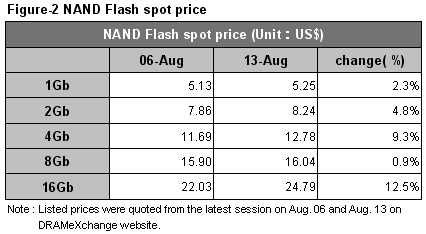
Finally, a comparison of the listed NAND Flash prices from the last session on August 6 and August 13 is shown below. Spot prices of the 1Gb chip rose from US$5.13 to US$5.25, a 2.3% increase. For 2Gb, they climbed 4.8% to US$8.24; 4G up 9.3% to US$12.78, 8Gb up 0.9% to US$16.04 and 16Gb up 12.5% to US$24.79.

The memory market watcher
DRAMeXchange is a global primary provider of future intelligences, in-depth analysis reports and advisory services on DRAM and Flash memory industry with coverage including current business, spot trading prices, and market trends, capital spending and wafer capacity trends, the impact of DRAM/flash memory products on the market, and other relevant PC industry information.
© DRAMeXchange ® Tech.Inc. All rights reserved.