DRAM contract price increases another 5% in 1HAug; DRAM supply in 2H revised downwards
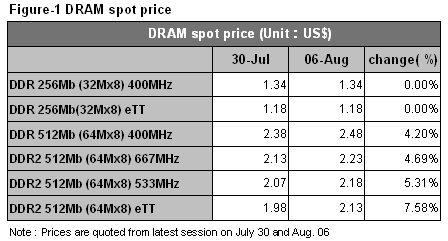
DRAM parts were traded in low price range during the beginning of the week Jul 30-Aug 6 but trended upwards afterwards. Quotes request was rarely spotted in the market, despite marketers usually checked quotes for another turn of pre-stock during this period of time.
DRAMeXchange sees no meaningful DRAM shipments last week, implying a healthy demand from PC OEMs and demand-supply status. For the spot market, Samsung's previous power outage brought forth relatively strong orders.
Price of DDR2 eTT 64Mx8 512Mb stabilized at the price range of US$1.94-2 on Jul 30-31 with mild gain observed later amid growing transaction volume. It resumed growth with a sequential gain of 7.58% observed and closed at US$2.13 on Aug 6. The same-specification branded chip also saw price trended upward by 4.69% on a sequential basis and closed at US$2.23 on Aug 6.
In DRAM contract market, prices sustained upward trend in 1HAug as expected. Price of DDR2 667 512MB UDIMM grew by ~5% from US$19.50 to US$20.50. Prices of the same-specification chip at contract and spot market are now very close (US$2.25 vs US$ 2.23). In the near term, the upcoming hot seasonal sales in the PC sector should help increase the 2GB content per box and drive up DRAM demand. DRAMeXchange foresees further price growth in 2HAug.
Samsung saw its NAND Flash production disrupted amid a Jul 31 power outage incident. Any potential capacity conversion between DRAM and NAND Flash at Samsung or fellow chipmakers should affect DRAM supply and thus, affect price trend. The DRAM supply growth is expected to be lower than originally projected. Both the DRAM contract and spot price may reach US$2.5/512Mb.
On a separate note, Winbond reports its 2Q loss totaled at US$41.6mn (or EPS -NT$0.37). The memory-maker plans to grow its NOR Flash output and focus on consumer logic IC production in 2H07 in order to enhance profitability. As it already inked contract with Qimonda on 75nm and 58nm, it will move to 75nm commodity DRAM production in FY08. From a longer-term perspective, DRAMeXchange expects Winbond should see its profit of commodity DRAM production to be constrained by its contract terms. But the new contracts on new technologies should see lesser price pressure and stabilize the profit margins.
Samsung Keeps NAND Flash sales Crown in 2Q07, Says DRAMeXchange; Samsung power disruption results in tighter NAND Flash supply
The average NAND Flash price plunged 40% in 1Q07, prompting manufacturers to put the brakes on further capacity expansions. In addition, Samsung, Toshiba and Hynix tried to improve their yield rates, as they migrated to more advanced manufacturing processes. Consequently, the Flash bit output in 2Q07 was relatively the same as in 1Q07. DRAMeXchange analysts point out that the easing oversupply conditions in 2Q07 helped drive up the NAND Flash prices by more than 10%. 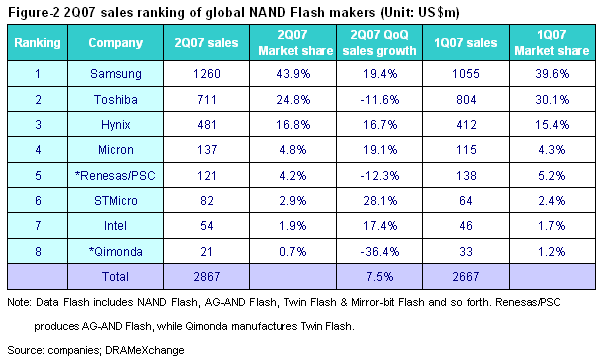
Sales Revenue Roundup of each respective NAND Flash maker:
Samsung continued to top the NAND Flash ranking list in 2Q07. The company accounted for 43.9% of the market share, up from 39.6% in 1Q07. In 2H06, Samsung transferred some of its NAND Flash production to DRAM. In 1H07, the company concentrated in enhancing its production node technology. In contrast to 1Q07, the bit growth and ASP in 2Q07 respectively grew 11% and 10%. As for the sales revenue, it increased 19.4% QoQ to US$1.26bn.
Although Toshiba's Flash sales were lower in 2Q07 than in 1Q07, the company maintained its No. 2 ranking with a 24.8% market share, down from the 30.1% in 1Q07. The decline was mainly attributed to the company's ongoing attempts in solving the production problems arising from the more advanced 56nm process. Its QoQ bit output decreased by approximately 10%. Furthermore, since most of its clients are long tem partners, the 2Q07 ASP was relatively the same as in 1Q07, rendering sales to decrease 11.6% to US$711m.
Hynix retained its No. 3 ranking in the list, where it captured a 16.8% market share, higher than the 15.4% in 1Q07. Like Samsung, Hynix also switched some of its production to DRAM in 2H06. In 1H07, it focused to improve its chip yield rates, as it employed the thinner 60 nm technology node. Therefore, the bit growth in 2Q07 was slightly lower than in 1Q07. Meanwhile, amid the 25% ASP jump over the previous quarter, sales grew 16.7% in 2Q07.
The top 3 NAND Flash makers still have a high market concentration, as they were responsible for roughly 85.5% of the global output. In terms of the other players, IM Flash will not begin to produce 50nm chips from its new 12 inch fab until late 3Q07. Nevertheless, the price rebounds and use of more advanced fabrication technology have helped stabilize the Flash sales of Micron and Intel in 2Q07, where they accounted for a respective market share of 4.8% and 1.9%.
Renesas continued to lower its own branded AG-AND Flash output, outsourcing the production to its partner--Powerchip. In 2Q07, both Renesas and Powerchip saw their sales decrease sequentially, rendering their market share to slip to 4.2%. On a different note, Powerchip plans to produce MLC NAND Flash products by the end of 3Q07.
Due to increased sales in cell phone applications, STMicro experienced a more evident NAND Flash growth in 2Q07, where its market share climbed to 2.9%. In order to continue its client services, Qimonda continues to gradually decrease its Twin Flash output. Therefore, sales in 2Q07 were lower, taking a market share of 0.7%.
DRAMeXchange expects the NAND Flash supply to tighten in 2H07, due to the upcoming traditional hot seasonal sales, and the fact that the migration to more advanced process still needs time to mature. Moreover, a power outage, which occurred in the afternoon on August the 3rd, affected Samsung's 6,7,8,9 and 14 production lines. The company revealed the problem had already been fixed by midday, August 4th. Samsung estimates the incident created losses amounting to US$43 million. As the facilities are a key NAND Flash production base, DRAMeXchange believes the power failure affected roughly over 5.5% of Samsung's monthly output and approximately above 2.2% of the global output. The insufficient supply that is expected to occur in the near term will grow even tighter, resulting in the Flash prices to increase further in August.
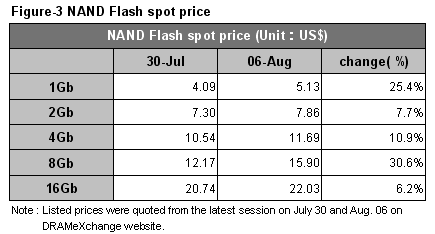
Finally, a comparison of the listed NAND Flash prices from the last session on July 30 and August 6 is shown below. Spot prices of the 1Gb chip rose from US$4.09 to US$5.13, a 25.4.% increase. For 2Gb, they climbed 7.7% to US$7.86; 4G up 10.9% to US$11.69, 8Gb up 30.6% to US$15.90 and 16Gb up 6.2% to US$22.03.

The memory market watcher
DRAMeXchange is a global primary provider of future intelligences, in-depth analysis reports and advisory services on DRAM and Flash memory industry with coverage including current business, spot trading prices, and market trends, capital spending and wafer capacity trends, the impact of DRAM/flash memory products on the market, and other relevant PC industry information.
© DRAMeXchange ® Tech.Inc. All rights reserved.