Spot market demand expected to rise in 1HAug; contract prices maintain upward trend
Last week spot prices declined at a gradual pace, as retailers and various module houses continued to lower their inventory levels. Market trading was thus relatively flat. Although July is traditionally a hot selling period in China, the end market demand has proven to be weak. It is projected that by early August the demand for an inventory stock up should start to pick up. In the July 23~27 period, the DDR2eTT slipped past the US$2 level to US$1.98, while the branded DDR2 512Mb 64Mx8 declined to US$2.13. In the contract market, in light of the hot seasonal sales in the PC sector, DRAM makers still hope to increase their prices by roughly 5%.

Samsung succeed in taking lead; DRAM supply bit growth to surpass 90% in FY07
An over 40% ASP slash in DDR2 512Mb in 2Q07 was resulted in a 24.4% QoQ sales decline among global branded DRAM makers in the quarter, according to DRAMeXchange. Yet, despite seeing sales shrank, most DRAM makers' expansion plans are not being discouraged. Most chipmakers are still following their capex plans as laid in early FY07, persistently expanding 12-inch wafer capacity and migrating to 70nm design geometry, as evident in the 23% QoQ supply bit growth in 2Q07. When yields for 70nm matures, DRAMeXchange projects that the persistent expansion on 12-inch wafer capacity, couples with penetration of DDR2 1Gb, will post the global DRAM industry with an YoY supply bit growth of over 90%.
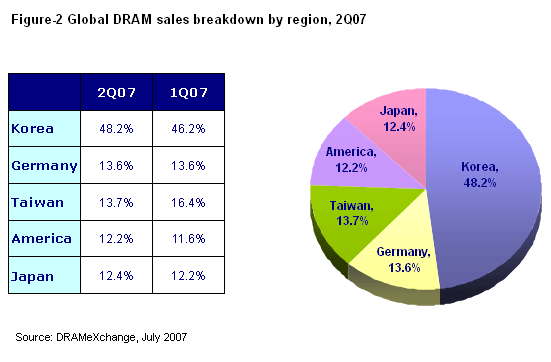
Sales breakdown by region shows that Korean chipmakers still led in terms of DRAM sales, with their contribution to global DRAM sales grew by 2ppt QoQ at 48.2% (Figure-2). Taiwan players ranked as the second-largest group but their proportion slipped from 16.4% in 1Q07 to 13.7% in 2Q07. DRAMeXchange explained the setback to slowing-down output, as well as over-centralized production to commodity DRAM.
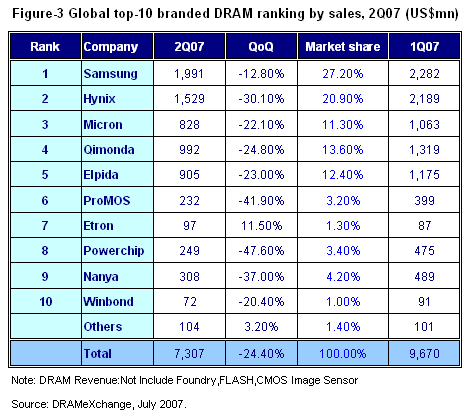
Sales breakdown by companies highlights intense competition between Samsung and Hynix. Chased by Hynix's aggressive market share gain, Samsung continues growing its DRAM wafer starts amount and boosting sub 80nm production proportion to overall commodity DRAM production to over 50%. These strategies were resulted in a QoQ supply bit growth as high as 31%. The number-one DRAM maker also grew its niche memory products proportion to about 50% of total memory output, resulting in a QoQ ASP drop of 33% and DRAM sales drop of 12.8% only. Hynix, on the other hand, only saw its QoQ bit growth reached 21% in 2Q07. With more memory production was assigned for commodity DRAM, ASP reduced by 43% QoQ and sales slipped by 30%. It still tops as the number-two DRAM maker worldwide, but the divergent strategy somehow highlights the wisdom on product mix.
Sales breakdown by various major production camps show that Samsung has its sales resumed in an encouraging pace with its sales accounted for almost one-third to global DRAM sales at 27.2% (Figure-4). The growth of Samsung sales, at the meantime, means sales decline at rivals. DRAMeXchange observes that most DRAM makers have their QoQ DRAM supply bit growth at over 20% in 2Q07 only. Since they mostly focused on commodity DRAM production, the price plummet as seen in the previous quarter whittled down their influences. With more Taiwan-based DRAM makers having fresh 12-inch wafer capacity onboard in 2H07, and more chips to be fabricated on 70nm under cost concern, the global DRAM market is going to see a fundamental structure change in accordingly, DRAMeXchange said.

Sleek new MP3/PMP products with wireless transmittance and stereo sound hit market. Shipment growth may exceed 50% in 2H07 over 1H07
Last Thursday, MP3/PMP leader Apple announced its 2Q07 earnings results, where it revealed 9.815 million iPods were sold. In contrast to the 10.54 million sold in the first quarter, this amounted to a drop of 7%. However, this marketed a 20% increase from the 8.11 million achieved during the same period of last year (Figure-5). The second quarter is usually considered a seasonal slowdown in the 3C market. Yet, in terms of the iPod sales, shipments dropped merely by 734K QoQ. DRAMeXchange believes iPod sales in 2007 should be relatively the same as of last year. Starting from 3Q07, iPod shipments are expected to increase more significantly. By 4Q07, demand during the Christmas season may push the shipment figure past last year's 21 million to a new high of 24.50 million. Aggregated iPod shipments are projected to reach approximately 57 million in 2007.

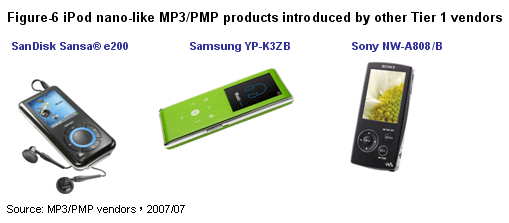
DRAMeXchange has also recently observed that other Tier 1 MP3/PMP vendors, such as SanDisk, Samsung and Sony are also offering similar MP3/PMP products in an attempt to rival against Apple. SanDisk was the first to offer the SanSa Connect series, which is equipped with a Wi-Fi function. Users can wirelessly linkup to Yahoo's online music download website without the need of a computer. Meanwhile, Samsung and Sony have also unveiled iPod nano-like products to consumers. In terms of the MP3/PMP music and sound quality, Samsung sports the DNSe 3D technology, while Sony has embraced its Clear Stereo&Clear Bass technology in enhancing its Sony Walkman audio qualities. DRAMeXchange projects new versions of the iPod nano will be released in 3Q07, where wireless transfers and stereo sound will be included.
In general, the launch of these new products will render the MP3/PMP market to be even more competitive. DRAMeXchange projects more than 83 million MP3/PMP-flash based products. Compared to the 55 million in 1H07, the growth is more than 50%. In the 2H07, the mainstream density of MP3/PMP devices will grow to 4GB. In terms of the Flash consumption, 1904M Gb will be consumed, a growth of 110% over 910 Gb in 1H07.
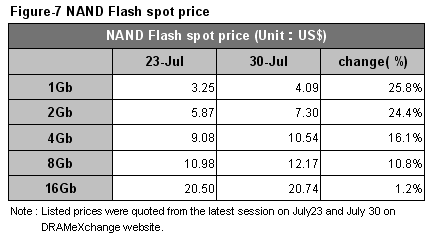
Finally, a comparison of the listed NAND Flash prices from the last session on July 23 and July 30 is shown below. Spot prices of the 1Gb chip rose from US$3.25 to US$4.09, a 25.8% increase. For 2Gb, they climbed 24.4% to US$7.30; 4G up 16.1% to US$10.54, 8Gb up 10.8% to US$12.17 and 16Gb up 1.2% to US$20.74.

The memory market watcher
DRAMeXchange is a global primary provider of future intelligences, in-depth analysis reports and advisory services on DRAM and Flash memory industry with coverage including current business, spot trading prices, and market trends, capital spending and wafer capacity trends, the impact of DRAM/flash memory products on the market, and other relevant PC industry information.
© DRAMeXchange ® Tech.Inc. All rights reserved.