Powerchip accelerates NAND Flash deployment; aspires collaboration with Elpida will culminate in becoming No.1 memory maker
Weak trading seen in spot market, amid market's "wait and see" stance.Trading expected to grow in mid-August. Rising demand may prompt contract prices to continue increasing until 4Q07.
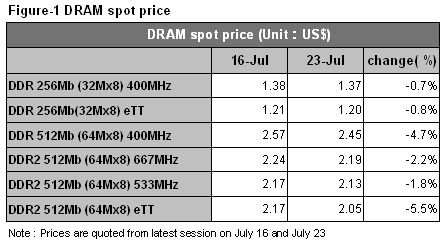
Last week the spot price continued to decline, as retailers and several module houses were still in the process of clearing out their inventory. By the end of July and early August, demand should start to pick up again, as inventory levels stabilize. Between the July16-20 period, the DDR2 eTT chip slid to US$2.05, while the branded DDR2 512Mb 64Mx8 declined to US$2.19.
In the contract market, the DRAM DDR2 512MB module price edged up by US$1~US$2, a roughly 5% increase. Given the fact that a few PC OEM makers place orders on a monthly basis during the hot seasonal sales, prices began to increase in 1HJul. Some DRAM makers have further adjusted their prices above the US$20 level--an indication that the oversupply situation has improved in the wake of the approaching strong seasonality. For 3Q07, if DRAM makers successfully transition to the 70nm manufacturing process to further lower their costs, they should be have a chance to turn profitable.
Beginning from mid July, DRAM makers have subsequently started to announce their earnings result for 2Q07, along with presenting their outlook towards the industry in 2H07. At the moment, both Inotera and Powerchip believe the DRAM average price will gradually rise in 2H07, where the price levels in 4Q07 will be even better than in 3Q07. DRAMeXchange has also observed that the PC shipment peak should occur around October~November. The annual PC shipment growth is expected to jump 12% YoY, a higher ratio than originally predicted. In light of the usual strong PC shipments in 4Q07, the DRAM content per box is projected to go up significantly. From a demand standpoint, it should peak during 4Q07.
From a supply perspective, despite the plunge in DRAM prices, only Hynix has switched some of its production to Flash. By contrast, Taiwan makers can only rely on more mass production to lower their costs, as they do not have any Flash products. In addition, ramp up of Taiwan's newer 12 inch fabs is scheduled to begin in 4Q07. Meanwhile, as several retailers and module houses still have a high inventory, they hope to decrease their losses by clearing out the excess chips during the hot selling season. A handful of DRAM makers also experienced higher chip stockpiles in 2Q07. All in all, the continued output increases and relatively high inventory levels of retailers may inhibit the momentum for prices to rise in 2H07. DRAMeXchange predicts the DDR2 512Mb chip price to stay near US $2.2~ US $2.5, while DDR2 1Gb to hover at the US$4.5~ US $5 level.
Among the quarterly earnings report currently released from DRAM manufacturers, they have all incurred losses. Inotera, which is a DRAM foundry, was the only maker to be profitable in 2Q07. Based on the DRAM makers' financial reports, the manufacturing costs in 2Q07 has dropped roughly to US $2.2~ US $3.2. From the current DRAM prices, some players should be able to break even in 3Q07.
A development worthy of notice is Powerchip's plans in accelerating its NAND Flash deployment. Aside from purchasing immersion equipment for the future production of 50nm NAND Flash chips, 400 or so engineers have been assigned to work with their Japanese counterparts in relevant R&D activities. Two 12-inch fabs located in Hsinchu are expected to produce NAND Flash after 2008. In 2H07, it will employ the 70nm process in rolling out 8Gb and above chips, and in 2008, it hopes to switch to the 50nm node technology. If all goes as planned, it will become the first Taiwan memory maker to mass produce both DRAM and NAND Flash. It will also continue to work closely with Elpida, where it aims to become the worldwide No.1 memory maker. By entering the NAND Flash market, it will help Powerchip minimize the impact brought forth from the volatile memory industry.
Wii stirs up "a healthy casual trend" in the gaming industry; NAND Flash contract price increases slightly in some densities.
At this year's E3 2007 game expo, which was held from July 11th~13th in Santa Monica, California, the Big 3---Nintendo, Sony and Microsoft, took the opportunity to reveal their respective future development plans in the video game sector. One of their key strategic goals was to play a dominant role in the living room's multimedia control center.
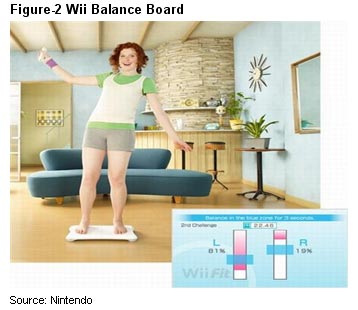
Nintendo plans to take advantage of the Wii's versatile wireless controller in expanding its user base to encompass all the family members. The current hot sales of Wii stems from the unique design of its remote controller. Players can play games in a much more interactive mode, which literally takes video game playing to a whole new dimension. During the E3 2007, Nintendo showcased the Wii Balance Board, which essentially transforms the game console into an "exercising tool". The company hopes the product can further appeal to female and senior users. In the future, when other controllers, such as the Wii Zapper and Wii Wheel, hit the market, it should help the Wii console better tap more market segments.
A key focus of the Xbox 360 is delivering high resolution video and superb gaming performance to users. Furthermore, Microsoft has also aggressively pushed forward the realization of the "games for Windows concept" via Vista, where it seeks to improve the compatibility between TV and PC games in allowing the Xbox 360 & PC integration to evolve into the living room's multimedia control center.
Meanwhile, Sony's PS3 is also packed with very powerful features. The multifunction game console provides state-of-the-art video and improved interactions among players. In the future, it will set up a Second life model to attract even more players to its gaming platform. It hopes the feature will also allow the PS3 to make a bigger push into the living room multimedia control center market.
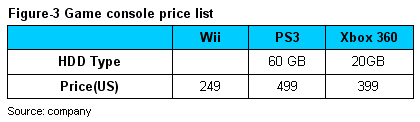
Both Nintendo and Microsoft are trying to develop their presence in the virtual online world by tapping their current user base. On the other hand, the more "casual" Wii console continues to concentrate on making the gaming experience more tangible and "fitness-orientated", rendering it more user-friendly, along with presenting a lifestyle of health & happiness. From a performance/price standpoint, in light of Wii's innovative features and lower price levels, it has become increasingly popular among consumers. In 2007, the expected sales of the Wii, PS3 and Xbox 360 are respectively expected to reach 15 million, 11 million and 6 million units.
In terms of the NAND Flash consumption, the Wii machine is currently equipped with 512MB of NAND Flash. Meanwhile, all three game consoles come with memory card or UFD slots for additional multimedia content storage. In 2007, the Flash demand in the game console market is expected to reach 4%. As the three different game consoles continue to grow, the overall Flash demand is projected to increase in proportion.
Excluding the slight price increases in some densities, the NAND Flash contract price in 2HJul has been relatively flat, as prices in 1HJul already jumped 20~30%, due to a tighter supply. On the other hand, amid the growing MLC output, the smaller SLC supply drove average prices up by 5~10%. In general, the July~October period is the high seasonality for downstream manufactures to stock up on inventory. However, between the May~July period, with major NAND Flash suppliers still in the "tuning stage" of the migration to more advanced process technologies, such as Samsung's 50nm node technology, Toshiba's 56nm node technology and Hynix's 60nm node technology, supply has been very tight. By the end of August, both Samsung and Toshiba should be able to improve their respective yield rates, thus the shortage of overall NAND Flash market will ease further. Nevertheless, we believe supply will remain a bit tight, where the NAND Flash contract prices will stay flat or increase slightly for some densities in August.
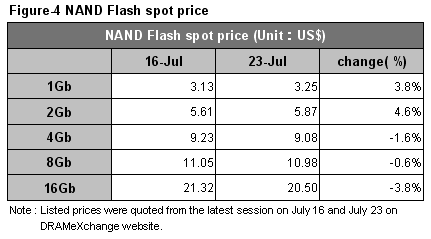
Finally, a comparison of the listed NAND Flash prices from the last session on July 16 and July 23 is shown below. Spot prices of the 1Gb chip rose from US$3.13 to US$3.25, a 3.8% increase. For 2Gb, they climbed 4.6% to US$5.87; 4G down 1.6% to US$9.08, 8Gb down 0.6% to US$10.98 and 16Gb down 3.8% to US$20.5.

The memory market watcher
DRAMeXchange is a global primary provider of future intelligences, in-depth analysis reports and advisory services on DRAM and Flash memory industry with coverage including current business, spot trading prices, and market trends, capital spending and wafer capacity trends, the impact of DRAM/flash memory products on the market, and other relevant PC industry information.
© DRAMeXchange ® Tech.Inc. All rights reserved.