DRAM contract price experience a minimum 12% sequential improvement in 1HJuly
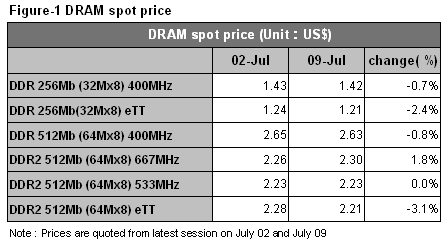
Amid the rise in the contract price, spot prices rebounded last week. Despite the price increase, there has been no apparent growth in demand. DDR2 eTT slipped slightly to US$2.21, while the branded DDR2 512Mb 64x8 chips rose to US$2.3.
Contract price of DDR2 512MB DIMM grew by US$2-3 sequentially at US$17 in 1HJul, an upward trend that is in line with DRAMeXchange's expectation. Excluding one Taiwan-based chipmaker, who only raised quotes by 12% (at US$17), most first-tier players had their quotes stay above US$18. Even for chips priced in DRAMeXchange's low-price range level, a US$3 sequential gain (or 20% up) was also observed. Some second-tier players even saw their quotes successfully boosted to US$20, the research firm said. DRAMeXchange believes that such an encouraging price rebound is a reflection of a reasonable price correction after previous price plummets.
DRAM prices saw a persistent downward trend since Feb with price fall accumulated at 20% QoQ in 1Q07, and the drop rate further enlarged to 50% in 2Q07. Corresponding gross margin at Taiwanese chipmakers trimmed to 30% in 1Q07, down from 40-50%, as recorded in 4Q06. When DRAM price reported further slump in 2Q with DDR2 512MB DIMM price averaged only at US$16.25, losses became inevitable in 2Q07.
Propelled by profit and market share concern, Hynix adjusted its 12-inch capacity at Korea fabs by shifting 100k DRAM capacity to NAND Flash production during April 2007. Such a reallocation resulted in a reduction of 20mn-equivalent DDR2 chips (in 512Mb-equivalent density) in July. Supply reduction, as well as PC OEMs' goal to drive average 2GB memory consumer version system penetration to exceed 30% in 3Q07, should jointly stop severe oversupply to surface again in 3Q07.
Demand is growing strong amid the aforementioned PC OEMs' goal, but magnitude of the supply growth is also strong. Hynix rival Samsung is aggressively boosting its DRAM output, while Hynix is advancing its manufacturing process to 66nm and boosting the average density to 1Gb. After seeing DRAM prices being corrected to a reasonable level in 1HJul, DRAMeXchange projects that DDR2 512MB DIMM price should stay at the US$20-25 range (equivalent to US$2.125-2.75 per 512Mb chip) in 3Q07. If chipmakers manage a stable yield on 70nm, a US$4-price 1Gb DDR2 chip should derive a gross margin of 25% and above for chipmakers. DRAMeXchange notes that profitability should stem mainly from chipmakers' cost down, rather than the projected upward price trend in 2H07.
Back to the basics of the NAND Flash market demand: Changes in small form factor memory cards
Following last week's analysis on how Apple's latest iPhone may affect the demand and supply balance of the NAND Flash industry, we turn our attention to another market driving force---small form factor memory cards, such as microSD, miniSD and so forth. This article will focus on the changes taking place in the mainstream density and market demand of such cards.
By looking at the overall NAND Flash market demand, cell phones and MP3/PMP players are the top 2 end devices in Flash consumption. Handsets account for a market share of roughly 27.3%, while the latter makes up around 24.8%. Undoubtedly, among the different company products, Apple's iPod has the biggest sway in the demand and supply of Flash chips. The iPod alone holds a market share of more than 50% in global MP3/PMP sales. However, in the handset market, there is no single company that can exert the same kind of influence as Apple Inc. This is because the Flash chip is not considered a key component, and many handset vendors avoid the increased costs from on board Flash by instead using an external memory card slot in storing the video and audio files. However, the expected strong sales of the iPhone could change the current market dynamics, especially in the mid to high end segment (migrating from external memory cards to built-in NAND Flash).
DRAMeXchange estimates that the market demand for small form factor memory cards in 2007 will reach roughly 420 million units, where the mainstream density will increase from 400MB in 1Q07 to 950MB in 4Q07. For 2007, the average storage density will be roughly 732MB. According to our survey, in 2H07 the mainstream density of small form factor memory cards used in cell phones will climb to 1GB, followed by 512MB and 2GB. Due to the successful transition to the 51nm and 56nm manufacturing process, both Samsung and SanDisk, two major NAND Flash makers, recently unveiled even higher density microSD cards (6GB and 8GB). Although these cards will not hit product shelves in the near future, the density of small form factor memory cards will definitely increase, as the multimedia applications in cell phones increase and the price of memory cards become more acceptable to consumers. Needless to say, their aggregated shipments will play a key factor in the NAND Flash market demand.
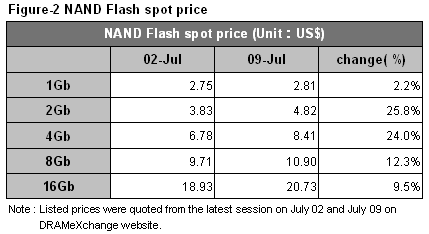
Finally, a comparison of the listed NAND Flash prices from the last session on July 2 and July 9 is shown below. Spot prices of the 1Gb chip rose from US$2.75 to US$2.81, a 2.2% increase. For 2Gb, they climbed 25.8% to US$4.82; 4G up 24% to US$8.41, 8Gb up 12.3% to US$10.90 and 16Gb up 9.5% to US$20.73.

The memory market watcher
DRAMeXchange is a global primary provider of future intelligences, in-depth analysis reports and advisory services on DRAM and Flash memory industry with coverage including current business, spot trading prices, and market trends, capital spending and wafer capacity trends, the impact of DRAM/flash memory products on the market, and other relevant PC industry information.
© DRAMeXchange ® Tech.Inc. All rights reserved.