DRAM makers likely to post losses in Q2; expected to break even in Q3 as prices rise
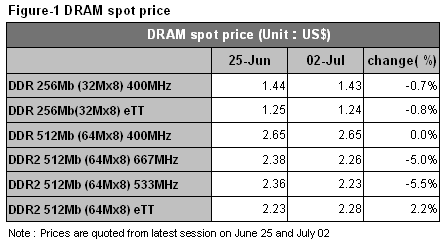
Market trading was sluggish last week, as manufacturers began to count their month-end inventory. In the China market, the reduction in the amount of smuggled chips from Hong Kong has caused a decrease in price queries, and a gradual decline in the spot price. The DDR2 eTT chip increased to US$2.28, while branded DDR2 512Mb 64Mx8 edged down to US$2.26. This shows that the short-term price upticks in the past few weeks have mostly arose from market speculation. The actual market demand does not seem to be strong enough in underpinning prices to increase further.
In 2HJun, the contract price for the Top 5 PC OEMs remained at US$15-US$16. Only a small portion of the Tier 2 players reflected the spot price increase in their contract price. As many PC OEMs build up their inventory levels ahead of the strong seasonal sales, demand in the contract market has picked up. DRAM contract prices are expected to go up by 10% in July. Relevant manufacturers are hoping the DRAM average price will stabilize in Q3. The fact in earning a profit may seem unlikely, but the stabilization will at least lessen the impact from the losses they may incur.
According to Micron's recently released earnings report for Q2, it can be summarized as follows: Revenue: US$1294M. gross margin: 8.8%.operatiig margin -15.07%.net loss around US$225M. In contrast to 4Q06, the DRAM average price experienced a 46% decline in 1H07. Amid the weak pricing environment, Micron has already suffered losses for two consecutive quarters. Nevertheless, in the wake of the DRAM makers' Q2 losses, Micron's performance has surprisingly been better than original market projections.
Currently, Micron's 8 inch fabs are responsible for roughly 60% of its DRAM output. Coupled by its continuing R&D investments, it has a higher cost structure. However, amid the DRAM industry slump, the company's product diversification strategy is starting to pay off. This is most notable in its Flash products, where they are accounting for an even larger share of the company's overall revenues. In addition, in terms of the DRAM output, with the price of Micron's 78nm DDR2 667MHz 1Gb chip being higher than the DDR2 512Mb, it has also helped improve its revenue figures. Having experienced two consecutive quarterly losses, pressure is growing for Micron. The company is expected to continue its product diversification strategy, and devise solutions in reducing its over-reliance on its 8 inch fabs.
Although Taiwan-based DRAM makers enjoy a better cost advantage, the fact that they only produce standard DRAM chips poses inherent risks to them as well. Thus, everyone is trying to devise new strategies in reducing this operational risk. A perfect example is the management battle between Powerchip and Macronix. Powerchip originally sought to gain control of Macronix, in order to accelerate its deployment in the Flash sector. Although it failed to do at the end, it is clear that DRAM makers are aggressively diversifying their product lines.
In light of the serious losses in Q2, DRAM makers are aware the oversupply will continue, which will affect their future expansion plans and R&D investments. Formation of a strategic alliance with other competitors is a good way to minimize the operational risks. Faced with these harsh challenges, the DRAM industry is expected to undergo another wave of consolidation in the not- to-distant future.
Last Friday's iPhone launch and upcoming upgraded iPods in Q3 set to affect NAND Flash demand & supply
Apple's highly anticipated iPhone was officially launched last Friday (June 29th), where people queued up in long lines to purchase the new stylish phone. According to a survey by Piper Jaffray & Co, an investment company, in just two days, roughly 50 thousand iPhones were sold, more than the original projection of 20 thousand from other research institutes. The reason behind the iPhone hype lies in Apple's successful marketing campaign in creating a technology product that is both trendy and unique among the public. Take the latest iPhone for example, the outer appearance follows the same simple design as Apple's other hit product--the iPod. As shown in Figure-2, the innovative 3.5" touch-screen (excludes the required keypad for normal handsets) allow users to easily browse the Internet or watch high-resolution videos.

Based on surveys conducted in New York, San Francisco and Minneapolis by Piper Jaffray & Co, during Day 1 of the iPhone launch, 90% of the buyers preferred the 8GB model. With only a US$100 price difference with the 4GB model, the doubled storage capacity proved to be a very appealing among consumers. The Flash used in the iPhone is said to come mainly from Samsung, where its Flash business have been significantly boosted by the hot iPhone sales. Samsung is currently the world's largest Flash supplier. With the iPhone taking a high priority in Samsung's Flash orders, it may affect the overall Flash market in 2H07.
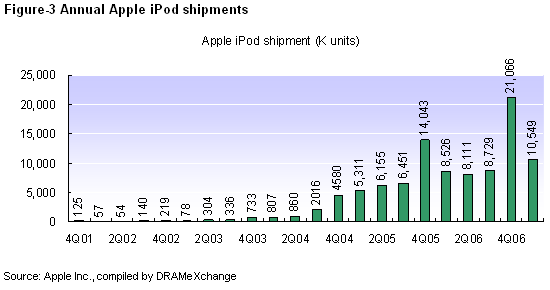
DRAMeXchange conservatively projects roughly 4 million iPhones will be shipped in 2H07. In 2008, the product will account for 1% of the worldwide cell phone market, or in other words, about 12 million iPhones will be shipped. If the shipment ratio between the 4GB and 8GB are the same in 2007, roughly 192mn (in 1Gb equiv.) Flash chips will be consumed by Apple's new cell phone. This figure will represent 2.4% of the overall Flash supply in 2H07, which is not particularly high. However, by looking at the iPod sales figure in the past few years, Q4 usually marks the strongest sales period during the year (as shown in Figure-3), which also holds true for the cell phone market. If Apple wishes to generate strong iPhone sales during this year's Christmas season, the stocking up of the Flash inventory would need to begin in 3Q07, where it will represent 5.7% of the quarterly market output. If Apple also unveils upgraded iPods in Q3, which may include new iPod video products that employ Flash for storage, the required amount in 3Q07 from both the iPhone and iPod will be more than 25%. Therefore, with Apple's products given a high priority in the Flash supply, the future sales of the iPhone will most certainly affect the NAND Flash market in 2H07.
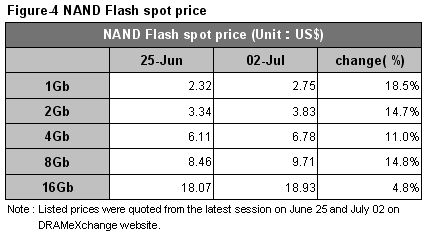
Finally, a comparison of the listed NAND Flash prices from the last session on June 25 and July 2 is shown below. Spot prices of the 1Gb chip rose from US$2.32 to US$2.75, a 18.5% increase. For 2Gb, they climbed 14.7% to US$3.83; 4G up 11% to US$6.78, 8Gb up 14.8% to US$9.71 and 16Gb up 4.8% to US$18.93.

The memory market watcher
DRAMeXchange is a global primary provider of future intelligences, in-depth analysis reports and advisory services on DRAM and Flash memory industry with coverage including current business, spot trading prices, and market trends, capital spending and wafer capacity trends, the impact of DRAM/flash memory products on the market, and other relevant PC industry information.
© DRAMeXchange ® Tech.Inc. All rights reserved.