DRAM prices to bottom out soon?
Beginning from Jan07, mainstream DRAM DDR2 chip prices began to spiral downwards. Up until now, although prices have rebounded sometimes, they have occurred only three times, ranging merely between 10%-15%, and lasting for less than 10 days. According to DRAMeXchange's database, the average price of the DDR 2 tumbled 20% QoQ in 1Q07, and in 2Q07, it is expected to decline a whopping 50% QoQ. When the mainstream DDR2 512Mb 667MHz chips slipped below USD 2, it attracted many buyers to take advantage of the inexpensive chips in stocking up on their inventory. Nevertheless, amid the continuing growth in supply and the hot season not arriving yet, the increased chip buying was not sufficient enough in keeping up the DRAM prices. The market outlook of the DRAM industry has started to look gloomier. With prices already below the manufacturing costs, major DRAM makers have expressed an unwillingness to cut their prices further in clearing out their excess inventory. Current market observations show the DDR2 chip price possibly bottoming out. If this occurs, it should drive up the chip demand, and spur a rebound in the spot price.
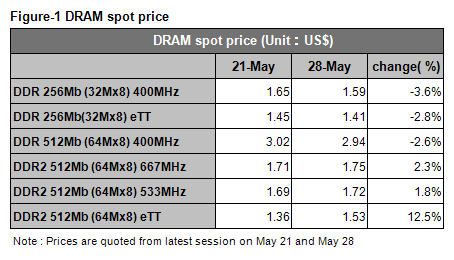
Last week, DDR2 eTT chips leapt 12.5%, hitting a weekly high of USD 1.65. On May 23rd, it experienced a daily price jump reaching 10%. This helped increase the branded chip price 2.3% to USD 1.75, resulting in much stronger market transactions in the DRAM spot market. Despite the fact that Taiwan DRAM makers posted a gross profit of nearly 50% in 4Q06, and 30% in 1Q07, DRAMeXchange believes the persisting DRAM price declines in May will cause them to post a loss in 2Q07.
Although DRAM makers must still ship their chips in May, they indicated no additional price cuts would be made, due to the continuing losses. Prices have thus started to increase for last week. Yet, the end market demand is not expected to pick up in May and June, and PC shipments have been performing worse than expected in May, in the wake of a weak seasonality. Furthermore, PC OEMs, major spot market buyers, and module houses still have inventory levels lasting for more than a month. DRAMeXchange believes that by only relying on buyers in purchasing cheaper chips, the DRAM price increase will be limited at least before June.
With prices already dangerously low, Hynix has already started to switch some of its DRAM production to NAND Flash instead. It is expected that Hynix's output in June will experience a slight decline, and in July, DDR2 output will decrease by 10%-20%. This has prompted the market to hold a more optimistic view for a DDR2 price increase in 3Q07. As DRAM makers are unwilling to yield to more price cuts, and with spot prices increasing, contract prices in June stand a strong chance of stabilizing.
Strong Digital Camera Shipments underpin its Major NAND Flash Application Status
Among the various NAND Flash application products, digital still cameras or DSCs, were once the biggest consumer of Flash. However, amid the rise of multimedia cell phones, and Flash-employed MP3 players spurred by Apple's iPod success, the Flash consumption ratio from DSCs has gradually declined.
In January, Japan's Camera & Imaging Product Association or CIPA, performed an annual DSC shipment forecast between 2007-2009. For 2007, shipment figures for Japan-made DSCs are projected to reach 84.87 million, an annual growth rate of only 7.5%. As Japan-made DSCs account for roughly 80% of the global DSC market, the DSC market appears to be encountering a weaker momentum for 2007. Nevertheless, by the end of 1Q07, Japan's DSC shipments grew 16% YoY to roughly 17.94 million, an indication that the DSC market is not experiencing any serious slowdown. DRAMeXchange believes there is still a 10% DSC market growth in 2007.
Sony and Casio, two Japanese DSC makers, each recently unveiled new models sporting a resolution of more than 10 million mega pixels. Although the mainstream DSC resolution remains at 7-8 million for 2007, many DSC makers continue to focus in enhancing the relevant functions and image resolutions of their devices. Some of the features in which manufacturers have been working on for the past year include: Anti-shock, high magnification optical zoom, high sensitivity, and auto-focus of a person's face. In DRAMeXchange's opinion, with DSC makers developing new DSC functions and further improving the image resolution, the NAND Flash consumption ratio by DSCs should stay at above 20%. All in all, DSCs are expected to remain as a major NAND Flash application for the time being.
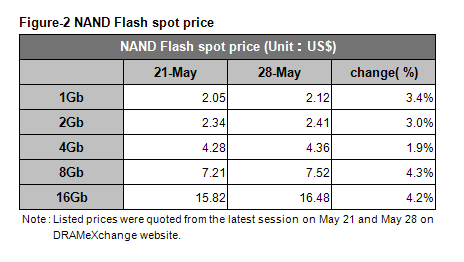
Finally, a comparison of the listed NAND Flash prices from the last session on May 21 and May 28 is shown below. Spot prices of the 1Gb chip rose from US$2.05 to US$2.12, a 3.4% increase. For 2Gb, they increased 3.0% to US$2.41; 4G up 1.9% to US$4.36, 8Gb up 4.3% to US$7.52 and 16Gb up 4.2% to $16.48.

The memory market watcher
DRAMeXchange is a global primary provider of future intelligences, in-depth analysis reports and advisory services on DRAM and Flash memory industry with coverage including current business, spot trading prices, and market trends, capital spending and wafer capacity trends, the impact of DRAM/flash memory products on the market, and other relevant PC industry information.
© DRAMeXchange ® Tech.Inc. All rights reserved.