DRAM oversupply may ease as manufacturers try to roll out more specialty products
Amid the increasing output from DRAM makers, and the inability of downstream retailers and module houses to effectively remove their excess inventory, spot prices maintained their downward spiral. In an effort to slow down the serious DDR2 oversupply, DRAM makers are trying to form new strategies in circumventing the highly competitive DRAM market.
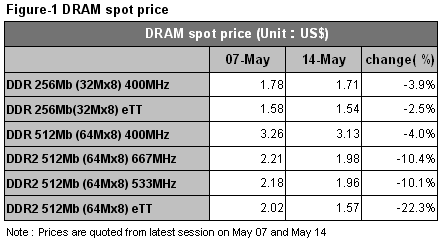
Spot prices declined sharply last week, where branded chips fell through the USD 2 level. DDR2 512MB 667MHz slid to USD 1.98, while DDR2 eTT dropped to USD 1.57. In a single week, the WoW decline in the spot market amounted to 22.3%. With prices showing no signs of a turnaround, buyers are in no hurry of making a deal, which has further weakened the already sluggish market conditions.
Demand has not improved in the contract market as well. As various PC OEMs have already signed long-term agreements with DRAM suppliers, there is no need for a further stock up of inventory on their side. Nevertheless, output continues to increase, as manufacturers migrate to more advanced manufacturing processes. With the inventory levels of downstream retailers and module houses remaining high, the extra chips have no way to go, but to be dumped in the spot market, resulting in the spot prices to continue their freefall.
Despite the current market conditions, Samsung maintained its upbeat sentiment toward the memory market during its global investor conference in early May. In response to the plummeting price declines, it has increased the ratio of its specialty memory products from 25% to 35% in 1Q07. In addition, the more recent capacity expansions are no longer allocated to the production of DRAM. Aside from Samsung, other DRAM makers, such as Elpida, Powerchip, ProMOS, and Winbond are searching for solutions in handling their less cost-effective 8 inch fabs, while others are rolling out more specialty memory products, or boosting the production of the better-priced 1Gb chip. These new measures may help slow down the DRAM capacity expansion, and alleviate the current DDR2 oversupply problem.
Major NAND Flash Makers Upbeat on 2H07 market demand
Major NAND Flash producers recently expressed an upbeat sentiment towards the market conditions for 2H07. Aside from Toshiba projecting prices to stabilize beginning from 2Q07, Samsung was also confident towards the Flash demand in 2Q07 and 2H07. It also held a positive outlook in the migration to more advanced manufacturing processes and overall Flash output. Although the storage density continues to grow in the various Flash application products, supply has not been increasing in proportion. Thus, Samsung forecasts supply may become insufficient in 2H07.
Samsung believes the memory card demand from the cell phone and digital camera markets will experience stable growth in 2Q07. Meanwhile, the standard memory card densities have already increased to 2GB (mainly because the market price has slipped to the USD 20 level). In addition, MP3 player manufacturers are building up their Flash inventory levels in anticipation of a strong end demand in 2H07. Samsung revealed that the overall Flash output is on the decline, where the wafer growth rate has declined from 4% in 4Q06 to 1% in 2Q07.
Samsung also plans to increase the Flash production ratio via the 50 nm process from 10% in 2Q07 to 30% by the end of 2007. Output of the 8Gb NAND Flash chips will also jump from 60% in 1Q07 to 75% in 2Q07.
DRAMeXchange believes the 2007 market demand for Flash will be in a more equilibrium state. Memory densities of key Flash products are expected to continue increasing. Furthermore, currently major Flash makers have no plans in switching from the production of DRAM to NAND Flash. Therefore, the supply and demand conditions in the Flash market should see a more stable development in 2007. This is definitely good news to all the industry players, ranging from the upstream, midstream and downstream segments.
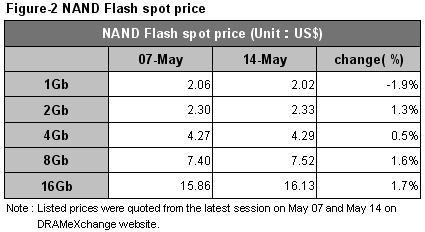
Finally, a comparison of the listed NAND Flash prices from the last session on May 7 and May 14 is shown below. Spot prices of the 1Gb chip declined from US$2.06 to US$2.02, a 1.9% drop. For 2Gb, they increased 1.3% to US$2.33; 4G up 0.5% to US$4.29, 8Gb up 1.6% to US$7.52 and 16Gb up 1.7% to $16.13.

The memory market watcher
DRAMeXchange is a global primary provider of future intelligences, in-depth analysis reports and advisory services on DRAM and Flash memory industry with coverage including current business, spot trading prices, and market trends, capital spending and wafer capacity trends, the impact of DRAM/flash memory products on the market, and other relevant PC industry information.
© DRAMeXchange ® Tech.Inc. All rights reserved.