DRAM contract prices continue downfall; 8 inch fabs becoming professional foundry services
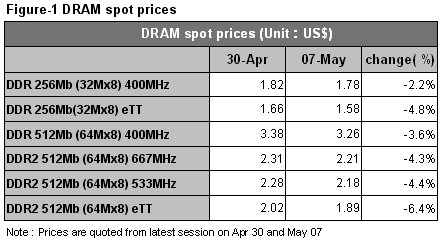
The week-long Labor holidays officially kicked off in China last week. Spot market transactions were weak in the Asia Pacific region, as retailers had already stocked up sufficient inventory. In general, the spot market price continued its downward spiral. DDR2 512Mb 667MHz dropped 4.3% to USD 2.21, while the DDR2 512Mb 667MHz eTT declined more than 6%, slipping past the USD 2 mark to USD 1.8-1.9. As people return to work in China and Hong Kong this week, it remains to be seen whether it can spur more market demand.
Following the quarterly inventory adjustments by OEMs at the end of April, they are still negotiating with DRAM makers on the future contract price. Currently, there are no signs of a buildup in inventory. As both DRAM contract and spot prices continue to experience a downward trend, and with no evident demand appearing in May, contract prices are projected to drop further.
Last week, Taiwan's PSC announced it would transfer the operations of its 8 inch fabs to its 100% owned subsidiary--Maxchip, where they will primarily be tasked for foundry services. This marks the second case in which a DRAM maker has sold its 8 inch fab to another player. The first case was the selling of Winbond's 8 inch fab to Vanguard. As for Promos, it plans to relocate its 8 inch plants to China in 2008. Nanya is also planning to use its two 8 inch fabs for foundry service purposes. In the wake of the plummeting DRAM prices, 8 inch fabs are fast losing their competitiveness in the manufacturing of DDR2 chips. DRAM makers must quickly chart a new strategy before they become a serious liability.
Codenamed Santa Rosa, Intel is set to officially unveil the next generation Centrino mobile platform this week. In addition to introducing a new CPU and chipset, it also utilizes a more advanced wireless module, which supports the 802.11n standard. Many consumers had delayed their NB purchases in the first half, as they waited for the release of the new platform. In addition, they are also waiting for Vista to grow more stable, along with the appearance of more Vista supportable programs. The Santa Rosa release, upcoming launch of the Vista SP1 and persisting DRAM price drops will be three key factors in shaping the Santa Rosa+Vista+DDR2 2GB module NB architecture for 2H07.
SanDisk and Sony jointly develop new SxSTM memory card specification for professional camcorders
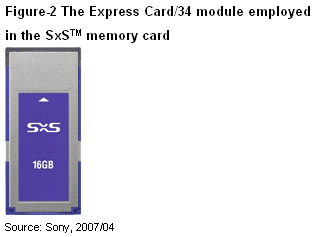
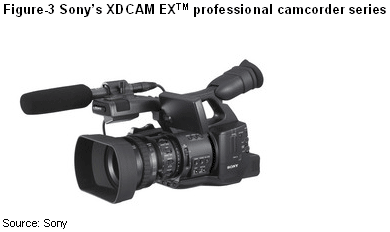
In mid April, global memory card leader—SanDisk, and entertainment and electronics giant—Sony, jointly signed an MOU (Memorandum of Understanding) on the joint development of the SxSTM memory card specification. The new product will follow the Express Card standard, and target professional camcorder users that require a high data transfer speed. The Sony XDCAM EXTM professional camcorders series will be the first in employing the SxSTM memory card as the storage medium.
This does not mark the first time for the two companies in working with each other. The Memory Stick Pro, Memory Stick Micro(M2)and Memory Stick Pro-HG that are used primarily in Sony's AV products are just a few of the successful memory card products developed together by Sony and SanDisk.
Needless to say, Sony is one of the world's leading AV equipment manufacturers. The annual aggregated shipment figures of its Cybershot digital cameras, SonyEricsson mobile phones, PS2 and PS3 game consoles, PSP handheld game devices and other related electronic gadgets accounts for more than 100 million. Thus, it can be seen why many of Sony's electronic products are compatible only with their own Memory Stick formats. SanDisk has always been an important partner with Sony in the development of new Memory stick products, due to its strong technical know-how and leading position in the memory card industry.
The latest SxSTM memory card specification mainly employs an Express Card/34 module that supports the PCI Express and USB interface standards. As mentioned earlier, the SxSTM project will mainly target camcorders with high data transfer rates. According to the respective news releases from Sony and SanDisk, the SxSTM memory card can achieve a maximum data transfer speed of 800Mb/sec or 100MB/sec. DRAMeXchange believes the SxSTM memory card will add a new twist to the development of the storage medium in the professional camcorder market, which should be further monitored in the future.
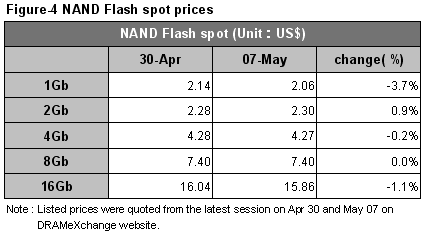
Finally, a comparison of the listed NAND Flash prices from the last session on Apr 30 and May 7 is shown below. Spot prices of the 1Gb chip declined from US$2.14 to US$2.06, a 3.7% drop. For 2Gb, they increased 0.9% to US$2.30; 4G down 0.2% to US$4.27, 8Gb remained the same at US$7.40 and 16Gb down 1.1% to $15.86.

The memory market watcher
DRAMeXchange is a global primary provider of future intelligences, in-depth analysis reports and advisory services on DRAM and Flash memory industry with coverage including current business, spot trading prices, and market trends, capital spending and wafer capacity trends, the impact of DRAM/flash memory products on the market, and other relevant PC industry information.
© DRAMeXchange ® Tech.Inc. All rights reserved.