Supply remains abundant amid major DRAM price corrections; biggest variable in 2H07 will be the demand & supply balance
The month-end inventory pressures have caused the spot price to slip further. Amid an anticipated DRAM price rebound, various retailers and module houses have aggressively stocked up on DRAM chips. Unfortunately, the current May-June market demand does not appear to be in line with their expectations. The overly high inventory levels are thus creating a negative impact on the spot price. In addition, despite the huge DRAM price corrections that began to take place this year, chip manufacturers are still pressing ahead with their capacity expansions. Therefore, whether or not the demand can keep pace with the increasing supply will be a primary issue to monitor in 2H07.
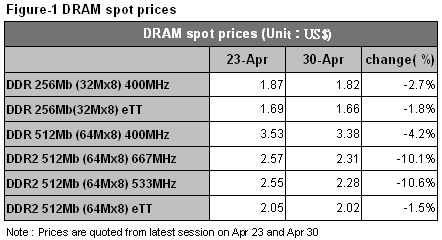
As mentioned earlier, the DRAM spot prices are being further dragged down by the month-end inventory pressures. Even with China's upcoming Labor holidays, downstream retailers and module houses are not seeing any evident increase in demand. Between the April 23rd -30th period, the DDR2 512Mb 667MHz slipped to roughly USD 2.33, while the DDR2eTT declined to USD 2.02. In light of the weak pricing environment, some retailers and module houses started to build up on their inventory levels, as they considered it as the cyclical bottom.
Their actions also stemmed from the fact that the projected PC selling season in 2H2Q would help spur the overall DRAM market demand. However, at the moment, demand is expected to remain weak in the May-June period. The excessive high inventory levels have already started to affect the DRAM spot price.
With DRAM manufacturers continuously increasing their output, the contract price is not expected to rebound soon, where they are forecast to tumble further in May. In response to the persisting DRAM glut, manufacturers are still mostly trying to increase their 12" fab output, in lowering their costs and expanding their market share. The significant DRAM pricing corrections do not appear to be having much an effect on DRAM makers, as they do not have any plans in scaling back on their production. This can be seen by Qimonda's recent decision in constructing a new 12" fab in Singapore. The increasing capacity is believed to be this year's most worrisome factor to the DRAM industry.
Nevertheless, every cloud has a silver lining. The plunging DRAM prices have at least helped drive up the DRAM content per box. For PC running the Vista OS, 1GB of DRAM is a basic requirement. With the Vista adoption rate increasing, only commercial models are now seen carrying 512MB of memory. Some consumer-based models are equipped with two 1GB memory modules. Single 2GB DRAM modules are still not very popular, as they are too expensive; priced at more than USD 100. It is forecast that the 70nm process technology will become more prevalent during 2H07. By then, the 1Gb chip will become mainstream, which will push the 2GB module to the new market standard.
Samsung officially mass produces 50nm 16Gb MLC NAND Flash; Intel/Micron samples similar products
By looking at the rapid development of next-generation NAND Flash manufacturing technology, it is not hard to understand why it is such an intensely competitive industry. According to Samsung's latest news release on April 29th, it has already begun to mass produce 50nm 16Gb MLC products. IM Flash Technologies, a joint venture company between Intel and Micron, also revealed on April 25th, the sampling of the 50nm 16Gb MLC chips. After unveiling the 56nm 8Gb MLC product, Toshiba plans to volume produce the 56nm 16Gb MLC chips in 2Q07. It can thus be seen that the Toshiba and SanDisk camps are making huge strides in their development of NAND Flash MLC technology.
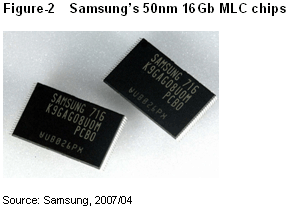
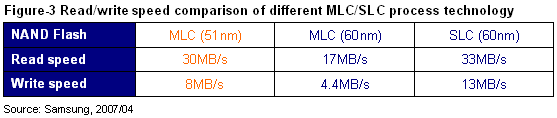
On July 19th, 2006, Samsung announced it had started to mass produce 60nm 8Gb MLC chips. Less than a year later, it has already migrated to the even thinner 50nm process in producing the higher capacity 16Gb MLC chips. The technical hurdles that need to be overcome in this new generation are even more difficult than before. Although Samsung's competitors have significantly improved their technology know-how, they still lag behind Samsung's technical edge. Furthermore, after experiencing the painful transition to the MLC process in 2006, Samsung has acquired a better understanding in the manufacturing of MLC chips. This helps it to be in a better position in developing more advanced manufacturing processes and higher storage capacities of MLC products.
In Jan06, Intel and Micron joined forces in establishing IM Flash Technologies (IMFT). By respectively pooling their NOR Flash and DRAM manufacturing capabilities, they were able to shorten the generation gap with both Samsung and Toshiba. In 2H06, IMFT had already employed the 50nm process to its 4Gb chip samples. In terms of manufacturing process, with its latest 50nm 16Gb MLC products, IMFT is merely one to two quarters behind the world's top 2 NAND Flash producers. Needless to say, IMFT is emerging as a serious threat to both Samsung and Toshiba.
As major NAND Flash suppliers start to sample or mass produce 16Gb MLC products, DRAMeXchange believes the major NAND Flash applications in 2H07, which include: memory cards, USB Flash drives, MP3 players and other storage devices, will see their densities increase further. Consumers will thus be able to purchase these products at even lower prices.
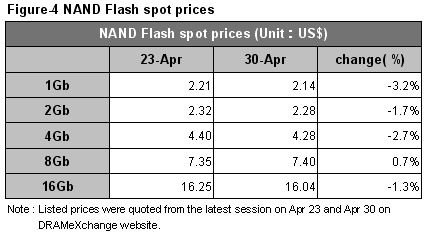
Finally, a comparison of the listed NAND Flash prices from the last session on Apr 23 and Apr 30 is shown below. Spot prices of the 1Gb chip declined from US$2.21 to US$2.14, a 3.2% drop. For 2Gb, they decreased 1.7% to US$2.28; 4G down 2.7% to US$4.28, 8Gb up 0.7% to US$7.40 and 16Gb down 1.3% to $16.04.

The memory market watcher
DRAMeXchange is a global primary provider of future intelligences, in-depth analysis reports and advisory services on DRAM and Flash memory industry with coverage including current business, spot trading prices, and market trends, capital spending and wafer capacity trends, the impact of DRAM/flash memory products on the market, and other relevant PC industry information.
© DRAMeXchange ® Tech.Inc. All rights reserved.