DRAM prices may soon hit bottom; new manufacturing process and bigger 1Gb chip shipment ratio key to success
The DRAM contract price slid to roughly USD 20 for 2HApr, which also affected the spot market price trend. In light of the PC selling season in 2H07, DRAM demand is expected to increase, as PC OEMs build up on their inventory. Therefore, 2H07 may represent the bottom of the current extremely low DRAM pricing levels. The persisting price declines have pushed DRAM makers to the verge of losing money. Migrating to more advanced manufacturing processes, and increasing the shipments of 1Gb chips will be two key factors in deciding how the respective DRAM makers perform in 2H07.
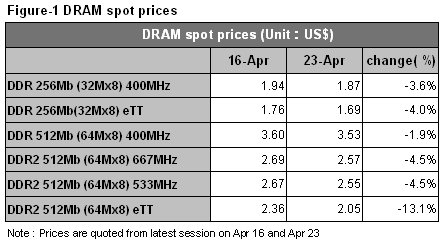
The pricing environment for the spot market remained weak, as demand was still sluggish. The DDR2 512Mb 667MHz tumbled to roughly USD 2.57, while the DDR2 eTT dropped to USD 2.05. In the contract market, prices fell as well, due to the removal of excess inventory by PC OEMs. Contract prices of the DDR2 667MHz 512MB were mostly finalized at USD 20 or even lower.
The current declines in the DRAM contract price have been much bigger than originally expected. This has been mainly attributed to the weak seasonality in the PC market, and huge imbalance in the demand and supply chain. DRAM makers have been forced to sell their chips at extremely low prices, as their monthly capacities continue to increase. Fortunately, with the inventory levels of PC OEMs now running lower and quarter end financial reporting coming to an end, DRAM demand may start to pick up. Coupled by the strong seasonality in the PC market in 2H07, the dismal DRAM chip prices may soon rebound.
As mentioned earlier, the ongoing price declines are dragging DRAM makers to the brink of losing money. In response, manufacturers are trying earnestly to further cut down costs. For instance, Micron recently announced the successful development of the 1.5V DDR2 chip using the 78 nm manufacturing process. The smaller voltage is capable of saving approximately 24% of power. As Micron owns a larger ratio of the less cost-effective 8 inch fabs, it is introducing chips with special specifications, in order to avoid the fierce price competition in the commodity DRAM market. For Samsung and Hynix, they have begun to run test trials using the 68 and 66nm process, along with increasing the shipment ratio of 1Gb chips for 2H07. On the other hand, Taiwan manufacturers are continuing to boost the capacity of their 12 inch fabs. Needless to say, amid the rapid capacity increase, the cost down mechanisms being introduced by the DRAM manufacturers will play an instrumental role in their future competitiveness.
NAND Flash suppliers speed up development of built-in memory products for emerging mobile communications market
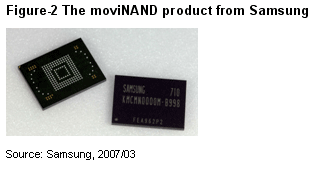
Among the 4 main NAND Flash applications, the MP3/PMP devices usually have the Flash memory built-in directly inside them, while cell phones and digital cameras use an external memory card in storing the image or music files. USB drives are also considered a primary application, as they are used extensively by PC users in backing up their data. Currently, roughly two-thirds of the NAND Flash capacity is consumed by memory cards and USB drives. Meanwhile, nearly one-third of the remaining ratio is allocated for built-in memory products, where they use either the standard NAND Flash or integrated Flash. For example, Samsung unveiled in March an 8GB moviNAND, where it is composed of four 16Gb chips manufactured by the 50nm process. According to the company's official news release, mass production of the product will begin before the end of 2Q07.
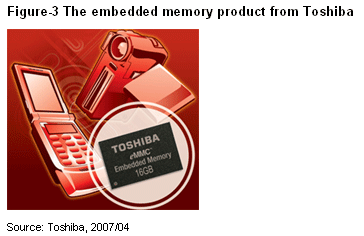
Toshiba, on the other hand, revealed in its website the successful development of a 16GB embedded flash memory. Manufactured by the 56nm process, the memory consists of eight 16Gb chips. Toshiba will begin sending samples to its clients in June. With the 8GB embedded memory product already delivered to clients for evaluation, the company plans to begin mass produce it in July.
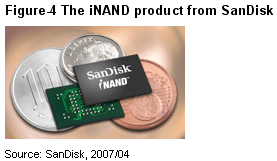
SanDisk, another Flash maker, showcased its iNAND product during Feb07 at the 3GSM World Congress that was held in Barcelona, Spain. The iNAND density currently ranges from 256MB to 4GB, and will be mainly targeted at mobile communication devices using microdrives.
As NAND Flash manufacturing migrates to even more advanced processes, and its relevant costs decline further, manufacturers of mobile communication devices are starting to show a growing interest in equipping their smart phones, GPS, PDA and other handheld devices with embedded Flash memory, instead of the more commonly used external memory card. On a different note, the scheduled Apple iPhone release in June, which will come in 4GB or 8GB models, is expected to spur more relevant manufacturers in switching to built-in Flash memory as the storage solution. These developments are also helping integrated Flash gain more popularity in the market.
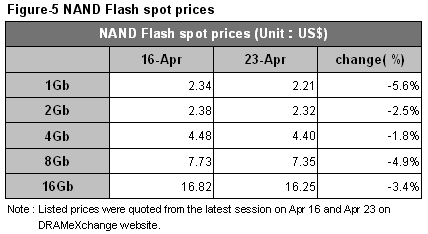
Finally, a comparison of the listed NAND Flash prices from the last session on Apr 16 and Apr 23 is shown below. Spot prices of the 1Gb chip declined from US$2.34 to US$2.21, a 5.6% drop. For 2Gb, they decreased 2.5% to US$2.32; 4G down 1.8% to US$4.40, 8Gb down 4.9% to US$7.35 and 16Gb down 3.4% to $16.25.

The memory market watcher
DRAMeXchange is a global primary provider of future intelligences, in-depth analysis reports and advisory services on DRAM and Flash memory industry with coverage including current business, spot trading prices, and market trends, capital spending and wafer capacity trends, the impact of DRAM/flash memory products on the market, and other relevant PC industry information.
© DRAMeXchange ® Tech.Inc. All rights reserved.