Intel officially enters SSD market by unveiling Solid State Drive with USB interface
On March 12th, Intel officially introduced to the market its Z-U130 Solid State Drive, which adopts an embedded USB interface in the PC platform.. According to Intel's website, to first test the waters, it will initially come in two low density formats: 1GB and 2GB. It expects to introduce a 4GB model in April, and a 8GB model at the end of 2007.
Unlike the ATA5 and SATA interface utilized respectively by Samsung and SanDisk, Intel's Z-U130 is compliant with the USB 1.1 and 2.0 specifications, where the main purpose is to allow downstream ODMs or OEMs to more easily integrate them into their respective PC platforms. However, in the press release, Intel revealed their future SSD products will also be compatible with other interfaces and carry even higher densities.
The fact that the NAND Flash industry is still in a nascent development stage was one of the key reasons in prompting Intel to enter the sector. In the next few years, the industry is still projected to experience strong growth. Furthermore, in contrast to traditional HDDs, the employment of NAND Flash as the storage medium improves the PC platform's efficiency. Advantages include faster boot times, more lightweight, more power conserving and quiet, improved durability and so forth. The only drawback is the manufacturing costs for each GB of NAND Flash are still way too higher than the HDD.
Thus, instead of offering a high density 32GB SSD like Samsung or SanDisk in the beginning, Intel is first introducing low density SSDs that range from 1GB to 8GB. As mentioned before, they can first test how the market reacts to their SSD product launch. In addition, they can also differentiate themselves from Samsung and SanDisk's foray in the high end mobile computer market by first focusing on low cost NBs or basic featured PCs of new emerging markets.
DRAMeXchange believes Intel's SSD product launch is a signal of the SSD's official entry in the PC sector. Once the average NAND Flash unit cost drops to a certain level, it has huge potential in partially replacing the traditional HDD. This will definitely be good news to NAND Flash makers, as they will significantly help consume their capacity.
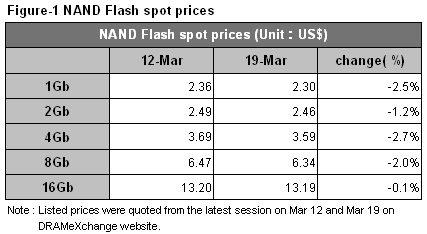
Finally, a comparison of the listed NAND Flash prices from the last session on Mar 12 and Mar 19 is shown below. Spot prices of the 1Gb chip dropped from US$2.36 to US$2.3, a 2.5% decline. For 2Gb, they fell 1.2% to US$2.46; 4G down 2.7% to US$3.59, 8Gb down 2.0% to US$6.34 and 16Gb down 0.1% to $13.19.
High DRAM inventory may cause DDR2 contract price to drop more than 10% in 2HMar
With the inventory levels of DRAM makers running too high, the DDR2 spot price continued to slowly trend downwards. Meanwhile, the DDR2 contract price is expected to slip more than 10% in 2HMar. The current DRAM prices have already grown awfully close to the production costs of manufacturers. Thus, if the DRAM makers can successfully clear out their excess inventory in the near future, there is a chance for the DRAM price to hit the bottom in April or May.
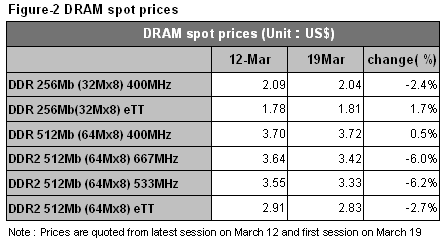
In the DRAM spot market, demand has been flat, where DDR2 chip prices continued to decline slowly. DDR chips fared only a little better, due to a tighter supply. The DDR2 512Mb 667MHz dropped to USD 3.42, while the DDR2 eTT slipped past the USD 3 mark to USD2.83.
The DRAM contract price is expected to decline further for 2HMar. The DDR2 512MB 667MHz module price of some DRAM makers has already reached USD27-28. However, as the DRAM inventory levels are too high at the moment, buyers still have the upper hand in the contract market. PC OEMs are expected to ask for more price cuts, where their acceptable price now stands roughly at USD25. Therefore, the contract price may continue to slip during the end of March to April.
Amid the DRAM price plunge in February, and sufficient DRAM inventory of PC OEMs, DRAM makers have been unable to effectively clear out the extra inventory from their monthly output. Furthermore, as the consumption of some DRAM chips are conducted in the spot market, this and the factors mentioned above helped contribute to the sharp declines in both the spot and contract prices.
As stated earlier, the DRAM price levels have already tumbled near the manufacturing cost levels. If DRAM manufacturers can effectively remove their excess memory, prices may possibly hit the bottom in April or May. However, as DRAM makers continue to ramp up production, the price rebound may not be very strong.

The memory market watcher
DRAMeXchange is a global primary provider of future intelligences, in-depth analysis reports and advisory services on DRAM and Flash memory industry with coverage including current business, spot trading prices, and market trends, capital spending and wafer capacity trends, the impact of DRAM/flash memory products on the market, and other relevant PC industry information.
© DRAMeXchange ® Tech.Inc. All rights reserved.