DRAM contract price slips past spot price as they drop roughly 10% for 1HMar
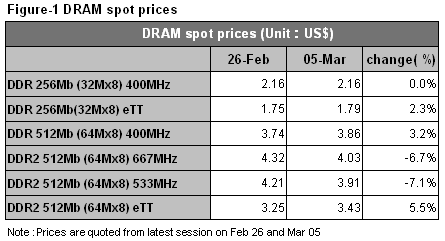
For the first week after the Chinese New Year Holiday, the restocking was mostly centered on DDR chips. Demand remained weak for DDR2 chips. Although not much market transactions took place, the DDR 256Mb eTT chips were slightly up by 2.3% to USD1.79. DDR 512Mb 400MHz was up 3.2% to USD3.86. In contrast to the DDR price increase, except for the DDR2 512Mb eTT chip price, which continued its climb before the Chinese New Year to USD3.43, the remaining DDR2 512Mb 533MHz and 667MHz were all down by more than 6% to USD3.91 and USD4.03.
The DRAM contract price for 1HMar continued to drop. Although the DDR2 512MB 667MHz modules has already declined below the USD40.00 mark, it has further slipped past the USD35.00 mark for 1HMar. If the selling price for DDR2 512Mb 667MHz UDIMM stands at USD34.00, a DRAM chip price is roughly USD3.87. Thus, the DRAM contract price is currently lower than the spot market price.
Between the Jan07 to Mar07 period, the DRAM contract price had sunk by roughly 30%. Previous forecasts projected that the price drops might occur in March. However, the market reactions in the spot price occurred surprisingly earlier, which prompted a rapid price correction during 1HFeb. The month-long declines rendered the contract price to slip below the spot price for 1HMar. This also shows that demand from the OEM makers have been lower than expected. In terms of the production costs for DRAM makers, it stands approximately at USD 25-USD32 for DDR2 667 512MB UDIMM. If the contract price continues to decline, for DRAM makers that own a higher manufacturing cost, losses which were experienced in 2005, may once again be seen for Q107 and Q207. The high profit margins that were seen in Q306 and Q406 may rapidly change to a situation, where losses or low profit margins may occur in the future.
Insufficient NAND Flash chip supply drives up market price after Chinese New Year
Last week, the NAND Flash spot price experienced a rebound in the 8Gb and 16Gb segment, where a 8% price jump was witnessed in a single day. Amid sluggish demand, the NAND Flash price has been declining ever since early Dec, 2006. Before mid-February, it had already fallen by 50%. Many market observers were concerned with the industry's development for 2007. However, the price rebound after the Chinese New Year has created a more upbeat market outlook for the coming months.
According to DRAMeXchange's observations, the huge jump in the NAND Flash spot price can be attributed by several factors: (1) Adjustments in the NAND Flash production from upstream suppliers (2) Component procurement from Apple for the upcoming iPhone release in Jun, 2007. (3) Lower inventory levels of downstream vendors after the 9 day Chinese New Year holidays.
In the light of weak demand in the end market and persisting price drops in 2H06, upstream NAND Flash suppliers had switched some of their production to DRAM chips instead. Therefore, beginning from Dec, 2006, the supply of NAND Flash chips to downstream vendors began to decrease significantly.
Apple's iPhone, which was unveiled to the public in Jan, 2007, is scheduled to be released in the North American market in Jun, 2007. Apple is said to have started releasing orders to upstream NAND Flash suppliers in preparation for its production. Although it remains uncertain how many iPhones can be initially sold, the success of its Flash-based iPod has prompted many market observers to hold a more bullish view on the iPhone's release, which comes in 4GB and 8GB versions.
Due to the 9 day Chinese New Year holidays, the inventory levels of downstream memory card makers and USB manufacturers had fell substantially. After the holidays came to an end, the downstream manufacturers began to increase their procurement from upstream suppliers. However, supply of some of the higher density NAND Flash chips were insufficient, which contributed to the jump in the 8Gb and 16Gb market price. As the situation is not expected to change soon, we believe the market price should continue to rise in the near term. It remains to be seen how long this trend can last.
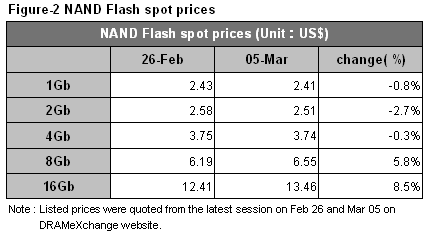
Finally, a comparison of the listed NAND Flash prices from the last session on Feb 26 and Mar 5 is shown below. Spot prices of the 1Gb chip dropped slightly from US$2.43 to US$2.41, a 0.8% decline. For 2Gb, they fell 2.7% to US$2.51; 4G down 0.3% to US$3.74, 8Gb up 5.8% to US$6.55 and 16Gb up 8.5% to $13.46.

The memory market watcher
DRAMeXchange is a global primary provider of future intelligences, in-depth analysis reports and advisory services on DRAM and Flash memory industry with coverage including current business, spot trading prices, and market trends, capital spending and wafer capacity trends, the impact of DRAM/flash memory products on the market, and other relevant PC industry information.
© DRAMeXchange ® Tech.Inc. All rights reserved.