Gap between contract and spot price narrows in February; ASP roughly US $43
Sluggish market demand and increased supply from DRAM makers sent the DDR 2 spot price lower, where the DXI index slipped from 4262 to 4139. The price difference in the spot and contract markets has begun to grow smaller in 1HFeb. The average price stands roughly at US $43.
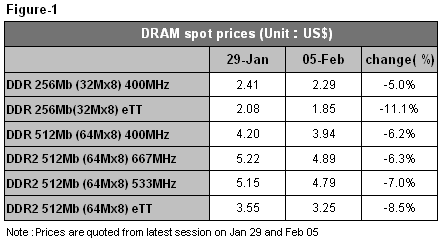
In light of a weaker contract market, DRAM makers have shifted their supply to the spot market, causing steep price drops. Module vendors and traders have adopted a very cautious approach to the declining prices, creating a vicious cycle of supply and demand. Amid the weak demand in the contract market, prices of branded chips have shown signs of a decline. DDR2 512Mb 667MHz officially slipped past the US $5 mark, arriving at the US $4.89 level. DDR2 512Mb eTT slumped 8.5% to US $3.25, while DDR 512Mb 400MHz lost 6.2% to US $3.94.
As PC OEM makers are already stocked up on DRAM inventory, and with no evident increases in PC sales after the VISTA launch, they are showing minimal interest in acquiring additional DRAM modules. Coupled by the reduced working days in February, DRAM makers are faced with rising inventory levels. Therefore, as PC OEM makers try to cut the contract price, it will narrow the gap with the spot price. As the drops may be quite substantial, various market rumors have added confusion to the contract price quotes. According to DRAMeXchange, for 1HFeb, the ASP is currently near the US $43 level, where the lowest has already dropped to $ US40.
How ONFI 1.0 may affect the NAND Flash industry
On Jan 22nd 2007, the Open NAND Flash Interface (ONFI) Working Group, which was initially formed by Hynix, Intel, Micron, Phison, Sony and STM, officially released the specifications of the ONFI 1.0 standard. But what exactly is ONFI? How will it impact the NAND Flash industry? In response to these two questions, a brief introduction of ONFI will be presented below.
Despite the numerous end products, there is currently no single standard for all the manufacturers in the NAND Flash industry to follow. The function of NAND Flash in the various hosts only acts as a storage device. It needs a controller IC to work as a bridge in transmitting the data signals between it and the various hosts. If the controller IC does not support the interface of a certain host, the NAND Flash chip will not function.
As Intel and Micron have also ventured into the production of NAND Flash, Intel's presence further highlights the growing development trend of NAND Flash in the PC application market. Only through a standardized interface can the data-sharing of the various hosts be conducted through a common platform. This is very important, if NAND Flash is to be integrated into PCs in a large scale, which is why Intel and several other NAND Flash players jointly formed ONFI. At the moment, there are a total of 39 well-known IT and semiconductor companies within the organization.
Although ONFI is expected to be a long-term positive development to the NAND Flash industry, it is worthy to note that the top 2 NAND Flash makers--Samsung and Toshiba/SanDisk, have not joined ONFI yet. As the duo account for roughly 70% of the total NAND Flash production, their influence towards the market can not be overlooked. Thus, their absence brings an uncertain outlook to the organization's future development.
No one is certain whether Samsung or Toshiba/SanDisk will eventually join ONFI, but needless to say, the development of ONFI relies substantially on their support. In terms of the NAND Flash industry's long-term development, it would be conducive if an industrial standard could be set up for relevant players to follow. Nevertheless, it remains to be seen how much actual progress can be achieved.
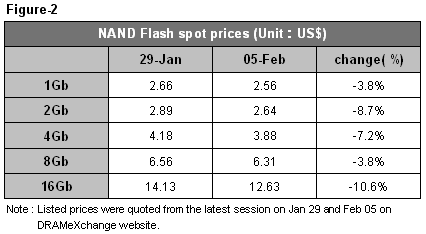
Finally, a comparison of the listed NAND Flash prices from the last session on Jan 29 and Feb 5 showed a price drop in all the various chip densities. Spot prices of the 1Gb chip decreased from US$2.66 to US$2.56, a 3.8% drop. For 2Gb, they plunged 8.7% to US$2.64; 4G 7.2% to US$3.88, 8Gb 3.8% to US$6.31 and 16Gb10.6% to $12.63.

The memory market watcher
DRAMeXchange is a global primary provider of future intelligences, in-depth analysis reports and advisory services on DRAM and Flash memory industry with coverage including current business, spot trading prices, and market trends, capital spending and wafer capacity trends, the impact of DRAM/flash memory products on the market, and other relevant PC industry information.
© DRAMeXchange ® Tech.Inc. All rights reserved.