Limited DDR demand seen in PC clone market;"window period"from upcoming Vista launch drags down DDR2 price
The sluggish DDR and DDR2 spot markets caused the DXI to slip from 4600 to the 4549 level. However, amid production cuts from DRAM makers and demand from the PC clone market, future DDR price drops should be limited. For DDR2, the PC market's weak seasonality drove down its market demand. To boost its growth, relevant component prices need to be cut further.
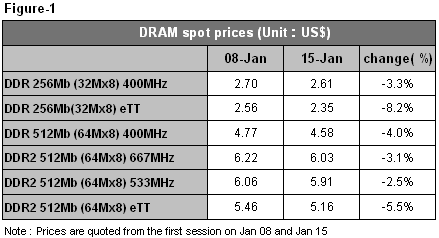
In the wake of the DDR2 spot market slump, transactions in the Chinese and Hong Kong markets were weak as well. Limited chip purchases sent the DDR2 spot price down. DDR2 667MHz 512Mb chips slipped to $6.03 USD, down 3.1%, while DDR2 eTT declined 5.5%, dropping to $5.16 USD. Although news of Hynix's production cuts slightly increased the DDR weekly price, the ending of the short-term inventory replenishments drove down the DDR price, where DDR 400MHz 512Mb fell to $4.58 USD.
Despite the ongoing DDR price drops, demand is still evident from the DT clone market. With the upcoming production stop of Intel 865 chipsets, along with the existing demand of low-priced products from emerging market, motherboard makers still have some 865 chipset motherboards in their inventory. In addition, as the DDR-support-only 754 series CPUs from AMD are still being sold in the markets, motherboard manufacturers are expected to clear out such products after the Vista launch. These DDR platform products are estimated to account for more than 10% of the DT market. Due to the huge DDR price drops in Q406, some DRAM makers began to reduce their wafer input to below 10%. The decreased supply should help stabilize the DDR price.
DDR2 spot prices are set to experience additional price cuts, as the current high prices are unable to stimulate market demand. Microsoft's Vista Home edition is scheduled to be released on Jan 30. However, a "window period" is expected during the initial release stage. In addition, the weak NAND Flash price has caused some DRAM makers to switch their original Flash production to DRAM manufacturing instead. The increased output has put additional pressure on the DRAM market price, as well.
In regards to the market expectation of seeing a boost in the demand for DDR2 chips from Microsoft's new operating system, relies mainly on two factors--- the PC's average DRAM content per box and the extent of the PC replacement cycle from Vista. DRAMeXchange projects that the launch of Vista's home edition will increase the DRAM content per box of each PC. In addition, for mainstream NBs that are above $599 USD, their bundle minimal memory will be at least 1GB. Thus, memory demand should be strong.
Nevertheless, from the PC shipment perspective, the anticipated replacement cycle brought forth by Vista is not very evident. From the estimated shipment figures of MB or NB OEM makers, the projected PC shipments for 1H07 are similar to the slow season seen in previous years. The motherboard sector is the only area to experience growth, as demand from Q406 was postponed until now. Therefore, from the factors mentioned above, Vista is not the only variable that will affect the DRAM sector. Its growth also depends on the costdowns of other computer components.
Looking at the new NAND Flash applications from CES
The main theme of this year's CES show focused on the realization of the digital home concept. The combination of the Vista operating system with HDTV capable TVs and portable electronic products (portable PCs, multi-function handsets, PMP, DV/DSCs, PND, smart home appliances...etc) via wired & wire-less connections was the highlight of the showcased products. The following section will provide an introduction on how these products will create new business opportunities for NAND Flash.
Vista's home edition is scheduled to be released during the end of January, 2007. Its Ready Boost and Ready Drive functions have brought forth many new application products (Ready Boost UFD & memory cards, Hybrid HDD, Robson modules, SSD.. etc.). In addition, its digital home concept will bring together the home video server, STB, game console, home PC and other hardware in serving as the " control center" in networking the household's various 3C electronic products. If broad-bandwidth connections are included, which are capable of playing or downloading HDTV videos, more powerful and higher storage-capacity portable 3C products will be needed. Demand for such products is set to increase, as the digital home concept matures, which will further boost the NAND Flash demand.
Furthermore, 3C electronic companies unveiled many high capacity NAND Flash-employed multi-function handsets, PMP and mobile PCs during the 2007 CES show. We anticipate that after the launch of Apple's brand-new handset, it will spur other manufacturers in developing multi-function handsets that are embedded with a multimedia download platform, in order to tap the business opportunities related to the delivery of multimedia content via wired & wire-less connections. In the future, the NAND Flash demand in such multi-function handsets will increase to 4~8GB. MP3/MP4/PMP devices will also follow the same growth pattern, where it can be connected to the digital home control center or car. The NAND Flash storage size will climb to 4~8GB, as well. UMPCs and Tablet PCs will also gradually become TV capable and include wired & wire-less connections. For mobile TVs, 3D games and video download will also become more widespread. Thus, 8~32GB SSD products should see more applications in mobile PCs and PMP. DV/DSC that emphasize on generating high resolution images will raise the requirement of the high-speed memory card to 4~8GB too.
All in all, the 2007 CES exhibition is a more concrete demonstration of how the digital home concept is unfolding. During March's CeBit and June's Computex Taipei, manufacturers are expected to roll out newer and more versatile multimedia digital- home 3C electronic products, resulting in even more NAND Flash applications.
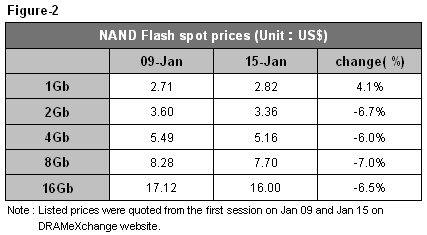
Finally, a comparison of the listed prices from the last session on January 9th and Jan 15th showed that only the 1Gb chips saw an increase in the NAND Flash spot price. For the remaining chips, they all experienced a decline of roughly 6~7%. Spot prices of the 1Gb chip increased from US$2.71 to US$2.82, a 4.1% increase. For 2Gb, they dropped 6.7% to US$3.36; 4G 6.0% to US$5.16, 8Gb 7.0% to US$7.70 and 16Gb 6.5% to $16.00.

The memory market watcher
DRAMeXchange is a global primary provider of future intelligences, in-depth analysis reports and advisory services on DRAM and Flash memory industry with coverage including current business, spot trading prices, and market trends, capital spending and wafer capacity trends, the impact of DRAM/flash memory products on the market, and other relevant PC industry information.
© DRAMeXchange ® Tech.Inc. All rights reserved.