DRAM contract price remains flat in 1HJan, Vista launch expected to affect future DRAM price
Amid plunging DDR spot prices, DDR chip procurement has become more evident. On the other hand, DDR2 demand remains sluggish, as seen in the DXI decline from 4622 to 4612. Minimal changes are seen in the DDR2 contract price for 1HJan. The future DRAM price trend is expected to depend a great deal on how the market reacts to the upcoming Vista release.
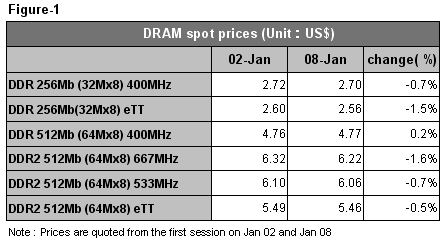
After the New Year holidays, demand has begun to pick up slightly in the spot market. The demand is mostly concentrated in DDR chips, where prices have appeared to hit the bottom. This is most evident in the Hong Kong and Shenzhen markets. With the plunging DDR price quotes coming to a halt, several distributors are already stockpiling additional DRAM in preparation for the Chinese Lunar New Year Holidays. DDR 512 MB climbed slightly to $4.77 USD, a 0.2% increase. For DDR2 chips, market demand remained uncertain. DDR2 667MHZ dropped slightly to $6.22 USD, while DDR2 eTT chips fell to $5.46 USD.
Contract prices for DDR2 modules remain stable for 1HJan. Average transaction price for DDR2 667MHz 512MB modules stood roughly at $50 USD. As PC OEM makers seek to avoid any occurrence of an insufficient DRAM supply, long-term contracts were already signed with relevant DRAM makers in Q406. Therefore, only a selected few were offering a lower price quote. In light of the weak demand, minimal transactions was observed in the DDR module market, where prices slipped by 2%.
Microsoft's new Vista operating system is scheduled to be launched at the end of January. Therefore, PC demand from the end markets is weak, as consumers delay their PC purchases. In anticipation of the Vista release, the production of Vista ready models from PC OEM makers helped boost the DRAM sales in Dec06. Despite the traditional weak seasonality of January, PC OEMs are still showing strong demand. Hoping to have an ample supply of DRAM, PC OEM makers are trying to take advantage of the weak seasonality in increasing their inventory. Thus, DRAM contract prices in January saw minimal fluctuations.
As stated above, PC sales have currently entered a weaker seasonality cycle. Among the various components, only DRAM modules are seeing a stronger demand, as PC OEM makers try to increase their DRAM inventory. It is expected the inventory levels should return to a healthier state by the end of January. If the Vista launch can indeed stimulate the PC market and digest the PC OEM's DRAM inventory, the PC shipment performance in February will be a key issue to follow.
SSD set to become the new killer application of NAND Flash, market demand expected to grow in 2008
SanDisk, who is a prominent Flash memory card maker, unveiled a 1.8" 32Gb Solid State Drive (SSD) storage device on January 4th, 2007. The product is initially expected to target enterprises. As the unit production costs for NAND Flash are expected to drop further, SanDisk expects the general public (especially business executives who travel frequently) to begin showing interest in purchasing NBs that are equipped with an SSD in the near future.
SanDisk was not the first manufacturer to utilize NAND Flash as the storage medium for the SSD. As early as Mar. 2006, Samsung introduced the world's first 1.8" 32 GB SSD. However, the SSD is still not very popular among the consumer market, which is due to the fact that the SSD unit cost is much more expensive than the HDD. In contrast to the $100 USD of a 1.8" 30GB HDD, SanDisk's new $600 USD 1.8" 32GB SSD is roughly 6 times as expensive.

Industry players believe that for the flash-based SSD to be accepted by the consumers, the price gap with HDDs must be much smaller. Under the current manufacturing process technology, it expected that SSDs will become more affordable in the year 2008. The reason in why flash manufacturers are pinning such high hopes on the SSD lies in its huge flash consumption. For example, a 32 GB SSD requires thirty two 8Gb chips (equivalent to the production of thirty two 1GB memory cards). If SSDs can be largely employed in the millions of NBs that are manufactured each year, the capacity demand in NAND Flash chips would be enormous. Hence, each flash maker are strongly anticipating to see the SSD in becoming the new storage device for computers.
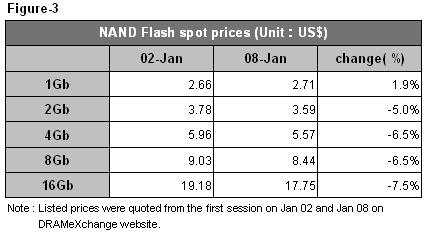
Finally, a comparison of the listed prices from the last session on Jan 2 and Jan 8 shows that except for a slight jump in the 1Gb NAND Flash spot price, the remaining chips all saw a respective drop. Spot prices of the 1Gb chip increased from US$2.66 to US$2.71, a 1.9% climb. For 2Gb, they dropped 5.0% to US$3.59; 4G 6.5% to US$5.57, 8Gb 6.5% to US$8.44 and 16Gb 7.5% to $17.75.

The memory market watcher
DRAMeXchange is a global primary provider of future intelligences, in-depth analysis reports and advisory services on DRAM and Flash memory industry with coverage including current business, spot trading prices, and market trends, capital spending and wafer capacity trends, the impact of DRAM/flash memory products on the market, and other relevant PC industry information.
© DRAMeXchange ® Tech.Inc. All rights reserved.