Year-end Inventory Checking and Communication Disruptions creates sluggish spot market
Inventory checking and communication disruptions caused by an earthquake last week, significantly decreased the Spot market transactions. A Weak Spot Price was reflected by the DXI, where it decreased from 4633 to the 4631 level. As for the DRAM forecast in 2007, game console are expected to be the next driving force of the DRAM industry.
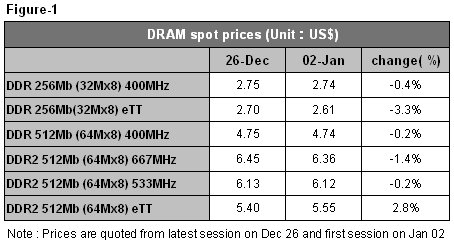
In the Spot Market, as DRAM makers and brokers conducted inventory checking last week, market demand remained sluggish. On the other hand, the 12/27 earthquake near southern Taiwan damaged the undersea cable lines, which disrupted communications in the Asian region. This led to a further decrease in the market transactions. DDR2 667MHz continued to drop to USD6.36. However, amid the New Year holidays, some brokers are expecting an increased Chinese New Year demand, and a tighter DRAM supply during the first week of each month. Speculative market activities thus drove up the DDR2 eTT price. In contrast to the other chip densities, DDR2 eTT showed a stronger growth, where it rose to USD 5.55, a 2.8% increase.
In addition to the strong NB sales during the year end Christmas holidays, the introduction of the next-generation game consoles also played a key role in digesting the DRAM production. This indirectly provided a big boost to the overall DRAM industry. According to relevant market surveys and official news release, the Wii console was the most eye-catching among the 2006 game consoles. After Wii's official release in November, Nintendo has set an official sales target of 4 million units. Data compiled in December already show its worldwide sales topping 2 million units. The PS3, which was introduced roughly at the same time, saw sales reaching only approximately 1 million units. Its high price tag and insufficient supply were key factors that affected the console's sales. Although the XBOX 360 was unveiled in 2005, it was still unable to achieve the 10 million sales target in 2006, as it faced intense competition from other players.
Due to the different specifications and sales price of next generation games consoles, the built-in memory size varies between each other. The XBOX 360 carries the GDDR3 700MHz 512MB, which is the highest memory storage among the three consoles. The PS3 deploys the XDR 3.2GHz 256MB along with the GDDR3 650MHz 256MB. Although the Wii is equipped only with the GDDR3 500MHz 64MB, its relevant low price and novel gaming experience significantly helped boost its sales volume.
The graphic memory of these game consoles are primarily provided by Samsung, Qimonda and Hynix. In order to meet the DRAM demand during the high selling season in Q4, along with the subsequent introduction of new game consoles, DRAM makers were forced to allocate some of their production to graphic memories. According to DRAMeXchange, roughly 3% of the DRAM capacity was used to roll out the built-in memory for game consoles. Coupled by the not-so-smooth supply from the DRAM makers, a tighter DRAM supply was seen in 2H06. Looking into 2007, in addition to Vista, the gaming industry is projected to become an important user of DRAM.
Huge sales of Wii and mid to high end cell phones stabilizes certain NAND Flash spot prices
After Nintendo's Wii console officially hit the North American markets on November 19th, 2006, its sales have continued to skyrocket. Its first batch of shipments to North America, Japan, Europe and so forth were completely sold out in only a few days. According to the official figures of Nintendo, it hopes to achieve a sales target of 4 million units at the end of 2006. By the end of Mar, 2007, it hopes to sell 6 million consoles.
Each Wii console is equipped with 512 MB of NAND Flash, where they are produced via Samsung's 4Gb SLC manufacturing process. In light of Wii's highly successful sales, the supply of this particular NAND Flash chip has grown tighter, which helped maintain its 7.2 USD spot price in Dec, 2006 (Figure 1). From the current soaring Wii sales, Nintendo is expected to ramp up its Wii console production to meet the market's demands. Thus, Samsung's 4Gb SLC Flash chips should remain stable in the near term.

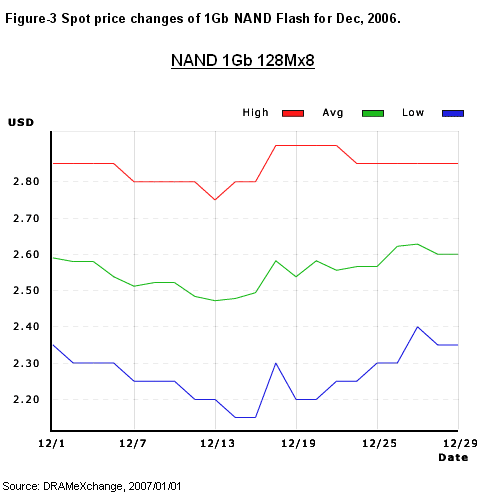
On a different note, based on DRAMeXchange's observations, cell phones equipped with multimedia or 3G functions, continued to see their shipments increase in Q4, 2006. This brought forth a growing demand for 128MB microSD cards. Currently, the mid to high end cell phones that are sold by cell phone manufacturers or downstream retailers are bundled with a 128MB microSD card. As the cards are mostly produced via the single 1Gb NAND Flash chip technology, in contrast to other high capacity chips, the spot prices of the 1Gb are more stable. According to some microSD card manufacturers, the gap in the manufacturing costs between 256 MB microSD and 128 MB microSD has gradually grown smaller. Therefore, it is anticipated that in 1H07, the 256 MB microSD should begin to replace the 128 MB microSD, and become the new mainstream storage capacity of bundled memory cards for the mid to high end cell phones.
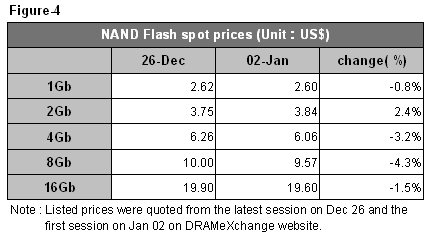
Finally, a comparison of the listed prices from the last session on December 26 with the first session on Jan 2 shows that except for a rebound in the 2Gb NAND Flash spot price, the remaining chips all subsequently saw a slight decline. Spot prices of the 2Gb chip increased from US$3.75 to US$3.84, a 2.4% climb. For 1Gb, they dropped 0.8% to US$2.60; 4G 3.2% to US$6.06, 8Gb 4.3% to US$9.57 and 16Gb 1.5% to $19.60.

The memory market watcher
DRAMeXchange is a global primary provider of future intelligences, in-depth analysis reports and advisory services on DRAM and Flash memory industry with coverage including current business, spot trading prices, and market trends, capital spending and wafer capacity trends, the impact of DRAM/flash memory products on the market, and other relevant PC industry information.
© DRAMeXchange ® Tech.Inc. All rights reserved.