2HNov DRAM contract price trend beats forecast with persistent growth
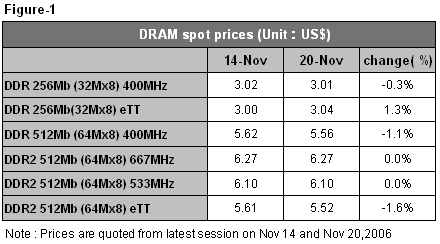
DRAM continues encountering divergent scenarios at different market places last week. Weak demand at the spot market still persists but the solid demand from contract customers brought us a better-than-expected price growth of 2-4% amid strong NB demand from mature markets. DXI only grew by a slight 13 points to 4,480 last week. Since demand for DDR is declining, price of DDR 512Mb was reduced to US$5.56 accordingly. For DDR2, the short-lived price rebound on Nov 14 did not sustain its momentum and resulted in a flat DDR2 prices (on all available frequency) eventually.
Although marketers generally believed DDR2 contract prices would stay flat in 2HNov, the final result shows that the price upside is much stronger than industry players estimated with an average 2-4% sequential growth reported. Price of DDR2 512MB 533MHz DIMM went up by about 2% to US$49.50 while DDR stayed flat as both demand and supply reduced. The main reasons behind the better-than-expected results are: 1, Strong PC demand for upcoming Christmas 2, Some DRAM makers' problematic 90nm transition issue tightens supply 3, Growing demand for DDR2 512MB 667MHz DIMM boosts overall DDR2 prices exceed US$50.
Since PC demand only showed meaningful rebounding sign from Aug this year, most PC OEMs previously delivered conservative forecasts to DRAM makers. When PC OEMs started worrying about Vista may postpone consumption in 4Q06, they again boost their DRAM content per box to 1GB and offer aggressive price cuts for NBs prior to Christmas and successfully spur consumption. On the other hand, supply is not completely fulfilling demand as some DRAM makers whom encountered 90nm transition issue before had prompted their customers seek for additional stocks from others.
Base of the ordering amount from PC OEMs, some DRAM makers noted that they could only fulfill about 70% of the demand. Although some PC OEMs boost DRAM content per box to 1GB has spurred contract prices up in 2HNov, they are concern that the ratio of 1GB system will fail expectation under the current DRAM shortage. Some PC OEMs could only ship their systems with lower frequency DDR2 533MHz DIMM, though demand for the same-spec 667MHz DIMMs is actually climbing.
But the mentioned scenario should be temporal. Long term speaking, DRAMeXchange expects system with 1GB DDR2 memory will rise as mainstream with a ratio surpassing 50% or topping 70% during year-end of 2006 and 1Q07, the traditional slow season for PC shipments.
According to the PC specifications that revealed from the two big US PC giants, most US$800-price NBs are still come with only 512MB of memory but those price over US$800 NBs usually go with 1GB. Although the present quote for 512MB DIMM is as high as US$50, only those NBs that price between US$800-1,000 have slightly exceed the reasonable 10% benchmark of DRAM content per box cost.
Projecting DRAM contract price trend in 1HDec, we see this price upturn is likely to persist as upstream components who grad the very last opportunity to push their stock prior to Christmas may sustain strong demand. Moving into 2007, we still maintain our positive outlook for DRAM prices in 1Q07 as the consumer version Vista should bring stronger memory upgrade demand. DRAM, no matter for contract or spot market, should able to deliver a price trend that beats seasonal pattern on the observed extending penetration of higher memory per system.
microSD- a new source of profitability
NAND Flash demand is now slowing after undergoing the seasonal upturn during Sept and Oct. As chip supply keep coming online from fresh capacity among suppliers, memory card makers are now allocating more capacity for the high-margin microSD card production. Thanks to the solid demand for bundle memory card at handheld applications, the production proportion of mircoSD card had exceeded half among all memory card types with most are ship without brand names.
Handset vendors are now fueling memory cards' demand substantially. Since leading handset vendors including Nokia, Motorola, Samsung and LG all equip their multimedia-orient handsets with microSD card slot, they usually bundle their handsets with 64MB-256MB density of microSD card to encourage sales. As microSD card could only package under COB (chip on board), those backend suppliers, who are capable to offer this packaging services, are becoming more popular on drawing investment from card makers.
DRAMeXchange believes that the extending penetration of multimedia-orient handsets and smartphones will certainly fuel growth of high-density (over 1GB) microSD card demand. Memory card makers should capable to roll out more high-density microSD cards from 2007 when chipmakers' production technology on microSD-specialize MLC NAND Flash mature. Memory card makers will definitely see new source of profitability accordingly.
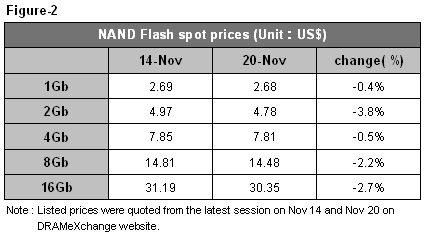
Reviewing the price trend between Nov 14-20, price of 2Gb dropped most at 3.8% to US$4.78. Price drop ranges for both high-density 8Gb and 16Gb were similar at a respective 2.2% and 2.7% while 1Gb and 4Gb were reduced by 0.4% and 0.5% respectively in the same period.

The memory market watcher
DRAMeXchange is a global primary provider of future intelligences, in-depth analysis reports and advisory services on DRAM and Flash memory industry with coverage including current business, spot trading prices, and market trends, capital spending and wafer capacity trends, the impact of DRAM/flash memory products on the market, and other relevant PC industry information.
© DRAMeXchange ® Tech.Inc. All rights reserved.