Although the persistent tight supply of DDR2 continues to boost prices up considerably last week, overall price growth momentum should decline. DRAMeXchange reveals the wave of the robust price trend should persist through Nov.
Amid strong demand, DDR2 still leads the growth on insufficient supply. Some Taiwan DRAM makers have trimmed their supply to the spot market. For the demand side, memory module makers still thirst for DDR2 chips, thus sustaining the overall price growth.
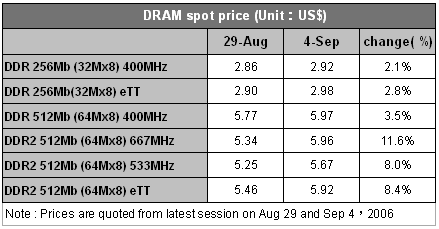
Price of DDR2 512Mb eTT (UTT) shot to US$5.92, and had once surpassed the prices of same-spec. branded chips. The higher frequency 667MHz chips also benefited from the price upside and grew by 11.6% to US$5.97. Price growth of DDR chips was relatively smaller than DDR2. Price of DDR 256Mb eTT (UTT) showed the crossover with branded chip, while the mainstream DDR 512Mb 64Mbx8 400MHz also enjoyed a gain and closed at US$5.97.
DRAM contract price had grown by 3-5% in 1HSep with DDR2 512MB DIMM hitting US$43, according to DRAMeXchange. The tight supply prompted some DRAM makers to reallocate the reserved stocks for the spot market to fulfill contract market's demand. Although the recent price increase of DRAM modules has discouraged PC OEMs on the DRAM content per box (such as not emphasizing the DRAM spec.), shipment proportion of 256MB DIMM should keep reducing due to the growing influence of Vista.?The mainstream DRAM module density will remain at 512MB as the backend production cost for 256MB and 512MB is the same. However, PC OEMs will be reluctant to equip their systems with 1GB density during this price uptick of chip prices.
Blackberry extends presence at Asia
Blackberry, the Canada-based RIM invented portable email device, is now spreading its influence to Asia. Following telecom service carriers from Australia, Hong Kong, Singapore, Taiwan's Chunghwa Telecom (CHT) starts introducing the red-hot gadget to local market in Sep.
With an approximate of five million-subscription base, the innovative "Push Mail" email retrieving technology has drawn peers like 7-Network, InteliySync and Microsoft to tap into respective development of "Push Mail" -like technologies. For RIM itself, it also extends its business scope by authorizing vendors to incorporate "Push Mail" to their devices. Nokia's E series handsets and Sony Ericsson's P990 are the two handset series that are compatible to RIM's Push Mail technology at the moment.
A memory density of 32MB with 4MB SRAM is the lowest memory density benchmark for multimedia handsets nowadays. The past few years' handset development illustrates the rising role of multimedia content at handsets. With the anticipated enhanced functionalities of handsets, the recessing handset shipment growth should obtain a new force to spur growth.
NAND Flash price up across the board; clearer price sign to arrive soon
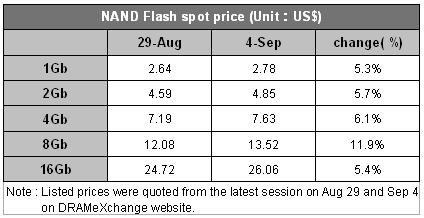
NAND Flash price trend swung upwardly last Thursday (Aug 31) after seeing a stabilization in the price fall, during the last week of Aug. Prices surged with the highest rate on Friday (Sep 1), where they jumped by an average of over 5% across the board, during Aug 29-Sep 4. Prices for 8Gb chips saw the most significant jump, up almost 12% over the period.
DRAMeXchange reveals several factors contributing to the sharp spike of NAND Flash prices:
- There have been rumors in the market indicating that Apple, Sony and Sandisk have begun to buy Nand Flash at a massive scale this month. Coupled by the fact that relevant suppliers have stopped their quotation, Module vendors are afraid overall supply may run short again in 4Q, prompting them to make purchase deals now.
- End-market is heading toward the traditional strong season. Demand is indeed picking up with buyers willing to pay a premium to secure supply. In fact, although pricing was considered weak in July and August, most of the end-product makers suggest demand was in-line with the seasonality.
- Samsung's capacity shift to DRAM and away from SLC capacity begins to take effect. For the past two months, Samsung began to reallocate some of its DRAM/NAND hybrid capacity to DRAM to improve its profitability. The move began to reduce new NAND supply for this month and helped to balance the demand and supply.
It is too early to judge whether the ASP rebound will be sustainable. The picture will be clearer after Samsung and Hynix release their new pricing in the next few days. Another key variable will be the willingness of buyers to accept the new pricing.

The memory market watcher
DRAMeXchange is a global primary provider of future intelligences, in-depth analysis reports and advisory services on DRAM and Flash memory industry with coverage including current business, spot trading prices, and market trends, capital spending and wafer capacity trends, the impact of DRAM/flash memory products on the market, and other relevant PC industry information.
© DRAMeXchange ® Tech.Inc. All rights reserved.