DDR2 price up momentum weakened but drop range sustained by seasonality
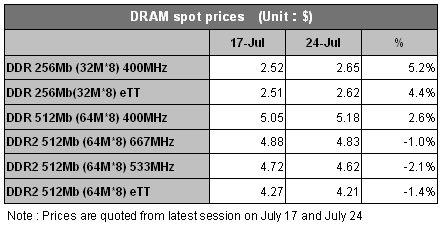
Spot prices of DDR and DDR2 trended divergently last week with DDR trended upward while DDR2 headed south. Supply insufficiency of DDR sustains the price upward momentum but distributors' DDR2 stock release pressured DDR2 pricing.
The continual technology transition to 90nm reduces supply of 256Mb DDR currently and prolongs the price upward trend. However, DRAMeXchange expects the ease of Intel's 865 chipset should edge out DDR as mainstream memory in 4Q, thus weakening the present price fluctuation.
For DDR2, spot prices that were once rocket to new highs amid PSC's previous price adjustment of eTT chips finally recessed as distributors start releasing stocks after making considerable profits. The growth of supply thus drags overall prices down last week. As we already observed growing tight supply signs at the DDR2 contract market, the setback of pricing should be limited though.
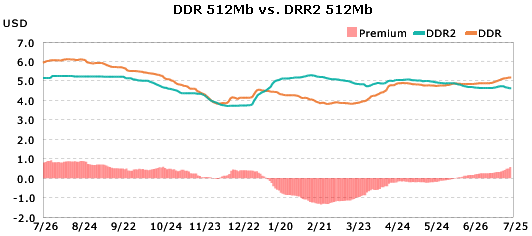
Prices of DDR 512MB 64Mbx8 gained by 2.6% sequentially at US$5.18 and was set much higher than the same-density DDR2's US$4.83 (533MHz) or US$4.62 (667MHz). Both 256Mb DDR branded and eTT (UTT) chips enjoyed price gains and closed at US$2.65 and US$2.62 respectively.?Spot price of DDR2 512Mb reduced by a slight 2.1% to US$4.62 while the same-spec. eTT (UTT) dropped lesser and closed at US$4.21.
2HJul DRAM contract price update: DRAM grew across the board
The negotiation of DRAM contract prices in 2HJul was smooth as PC OEMs were cooperative in price settling and did not resist much regarding the limited price adjustment. Prices of DDR 512MB DIMM were able to maintain the price growth momentum amid the continual demand and supply recession and resulted in price premium over the same density DDR2 at both spot and contract market. DDR2 512MB 533MHz gained by 2.33%, or US$1, while the higher frequency 667MHz only kept flat. The flattish DDR2 512MB 667MHz quotes reflected the narrowing down price difference with 533MHz. DDR2 1GB 667MHz was also quoted flat at the meantime.
Tracking the contract prices negotiation in 1HJul, DRAM makers insisted to hold their quotes flat or just willing to accept 3% range of drop though most PC OEMs were aggressively lobbying for a 5-8% price reduction. The entire price negotiation prolonged amid the Independence Day at US. Some chipmakers had to cut their DDR2 512MB 533MHz DIMM prices by 2-3% and able to kept DDR DIMM prices to grow at the same rate. Noted that the settled US$38 price tag for DDR2 512MB 533MHz in 2HJun was just the special offers for limited customers, the official quote thus able to close flat at US$38 while some DRAM makers did reduce their prices by US$1 to US$39 and some others managed to propose a slight raise.
Clear NAND Flash price trend only to arrive in August
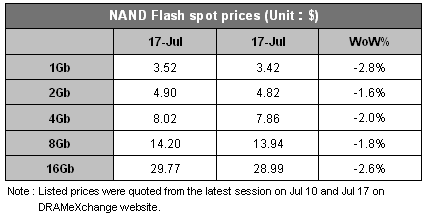
The current NAND Flash market is still managed to sustain the warming up demand but overall environment is still mist under uncertainties. Transaction volume of all density NAND Flash obviously trending upward but DRAMeXchange projects clear price indication will only emerge in August.
The mentioned tepid demand persisted last week with overall prices kept correcting to lower prices. Sequential price fall was kept at the range of 2-3% with 4Gb part able to counter price fall pressure most.
DRAMeXchange observes that demand has been warming up from July in compare with previous month's sluggish transaction. Transaction volume is obviously trending upward, though the entire environment could hardly compare with previous year.
Although Samsung had raised its quotes in 1HJul with rival Hynix soon follow in 2HJul, the actual transaction deal was mostly traded lower prices than the quotes set as most buyers anticipate prices will drop further by late July. Overall demand environment is still constrain under the cautious outlook.
We believe the price trend of NAND Flash will only grow clear in Aug amid the anticipated stop of continuous price fall. Despite most marketers expect the high-density MP3 players from big names like Apple, SanDisk, Microsoft and Sony that about to roll out in 3Q will spur demand, the actual demand for memory card does not hint any meaningful price rebounding sign with demand staying at standard level only.
Apple outshines both AMD and Intel in 2Q performance
Both of the CPU giants, Intel and AMD, reported sluggish performance in 2Q06 prior to the anticipated benefits that may bring amid the aggressive price adjustment to a comprehensive product lineup. Apple, which has long been distancing itself from the mass, outshined competitors with satisfactory sales and also delivered a relatively bullish outlook.
AMD announced that its 2Q revenues dropped by 3.5% YoY and 9% QoQ in 2Q06 at US$1.2bn, reflecting the market share drainage and margins setback that driven by the price cut competition by rival Intel. Except for the relatively satisfactory sales from server-use Opteron, sales for entry-level to mainstream CPU lineups for both notebook (NB) and desktop (DT) PCs both slipped.
Intel also reported a poor quarter as rival AMD. The chip giant reports its 2Q revenues dropped by 13% YoY and 10% QoQ in the same period at US$8bn along with the enlarged 60% YoY slash in operation margins (at US$1.1bn) than the previous quarter.
Despite reporting a YoY 3% sales growth in Japan, Intel reports its sales dropped most at Europe (24%) with Asia Pacific (14%) and North and South America (8%) followed. The complete CPU lineup sales suffered decline with DT and enterprise-use CPU reduced by 28% while NB and portable solutions 5%.
Projecting its 3Q outlook, Intel is conservative that its quarterly revenues should only grow slightly to US$8.3-8.9bn with margins stay at 49?%. The chip giant reported revenues of US$9.96bn with margins of 59.7% in the same period of last year.
Apple, on the contrary, outshines competitors with a YoY sales growth of 24% (at US$4.37bn) and net profit growth of 48% (at US$472mn), despite its revenues stay flat sequentially. Macintosh-series PC and iPod drove strongest YoY sales growth with a respective rate of 12% and 32%. The company projects its 3Q outlook should able to sustain the growth momentum with an anticipated 22-25% YoY growth at US$4.5-4.6bn.
Apple sold a total of 1.33mn of Macintosh PCs and 8.11mn iPod in 2Q06. Of the over million PCs shipped, 75% were built on the Intel platform, according to company CEO Steve Jobs. Notebook PCs accounted for the majority of Macintosh PCs shipment and the sales and shipment amount of Macintosh NBs both jumped by 61% YoY at the expense of 23% drop in DT PCs shipment amount and 17% drop in sales in the same period.

The memory market watcher
DRAMeXchange is a global primary provider of future intelligences, in-depth analysis reports and advisory services on DRAM and Flash memory industry with coverage including current business, spot trading prices, and market trends, capital spending and wafer capacity trends, the impact of DRAM/flash memory products on the market, and other relevant PC industry information.
© DRAMeXchange ® Tech.Inc. All rights reserved.