Supply-demand seesaw reflects on recent DRAM spot price trends
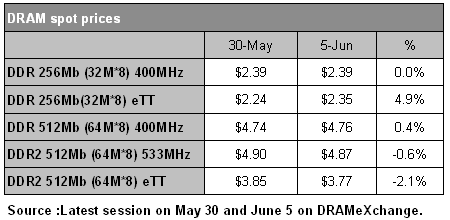
Last week, DDR chips was the hot commodity in the spot market during May 30-Jun 6 as suppliers continue to convert capacity to DDR2 worry marketers for potential supply drop. Prices for the DDR 256Mb 32Mbx8 400MHz held flat at US$2.39, with the 64Mbx8 specification up 0.6%. eTT (UTT) prices surged from US$2.24 to US$2.35 as PSC decided to hold back shipment. DXI was dropped from 3,337 to 3,333 on DDR2 weakness.
DDR2 spot prices dropped across the board last week without any significant demand revamp weak pricing. DDR2 512Mb 64Mbx8 533MHz dropped from US$4.90 to US$4.87, with the 64Mbx8 specification N.M.B down to US$3.77. Supply increased as PSC begins offering eTT DDR2 as we mentioned last week
DDR2 contract price to go down near 3% - 5% in 1H June; DDR remains strong
Contract prices for DDR modules should stay flat or slightly up on tight supply in 1HJune while quotes for DDR2 modules show weakening signs although final deal settlement is still under negotiation. DRAMeXchange expects DDR2 should still reduce by 3-5% on easing supply.
The previous tight DDR2 supply which annoyed PC OEMs was due to the mentioned production problem at a leading player in April. Although prices remained strong on tight supply, we see easing signs from late May, alongside with the supply boost among makers from PSC's Fab 12B, ProMOS' Fab 3 and the new capacity that contributed by the recent transition from Hynix's Fab M10 (China).
NAND Flash enjoy tepid demand growth in minimal range
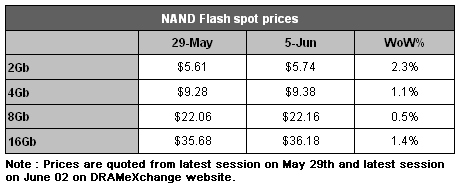
NAND Flash spot prices gained slightly last week. Overall speaking, prices for 2Gb and 16Gb chips led growth with an over 1pp on a weekly basis while prices for 4Gb and 8Gb bits also edged up slightly. Buyers were more active last week as they typically did at the end of every month and the Dragon Boat Festival (May 31) in some Asia regions also contributed to the active transaction. However, decreased supply was the main driver to the price gains, rather than an industry-wide demand warm-up.
Demand for the 16Gb chips were better on Monday (May 29) due to the steep price drop in the third week of May. However, trading volume over the entire week was slow as traders anticipated more price cuts. In contrast, prices for the 2Gb chips began to increase in the afternoon of last Monday prior to the Dragon Boat Festival.
Prices for Hynix-made chips were relatively stable amid steady supply while Samsung's 4Gb chips had a mild gain after the Dragon Boat Festival because of slight supply drop.
Most suppliers raised their prices as supply remained tight in the spot market. Prices of most products went up last week with the exception of 1Gb chips. Trading was more active than the third week of May.
The gain in spot price was a surprise to most market participants. General expectation for last week was that prices would drop as they typically do at the end of every month.
Intel delivers aggressive price reduction plans to secure market share
Intel is taking aggressive measures to fend off AMD. The chip giant announced to cancel all rebates offered to the world's desktop (DT) PC companiess in late May and will also cut DT CPUs prices by as much as 60% from late July in order to prevent any customer-drainage. With these moves, Intel has two goals in mind: market share gains in both DT and NB segments, and also accelerate the NB replacement.
Intel at the same time will roll out Core2Duo in August, hoping Duo2Core will be the mainstream CPU line for notebooks (NBs). Intel will also cut three models of Core Duo (Napa) NB-use CPU prices by as much as 33.6% prior to the reduction of DT CPUs.
PC makers, however, are suffering from Intel's aggressive measures. For example, Europe's NB sales were dismal in May and NB suppliers are lowering 2Q06 shipment targets because of the excessive inventory. PC makers are also slashing old-generation NB prices. Excessive inventory, as the result of platform transition and seasonal weakness, so far remains as NB suppliers' biggest pain.
AMD to extend strong roles at business applications market
AMD rolled out three new platforms aimed at business users at a recent technology briefing for analysts.
Marty Seyer, senior vice president of the commercial business segment for AMD, said the platforms will focus on adding coprocessors with the Opteron (the server CPU lineup) to tightly coupled security, virtualization and management for servers and DTs and as a virtual desktop model. These platforms follow the AMD Live!, which was announced earlier this year for the consumer market.
A platform code-named Torrenza will allow system builders and OEMs to use AMD's fast hyptertransport (HT) link or an empty socket in a dual or multi-socket motherboard to pair the Opteron with coprocessors that will boost specific computing functions.
The Trinity platform is fashioned for security, virtualization and management. AMD will be putting an open management partition that is extensible for partners "in part of the core of DDR2" memory in next-generation processors. AMD will pair that with its virtualization technology and its security plans, code-named Pacifica.
AMD's third new platform, code-named Raiden, is focused on a "virtual desktop" environment where much of the capabilities are delivered to a client device from a server or blade system.
Seye said that AMD feels so confident about its momentum in the server space it is increasing its 2006 year end goal to 30% from 20%. At the end of the first quarter, AMD held 25.7% of the U.S. server market and 15.3% of the worldwide server market, according to Gartner Dataquest.

The memory market watcher
DRAMeXchange is a global primary provider of future intelligences, in-depth analysis reports and advisory services on DRAM and Flash memory industry with coverage including current business, spot trading prices, and market trends, capital spending and wafer capacity trends, the impact of DRAM/flash memory products on the market, and other relevant PC industry information.
© DRAMeXchange ® Tech.Inc. All rights reserved.