DDR prices stable on insufficient supply concern, growth of DDR2 chips not gaining positive feedback
The drop of DXI (from 3,343 to 3,338) in the week May 22-29 reflects the DRAM price downside pressure at the spot market with only eTT (UTT) chips managed to resist drop.
Price of eTT (uTT) DDR is the only mainstream DRAM chip that enjoyed sequential growth last week amid PSC's reluctance to release stocks at the spot market. The concern of potential supply drop thus boosted prices to rebound to US$2.24. Prices of DDR were stable on the observed demand from China on May 26, though the volume requested was minimal. Prices of DDR 256Mb 32Mbx8 400MHz slipped by 0.4% and closed on US$2.39 while the high-density DDR down 0.6% and closed up US$4.74.
DRAMeXchange observes that PSC starts releasing eTT (UTT) DDR2 chips to the spot market but the demand did not catch up with the supply growth on accumulated inventory at memory module houses. Prices of DDR2 512Mb 64Mbx8 533MHz lost by 1.4% to US$4.90 while price of same specification N.M.B DDR2 chips dropped by 0.5% to US$3.85.

DRAM prices to stay flat or drop slightly in 1HJun
The lack of DDR modules boosted contract prices of some 256MB DIMM grew to US$19.50-21 from US$18.50-20.50 while most were boosted to US$20.20 from US$19.50 in 2HMay. Prices of DDR2 512MB DIMMs, however, were dropped to US$42-47 from the previous US$44-49 in the same period.
As the price growth of DDR modules lagged behind DDR2's in a considerable range, the price growth of DDR still made the average prices quoted below DDR2's.
Marketers are generally attributing the strong DDR demand to the relatively high shipment proportion of Intel's DDR-supported 865-series chipsets. DRAMeXchange anticipates that this wave of DDR uptick should eliminate from July as motherboard makers had already hinted that inventory of 865-series chipsets will be fully digested in late June and the mainstream demand should convert to DDR2 accordingly. We believe DDR's application will shift from PC to handheld applications and low power SDRAM.
Projecting DRAM contract price outlook in 1HJun, marketers are still vary in their outlooks. Some are predicting that prices of DDR2 should slip by 5-10% on the relief of supply. DRAM makers, on the contrary, believe demand will pick up amid system makers' pre stock preparation in June. DRAMeXchange expects overall price drop should be limited in 1HJun and prices may have chances to stay flat sequentially. The upcoming price negotiation should be tough between buyers and sellers with negotiation period may even extend.
Weak demand lulls NAND Flash transaction, solid demand firms 2Gb price
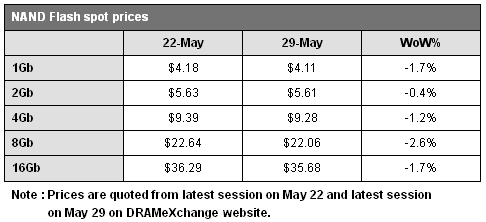
The seasonal demand downturn for consumer electronics lulls NAND Flash transaction in the week May 22-29 with demand from makers kept trifling, especially when they are facing the month-end financial pressures. Marketers who hold inventory on hand were forced to release these stocks at the market. DRAMeXchange observes that only 2Gb parts were capable to resist the price fall with slight sequential drop but 16Gb suffered the largest drop.
Average prices of all major density (1Gb to 16Gb) all trended downward on May 22 amid weak demand from end product makers. Buyers who continued to suppress quotes, further disappointed sellers and failed deals. DRAMeXchange only observes limited transaction volume last week. Prices for 2Gb parts, however, rebounded on May 26 and backed to May 22's level amid persisted shortage. Demand for 2Gb parts is still above general demand, thus, holding related prices firmer.
Prices of 16Gb dropped most among all density last week and we believe this reflects the price pressure that posts by Samsung on the newly introduced K9WAG08U1A item at the spot market. Since marketers are still unfamiliar with its quality and reliability, the lower quotes than the previous generation (K9WAG08U1M) pressures on overall pricing for 16Gb parts. The relatively lower demand for 16Gb is also another main reason for the largest price drop in compare with other density parts.
Lenovo - stiff challenges ahead on unsatisfactory financial performance
Price competition erodes Lenovo's revenues and profits.
Despite the strong revenues growth in FY 4Q05, China-based PC maker Lenovo encountered profit setback amid the vicious price competition in the US, said company executives on last Thursday during its investors conference.
Lenovo reported sales of US$3.1bn in 1Q06 and a loss of US$116mn prior the one-year establishment of its PC unit consolidation by acquiring IBM's PC unit. Tracing back the company's performance in the same period last year, Lenovo reported sales of US$607mn and profit of US$21mn.
Yang Yuanqing, company director, noted that Lenovo accounted its fiscal year financial results ahead of schedule for the preparation of the IBM deal. The company also announced the appointment of William Amelio to replace Stephen Ward as CEO of the Lenovo Group.
Amelio joined Lenovo from Dell. where since 2001 he served as senior vice president, Asia-Pacific and Japan.Lenovo adopts the "dual-business" mode at domestic and foreign markets in order to extend its share. The company will stress the “partnership” with large-scale enterprises but focus on deploying the markets for small- to mid-range companies at overseas regions. Leneovo will mainly bear the role as a system supplier, rather than a complete service provider for these targeted customers as these customers do not value after-sell service as much as large-scale enterprises.
IBM to distant its relation with LenovoLenovo announced on May 29 that it would revise the deal that it settled with IBM regarding the transfer of IBM's PC unit that inked in 2004.
Under the new settlement, IBM could release as much as two-third of its Lenovo shares that were previously abandon to transfer from May 25. IBM is also free to transfer its entire stake at Lenovo from November 1, 2007.
Before the revision, IBM could release one-third of its stake at Lenovo from May 1 2006 (one year after the deal settlement) and the remainder stake could be released from May 1 2007. The final lot is allowed from May 1 2008.
IBM hold 932mn shares and another 375mn shares (without voting power) at Lenovo through May 25 2006 and this total stake are under transfer/release to third party regulation.
The speculation about IBM's aim to distant from Lenovo had been circulated at the market for a while. Lenovo announced to purchase back the 18.5% stake (or 436 shares, worth HK$1.19bn) that IBM released. The stake of IBM at Lenovo thus decreased to 13.4% from the previous 18.9%.

The memory market watcher
DRAMeXchange is a global primary provider of future intelligences, in-depth analysis reports and advisory services on DRAM and Flash memory industry with coverage including current business, spot trading prices, and market trends, capital spending and wafer capacity trends, the impact of DRAM/flash memory products on the market, and other relevant PC industry information.
© DRAMeXchange ® Tech.Inc. All rights reserved.