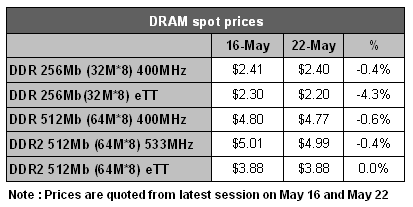
No major transaction shore up DRAM spot prices last week and the overall market is notionally quiet. DXI only grew by 19 points to 3,344.
For DDR, eTT (uTT) chips suffered larger loss than others with prices pulled back to the US$2.20 level from last week's US$2.30. The same-specification DDR 256Mb 32Mbx8 400MHz and 512Mb were decreased by a respective of 0.4% and 0.6% and closed at US$2.40 and US$4.77. As PSC had informed customers that it would continue trimming down its DDR output, and motherboard makers post bullish outlook about DDR demand through July, DRAMeXchange observes that marketers are cautious to control their released stock. The strength of downside price risk should be limited.
DDR2, though managed with limited price fluctuation, overall demand is still weak. Prices of DDR2 512Mb 64Mbx8 533MHz dropped slightly to US$4.99 while the same-specification N.M.B chips maintained at US$3.88. We observe that AMD has started releasing its latest DDR2 800MHz-supported CPU and this should stimulate some performance users to upgrade their platforms and spur DDR2 demand to a certain level.
2H May Contract prices :DDR continues gain, DDR2 reports slight drop
Generally speaking, memory makers succeeded to raise DDR quotes further in 2HMay as DDR modules supply are still in short. Most DDR 256MB modules were traded at the US$19.50-20.50 range with limited chipmakers able to push prices to the US$21 range. PC OEMs generally agree that supply for DDR modules is insufficient in May but wouldn't agree the raised % by DRAM makers, thus making the whole negotiation more tough.
For DDR2, although some DRAM makers budged to lower their quotes under the strong request for price reduction for memory modules, overall supply is still tight. We observe that under this industry-wide tight supply, supply situation does show some progress. Our checking show that the "high-range" DDR2 prices show obvious drop while only limited chipmakers offer DDR2 in the "low-range" price levels. The drop rate of "average" is far lower than these two ranges and closed at US$43.50-45.
DRAM makers generally anticipate the present tight supply to persist prices to stay at strong levels amid the upcoming seasonality upturn. DRAMeXchange foresees that DRAM makers should able to enjoy profits in 2006 with margins staying at 20-30% range on production advancement. The ramping up output from 90nm process and 12-inch fabs should help shrinking cost further. The future price trend should reflect demand and the impact over production costs among chipmakers.
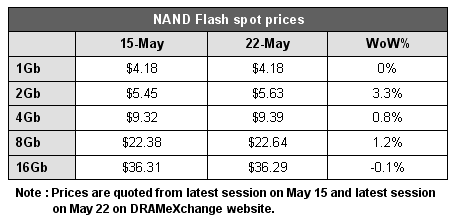
2Gb NAND Flash continues leading price upThe trough at NAND Flash spot market persisted as Samsung and Hynix that both announced the price raise last week, as well as the obvious drop in NAND supply at spot market, had jointly constrain overall transaction.
Supply of 2Gb is still in severe shortage, thus boosting the price to grow by an average of 3.3% last week. We observe that spot price of 2Gb were once shoot to US$5.95 on May 18, up by over 6% from May 16's US$5.60. NAND in other densities all enjoyed growth before May 18 in limited rates with price of 16Gb slipped from May 18 and remained static at US$36.29 since then.
Sources suggested three main reasons for the shortage of 2Gb parts: 1, Toshiba stops supplying 2Gb NAND to its customers from April, thus boosting demand up at the spot market. 2, Samsung transits its capacity to 4Gb and above density MLC NAND and led to overall SLC-made 2Gb NAND output reduced by two-third. 3, Many digital cameras and mobile phones vendors increase the bundle memory card density from 128MB to 256MB and grows demand for 2Gb chips.
Prices for other densities NAND were relatively stable along with the listless transaction. Since most customers attain their booked stocks from the contract market, they are not urgent to source for stocks from the stock market.
Microsoft vows to develop emerging market potential; preps new OS to boost PC transition
Microsoft and Lenovo introduces pre-paid PC purchase program from emerging markets
Microsoft partners with Lenovo on the introduction of a PC deposit program for emerging markets recently. Under this program, consumers only have to pre paid a deposit for their PCs and pay the remaining amount via a so-called "pre-paid card". This kind of paying program is similar to the pre-paid telephone card of handsets.
Under this innovative paying program, consumers will find their consumption barrier lower and the program is suitable for consumers that are unable to pay the amount in lump sum or with lower income. Microsoft and Lenovo had already introduced this program in Brazil and will launch the program in China, Brazil and Mexico, etc.
Microsoft budgets 250mn RMB to grow software development at China
Steve Ballmer, the CEO of Microsoft, had recently inked the letter of intent with China's CCID, promising to invest a total of 250 million RMB at China on software development. Sources suggested that Microsoft would mainly utilize this budget fund to educate software developers: recruiting a thousand of software lecturers, 20,000 engineers and another 50,000 of present software workforce. Under this letter of intent, Ballmer also promised that Microsoft will help offering consulting services and training for three CCID-chosen enterprises.
System makers concern about "Vista-ready" systems
In light of the anticipated launch of new Windows Vista in late 2006, Microsoft unveils the details of required hardwares: CPU 800MHz, 512MB memory, 20GB HDD, CD-ROM. Noted that the announced hardware specifications will only support the core features that Vista offers but not the high-resolution 3D Aero user interface. A system that is capable to deliver complete Vista performance, however, must equips with the listed components: CPU 1GHz, 128MB graphics memory, 1GB memory, 40GB HDD and DVD-ROM.
Some system makers comment that the difference of hardware will result in difference of Vista performance and they are concern about the deployment as it is difficult to standardize a "Vista-ready" system.

The memory market watcher
DRAMeXchange is a global primary provider of future intelligences, in-depth analysis reports and advisory services on DRAM and Flash memory industry with coverage including current business, spot trading prices, and market trends, capital spending and wafer capacity trends, the impact of DRAM/flash memory products on the market, and other relevant PC industry information.
© DRAMeXchange ® Tech.Inc. All rights reserved.