The acceleration of DDR consumption among downstream players amid the reduced supply, as well as the stable demand for DDR, boosted DDR spot prices with related sequential growth at spot market larger than contract's. As mentioned in our previous reports, DRAMeXchange sees chipmakers transit their DDR capacity to DDR2 in 1Q06. The drop of supply thus stimulated downstream players to speed up their procurement pace under the concern of insufficient stocks.
DDR supply shows tightening signs currently and this result in the growth of non-branded chip prices that edge to levels of branded chips. Supply of DDR2, however, is now outpacing demand and results in a larger difference between branded and non-branded chip prices.
The upbeat of DDR spot prices continued to boost DXI trended up by 0.68% (or 21 pt) to 3,099 in the week Apr11-18.
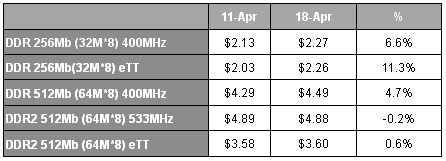
Spot price of DDR 256Mb 32Mbx8 400MHz grew by 2.7% WoW at US$2.26 while price of high-density DDR 512Mb 32Mbx8 400MHz up 3% to US$4.46. DDR 256Mb eTT (uTT) chip gained by US$0.24 at US$2.25 and highlights the narrowing down price difference with branded chips.
DDR2 512Mb 64Mbx8 533MHz price dropped slightly to US$4.87 from US$4.89 while the same-specification non-branded chips were quoted at US$3.57 - a US$1.3 price gap here between branded.
DRAM contract prices are likely to stay flat through May, thanks to solid DDR demand and the temporal setback in DDR shipment.
The buoyant DRAM contract prices persisted through the complete 1Q06 and DRAM prices were still managed to keep flat in 1HApr, versus the initial expected downside trend among marketers.
Spot prices of DDR kept trending upward from late Mar on the dominant power that DDR enjoys at spot market and the drop of supply on the mentioned capacity transition.
Marketers added in saying that supply of DDR at the spot market is reduced as those DRAM makers who mainly ship their chips drop their supply amid the mentioned transition on DDR2 production.
Sources also suggested that the setback in DRAM shipment is also due to the production issue that a leading chipmaker encountered. This maker found yields decline upon a certain step that they found production issue.
DRAMeXchange sees the impediment to output should persist during late Mar to Apr with more significant impacts expected in Apr. Overall output should improve in May.
Some others are also observing that DRAM makers are landing more orders from OEMs in Apr, signifying the persisted tight supply. Some makers are even bullish in saying that DRAM contract prices should stay flat through May.
NAND Flash spot prices stabilize, price premium emerges again
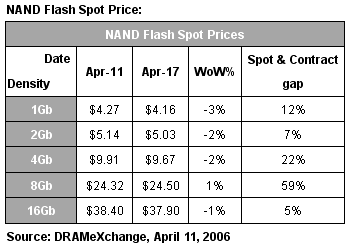
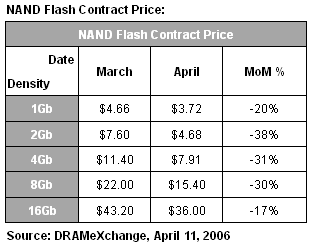
Although April NAND Flash contract prices show a 17-38% MoM drop amid the quarter-end sales pressures, the current spot market shows a more stabilizing price trend. DRAMeXchange observes that NAND spot prices are finally outstripping contract quotes with a price premium of 5-59%- a price difference that had been absence from the markets for a quarter's time. We believe this price difference is mainly driven by the stronger demand and limited component inventory at downstream players.
NAND contract prices report a max. MoM drop of 38% on 2Gb in line with persisted downside price trend. The weak demand and bountiful supply during late 1Q06 had jointly pushed suppliers to lower their prices further in late Mar. We see 2Gb NAND as the part that suffered from the hardest drop as the mainstream density at retail market has already migrated to 4Gb and above. Prices of 4Gb and 8Gb, which had both reported sequential drop of over 30%, reflect the severe price competition amid the improved yields on 70nm-made SLC (Single Level Cell) chips and growth of 90nm-made MLC (Multi Level Cell) output. (Note, DRAMeXchange publishes contract prices on every 17th of the month is the real time quotes that compiled from the 18th of the prior month to the 17th of the listed month.
Spot price trend stabilizes and shows a price premium against Apr contract prices on stronger demand and limited downstream inventory. Spot prices of NAND Flash only report a mere 1-3% drop in the week Apr11-17 with 8Gb part even reports a gain of 1%. Stronger demand is observed from China and Japan amid the upcoming long holiday during late Apr to early May. Demand for NAND is picking up on the anticipated growth of UFD (USB Flash Drive), MP3P and memory cards. In order to meet customers' request on prompt delivery, suppliers are pre-stocking their finished goods. Overall transaction was boosted as inventory among downstream players are limited.
PC market watch: China government shows healthy signs on official softwares adoption, Lenovo fills US retailer market with new ingredients
China government officially announced that all government agencies are forbidden to adopt any PC that is not equip with official softwares from April 13, according to announcement made by the National Copyright Administration of China on April 13. Under the new policy, any domestically produced or imported PCs must embedded with official OS before sale. Any systems without pre-install official OS will be banned for sale in Beijing.
The new act of the regional government highlights that China government values much about the proper adoption of softwares among government agencies. In addition to spread the proper concept among government agencies, Beijing government also decides to investigate any illegal softwares installation of softwares among domestic/foreign enterprises, either state own or non state own from late April.
Beijing is the first regional government that deploys these new measures on tracking proper use of softwares and these measures are expected to spread to other level-one regional governments from 2H06.
Lenovo partners with Best Buy on Lenovo 3000 sales
Ever started introducing the low-priced Lenovo 3000 series PC during late Feb06, this series of PC is now available for sale at US market by partnering with Best Buy. The China-based PC giant aims to push sales of Lenovo 3000 via Best Buy in order to conquer potential demand for those enterprises that house less than 20 personnel.
Although marketing PCs through Best Buy could help Lenovo to reach those smaller scales of enterprises from various regions, the partnership still fills with the listed potential risks -
1, Products are overlap/contradiction between retail and commercial-branded products. Most PCs available at Best Buy are target for general consumers, but the competitive price that Lenovo offers may spur competition with the current available PCs at Best Buy, disregard Lenovo positions itself for the business market.
2. Competition between Best Buy and VAR. Lenovo 3000 offers VAR, the original reseller program of IBM, with more competitive-edge products but may also steal customers from VAR potentially.

The memory market watcher
DRAMeXchange is a global primary provider of future intelligences, in-depth analysis reports and advisory services on DRAM and Flash memory industry with coverage including current business, spot trading prices, and market trends, capital spending and wafer capacity trends, the impact of DRAM/flash memory products on the market, and other relevant PC industry information.
© DRAMeXchange ® Tech.Inc. All rights reserved.