DDR2 exposes under enlarged price fall risk
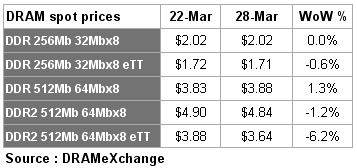
According to DRAMeXchange, Cyclical downturn on PC demand prolonged the trough of DRAM spot pricings. Over the week Mar21-27, DDR continued managing to have a stronger counter power over price drops than DDR2. The relatively strong DDR price trend should persist in expense of the anticipated enlarged price drop of DDR2 over the coming weeks.
Price of DDR 512Mb 64Mbx8 400MHz grew by a slight US$0.04 to US$3.87, reflecting the solid demand for high-density chips from module makers. DDR 256Mb 32Mbx8 400MHz stayed flat at US$2.02-2.03 while the same specification uTT(eTT) chips also stabilized at US$1.71-1.72. Industry players estimated that the price fall of uTT(eTT) chips should be limited in the future despite the upcoming slow season demand.
Prices of DDR2 remained weak last week with non-major-brand (NMB)512Mb 64Mbx8 533Mhz DDR2 leading the price drops at 6.18% to US$3.64. The same specification branded DDR2 chips also dropped by 1.8% to US$4.84.
Although the price difference between the same-density 512Mb DDR 64Mbx8 400MHz and DDR2 64Mbx8 still stays at 25% on limited transaction volume of the later chips, DRAMeXchange foresees that the price difference will narrow down over the coming weeks with DDR2 exposing to larger price drop pressures.
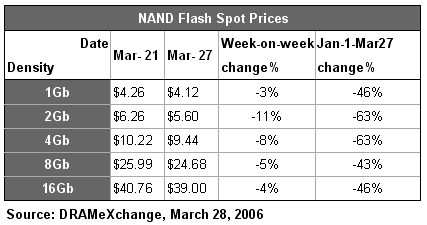
Spot prices of NAND Flash edged down further in the last week of March amid the quarterly financial pressures. The over 50% average price slump of NAND through year to date has spurred bundling demand from consumer electronics (memory cards, USB Flash drive, MP3P, etc.) and gift market.
DRAMeXchange indicates that 2Gb and 4Gb are the two density of chips that encountered the bleakest price falls and the prices of these two chips had nose dived by an average of 63% while other densities chips had also plummet by a minimum of 43%. The deteriorating price dips are now come along with the overage of these two parts. The over 50% price drops through year to date interprets that consumers spending the same quantity of budget could now enjoy a double growth of NAND density in compare with early this year. A consumer whom bought a 2Gb part in Jan could have now gets a 4Gb instead with the same amount of money.
On top of the considerable overage of the mentioned parts, DRAMeXchange also observes the production transition for these two densities' chips production on 90nm, 70nm and 60nm processes. DRAMeXchange notices that some new comers start producing 4Gb on MLC architecture. With the multiple choices on available 2Gb and 4Gb parts, required time for customer qualifications takes longer. Under this concern, some producers only subscribe some of their products for validation, which in turns limit these goods' applications and drag prices drop further.
For the week Mar21-27, price falls of 1Gb, 8Gb and 16Gb showed minimizing dropping signs at a drop range of 3-5% only on normalizing market equilibrium. Demand for these parts were mostly came from the bundling demand from consumer electronics and gift markets with mainstream density stays at 128MB(1Gb). Memory density at retail market is now migrating to 1GB(8Gb) and above.
Moving ahead to 2Q, DRAMeXchange is still doubtful about any price rebound under the current technology advancement trend. Unless any killer application appears and digest the rapid growing NAND capacity, prices should still place under shadows.
Kevin Rollins, CEO of Dell, admitted that the company's revenues setback in 2Q and 3Q of 2005 was a reflection of the failure of pricing strategies, rather than the direct-sales mode that the company has long established. DRAMeXchange believes that the PC giant did make its fatal mistake in attempt to swing its first revenues setback. When Dell discovered that the sales of low-priced PCs trended revenues opposite to what it estimated in 2Q, it shifted its focus on high-end models in the following quarter. However, the positive impact on this shift was minimal due to the relative limited market size of high-end PCs market, for this reason, it unable to prevent the problem that revenues setback continuously.
In line with the retarded revenues of Dell, the 60-70% sales growth of Acer PCs at China has shaken the confidence to Dell's direct sales mode. Tracking the history of Dell, its solid foothold that established throughout the past two decades is built on its success establishment of direct-sales mode. The six worldwide assembling plants, as well as the consideration of another assembling plant at Xiamen China, prove that Dell still hold confidence to its sales mode.
Although Dell pulled its revenues back on positive track in 4Q05, it still trimmed down its 1Q06 revenues forecast to 6-9% – the first time that posted quarterly revenues growth to single digit. DRAMeXchange believes there are two major reasons behind this conservative revenues forecast: 1, Dell places its focus on emerging markets deployment in 1Q06 like the establishment of a logisics center at Malaysia in Jan06. As shipment concentrated on low-priced models, the associated growth momentum to revenues should be limited. 2, The entire market for mid-range and high-end PCs are temporary put on hold as consumers are mostly await for the anticipated price cuts of Intel's dual-core CPU platforms.
Dell requests "discount" to preserve margins
In order to cope with the negative impacts from slowing-down revenues growth, Dell is reportedly requesting its OEM partners to pay 3% of their revenues in order to win the contract orders for 2007. Although the contract orders for 2007 had been settled, the delay Intel's new Centrino Santa Rosa to May 07 had prompted Dell to reshuffle its product deployment, thus offering it the bargaining power to negotiate with its OEMs.
DRAMeXchange regards the direct sales business model and the price negotiating room from barebones are the two major factors that grant Dell the power to negotiate a more price-competitive deal.
Dell, that has long been benefit with low cost from its direct sales mode, offers more flexible price negotiation room with OEMs in the past. However, as low-priced PCs are now growing its significance at the overall PC market, the shrink of margins has prompted Dell to seek for solutions to maintain its margins to a certain level.
In addition to margin concern, PC OEMs that enjoy relative flexible margins also allows Dell to voice out the request. Since most PCs are order in barebones without key components and OEM source components from their associated partners, these OEMs could have enjoyed a relatively higher margin than shipping "complete-system". Dell observes this flexible margins room that PC OEMs could have enjoyed and seek for "contribution" accordingly.
Although the "discount" negotiation is not settled yet, it is certain that PC OEMs have to counter with a potential drop of margins to trade for massive shipment growth and the positive impact over share prices. With the average net margins of notebook production only stay at 2-3%, any OEMs that confront with the negotiation will have to face stiff challenge on margins and the ranking of these OEMs should have re order accordingly.

The memory market watcher
DRAMeXchange is a global primary provider of future intelligences, in-depth analysis reports and advisory services on DRAM and Flash memory industry with coverage including current business, spot trading prices, and market trends, capital spending and wafer capacity trends, the impact of DRAM/flash memory products on the market, and other relevant PC industry information.
© DRAMeXchange ® Tech.Inc. All rights reserved.