Flattish transaction with DDR drew most attention
The slight drop of DXI (from 3,000 to 3,007) in the week Mar7-13 reflects the persisted weak demand for both DDR and DDR2 at the spot market. Demand was mainly driven by DDR parts as memory makes did not ramp up their DDR2 demand after piling up enough stocks and PC OEMs stopped sourcing stocks at the spot market. Spot price of DDR2 533MHz 64Mbx8 thus dragged down by a slight US$0.05 to US$5.04. Prices of DDR were fairly flat with 256Mb 400MHz 32Mbx8 price only dropped slightly to US$2.08 and the same specification uTT (eTT) chip stayed flat at US$1.79.
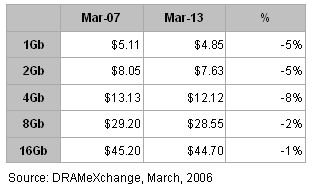
On the other hand, general demand for NAND Flash parts remained weak and the flooding of supply persisted giving price downward pressure last week with low-density parts (4Gb and below) suffered a comparatively larger drop rate than high-density parts. (1Gb to 4Gb with drop of 5-8%; 8Gb to 16Gb with drop of 1-2%).
DDR prices rollover ahead
The recent DDR spot price rally hints an upcoming price bottom ahead despite 2Q as the traditional low season. The price fall should constrain within 10% and resume the growth momentum soon. Tracking the DDR spot price trend in the previous months, prices of DDR 256Mb 32Mbx8 had once peaked at US$2.33 in mid Jan after recording the price lifted by 15% (from US$2 in early December). Price fall was soon followed and dragged the price to reduce by almost 11% to US$2.08 on Mar13. Price of the same specification eTT (UTT) parts had also shoot by almost 27% in the same period and peaked at US$2.3 in mid Jan, i.e. quoted at the similar level as branded parts. The price nose dived by 22% since then and reached back to US$1.8 on Mar13.
The price growth momentum of DDR2 followed DDR with price hiked up to peak levels during late January. The growing severe shortage from late Dec. had prompted PC OEMs to secure for more stocks at the spot market amid the shortage observed at contract market. Spot prices of DDR2 512Mb 64Mbx8 rocketed over 40% within a month to US$5.29 in late Jan and this record-high price level last through Feb. The strong prices only record setback from early March and dropped by a slight 5% at US$5.04 on Mar13. The price trend of the same specification uTT (eTT) parts sticks in line with the mentioned price fluctuation and had once shot by over 40% to US$4.31. The price started falling after peaked and dropped by 6% to US$4.05 on March 13.
DRAM contract price fall to limit within 20% in 2Q
DRAM contract prices should still subject to negative trends in 2Q06 under the cyclical demand downturn but the rate of drop should weaker than last year, thanks to the absence of no irritating factors for potential oversupply. Contract prices of DRAM should fall less than 20% QoQ in 2Q06 and we estimate that the average price of DDR2 512Mb 64Mbx8 DIMM in Q2 should be above US$3.7 compared to this quarter's averaged US$4.6.
Samsung that continues growing niche memory (including mobile RAM, graphics memory) should constrain its commodity DRAM supply. Micron should also divert more focus on NAND Flash at expense of commodity DRAM drop. Hynix's capacity reallocation to its new established Wuxi China plant should also limit supply on the anticipated -10% supply bit growth decline. For some DRAM makers, they should see their supply being limited when ramping up production to 90nm node.
DRAMeXchange estimates the proportion of DDR to overall commodity DRAM ( DDR+DDR2) should still stay at 40% in 2Q and the ratio will diminish to below 20% in 4Q amid the chipset and CPU launching schedules among industry players. Intel's production roadmap hints that 30% of its overall chipset output should be DDR-supported 865-series chipset with the reminder as 915/945-seires in 1H06. VIA should only debut its DDR2-supported chipset in June while rival SiS will only start volume produce similar chipsets in 3Q. For AMD, it will only start supplying its new socket CPU M2 (for both contract and spot market) in June.
Emerging module demand of 1GB/2GB sustains price rally on high-density NAND Flash chips
Prices of high density parts stood relatively firm amid the demand for 1GB and 2GB modules form memory card and UFD (USB Flash Drive) manufacturers that spurred demand of 8Gb and 16Gb parts. We observe that China, Taiwan and Korea are the regions that show stronger demand for these parts, though the transaction volume was only limited to few thousand pieces per deal.
As for 1Gb to 4Gb parts, manufactures tend to adopt these parts for gifts market and with only minimal demand. The anticipated supply growth for low-density Flash parts should continue weighing on the price trends in the following weeks.
Although everyone is still waiting for concrete orders landing status from the ongoing CeBIT show at Hanover, Germany, the demand that driven from this show should come less promising than previous years from our current source checks.

The memory market watcher
DRAMeXchange is a global primary provider of future intelligences, in-depth analysis reports and advisory services on DRAM and Flash memory industry with coverage including current business, spot trading prices, and market trends, capital spending and wafer capacity trends, the impact of DRAM/flash memory products on the market, and other relevant PC industry information.
© DRAMeXchange ® Tech.Inc. All rights reserved.