Feb. 21, 2006 DDR2 persists its price momentum at contract market with related DIMM prices grew by an average of 10% in 2HFeb. NAND Flash spot prices, on the contrary, slashed by 18-25% last week amid the seasonality impact and bountiful inventory.
No fresh DRAM spot transaction ?
The continual DXI index drops (from 3,078 to 3,052) in the week Feb14-21 reflects sluggish DDR price trend with transaction of both DDR and DDR2 remained quiet last week in the spot market.
DRAMeXchange observes that Japan-based Elpida had reduced its DDR2 512Mb 32Mbx8 533 MHz spot price by a slight US$0.01 to US$5.27 last week. Overall speaking, DDR kept staying at its price downside with DDR 256Mb 32Mbx8 400 MHz and the same-specification 512Mb chip suffered a respective drop of 3.6% (to US$2.13) and 1.7% (to US$3.98). The upcoming official price release of Powerchip Semiconductor Corporation (PSC)'s Mirra-brand DDR 256Mb 32Mbx8 eTT (UTT) chip to module makers had also hold traders' consumption and resulted a 3.5% drop to US$3.98 last week.
DRAM contract price in 2HFeb: DDR stay flat, DDR2 grows by 10%
According to our checks, contract prices of DDR module notionally stay flat with only selective parts reported price up slightly. DDR2 hold firm on its upward price trend with an average of 10% sequential price growth recorded. Most DRAM makers are bullish about DDR2 contract price up in 1HMar as the present shortage should persist through then.
We see PC OEMs aggressive ramping up their DDR2 demand from last December, in contrast to DRAM makers whom started to reduce DDR2 wafer in proportion from last October. This unbalance demand/supply finally lead to the severe shortage in this quarter.
DRAM makers that adjusted their DDR2 production proportion are not just transiting all back to DDR. Samsung, for instance, has converted its DDR2 production capacity to niche memory including Mobile RAM and graphics ICs while another one transited capacity to consumer DRAM.
As some PC OEMs still maintain their DDR adoption rate at 50-60%, they were opened to limited price raise in this negotiation amid the notionally balance demand/supply. After the copious negotiation in 1HFeb, DDR 256MB DIMMs were priced at US$20 (US$2.25 per chip). Noted that we observe related DIMM priced at US$19.5 at the high levels and it is likely that some might settle the price at US$20.
After DDR2 256MB/512MB DIMM experienced record-high price sequential growth at US$22 and US$44 in 1HFeb, we observe that some are still negotiating DDR2 DIMM quotes with most PC OEMs generally accept an almost 10% sequential up. Although the contract prices of 256MB and 512MB DIMM were priced at US$24/$48 at the highest currently, some DRAM makers actually quoted the high-range prices at US$24.5/$49. As some US-based PC OEMs had already secured their required volume in early February and locked the DDR2 256MB/512MB prices at US$20/$40 for 2HFeb with limited increasing range.
Seasonality demand downturn and inventory pile up to slash by 18-25%
The weak demand and bountiful inventory dragged NAND Flash spot market during the past two weeks.
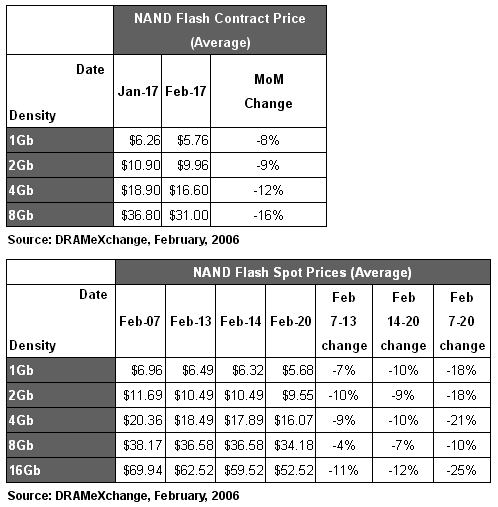
Spot prices of 16Gb and 4Gb NAND Flash leaded the fall with a 25% and 21% drop to US$52.52 and US$16.07 respectively. Prices of 1Gb and 2Gb both suffered a 18% sequential drop at US$5.68 and US$9.55 while 8Gb also recorded a 10% price fall at US$ 34.18.
The listless NAND Flash demands are driven by following reasons.
First, 1Q is usually the seasonal low period for NAND Flash and some card makers still have plenty of NAND Flash stock on hand that they had prepared before the Chinese New Year break.
Second, considerable amount of NAND Flash related consumer electronics such as memory cards and MP3Ps are still circulating at channels after demand peaked during previous festivals, overall demand for NAND Flash components should be discourage accordingly in 1Q. Lexar's 4Q profits record help illustrated this scenario. It announced its 4Q earnings last week and stated that it suffered loss due to inventory accumulation for higher margin products amid lower-than-expected channel sales.
Third, the lowest price benchmarks of MP3Ps are dragged lower upon Apple's recent moves including the introduction of the new 1GB iPod nano (US$149) and the price cut of iPod Shuffles (1GB model drops from US$129 to US$99; 512MB model drops from US$99 to US$69). The aggressive moves should further squeeze the profits of smaller consumer electronics brands and leave limited rooms for high priced NAND Flash components.
NAND Flash contract price falls to trend moderate in March
NAND Flash spot prices of 2Gb to 8Gb that recorded by Feb13 had already fallen below the contract prices that posted during Jan06 by 1-4%. This trend resulted in a tighter contract price pressure to contract prices quotes in Feb. NAND Flash contract prices had declined by 8-16% in Feb06 with current contract prices for 1Gb to 8Gb parts averaged at US$5.76, $9.96, $16.6 and $31 respectively.
Downside contract price risks should persist through March as the first quarter is about to end. However, we expect the price drop should trend moderate after the recent dramatic price fall. Noted that the yield improvement on MLC-made NAND Flash production should still drawing alert as this may factor output to outstrip demand.

The memory market watcher
DRAMeXchange is a global primary provider of future intelligences, in-depth analysis reports and advisory services on DRAM and Flash memory industry with coverage including current business, spot trading prices, and market trends, capital spending and wafer capacity trends, the impact of DRAM/flash memory products on the market, and other relevant PC industry information.
© DRAMeXchange ® Tech.Inc. All rights reserved.