By Joyce Yang, Marketing Intelligence Team, DRAMeXchange
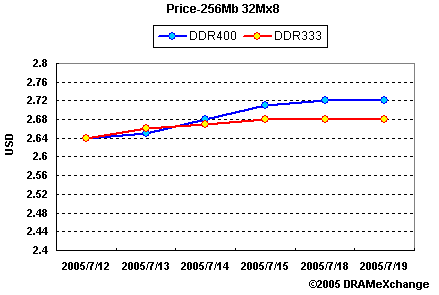
DRAM mainstream chip, DDR 256Mb 32Mbx8 400MHz has continually traded up 3% from $2.64 to $2.72 from July 12 to July 19. During the same period, eTT(UTT) chips have shown stronger uptrend momentum as the major eTT supplier still has not released any to its major customers and distributors in the spot market last week. 256Mb 32Mbx8 eTT chip was up 4.8% from $2.49 to $2.61. Usually, the price gap between eTT and major brand average price ( for example, Hynix ) is around $0.20, the price gap will extend to $0.30 during the downtrend or shrink to $0.10 during the uptrend, sometimes, eTT prices can be traded higher than major brand average price if there's overheating demand in spot market. Thus, the pricing trend of eTT chips can be a leading indicator of DRAM spot prices.
We forecast DDR 256Mb 32Mbx8 average spot price to go up continually and reach $2.80 soon next week or so.
PC shipment up 6% to 7% MoM in June
Taiwan tier-one motherboard makers have reported an upside surprise on June shipments. The growth on aggregate shipments from top four makers showed stronger than the tier-two motherboard makers as they have been consolidating market share from tier-two makers. The top four motherboard makers' June shipment has reached 7.9 million units, the growth is mainly driven by the upside from Asustek and Microstar.For notebook shipment, Taiwan ODM, Compal and Quanta also reported an upside on shipment though the ASP trended down with fierce competition.
We've observed demand for DRAM has turned stronger since the second half of June. We believe the stronger demand is contributed by the better than expected PC shipment in June as most PC OEMs still hold lean inventory in June and have a stable or slightly up content per box ( memory installed per PC system ) policy. Some major PC OEMs have felt a tighter supply of DDR SDRAM than DDR2 SDRAM since the second half of June.
DRAM supply update : DRAM capacity allocation to NAND Flash and reduction in DDR2 ramp up
We estimate DRAM supply shortage will enlarge in August as DRAM supply bit growth constrained by more capacity allocating to NAND Flash. Especially for one Korean DRAM maker which has switched one Chong-Ju DRAM fab which accounts 20% - 25% of its total DRAM capacity to NAND Flash only since the second quarter. Besides, the USA and European DRAM makers also have solid plan to double their NAND Flash capacity starting the third quarter. We believe the capacity transition to NAND Flash is a good strategy for DRAM makers to reduce their risk exposure on DRAM pricing volatility.
With concern of Intel 915 chipset shortage and slower than expected demand of DDR2, some DRAM makers have slowed their DDR2 ramping up plan or reduced their DDR2 capacity to match the PC OEMs customers' need for DDR1. Besides, DDR2 premium over DDR1 have shank to zero to most PC OEMs customers and to channel customers, DRAM makers' profitability on DDR chips will be better than DDR2 chips as DDR2 cost is still higher than DDR1. DDR2's die size is about 5% bigger than DDR, thus, DDR2 is to yield less gross dies in the same size wafer even DDR2 yield rate matures. Besides, according to our update with Taiwan backend companies last week, DDR2 512Mb still requires over 1000 seconds in testing time and may reduce to 700-800 seconds - the average testing time for DDR 512Mb, until the fourth quarter of 2005. Furthermore, the FBGA package of DDR2 in 512Mb is around $0.10 higher than DDR1 TSOP package in 512Mb.
We estimate the DDR2 average penetration in PC and server/ workstation to be below 45% in December 2005 according to DRAM makers' adjustment on capacity ramp up and allocation on DDR and DDR2.
By Judy Chen
2Gb and above density remain hot items in spot
This week's NAND Flash spot market for high density chips remains feverish. Spot prices for 2Gb and above densities increased 4%-7% making 2Gb, 4Gb and 8Gb to reach USD12.79, USD23.32, USD44.2, respectively. Reasons for this price trend are mainly due to lack of supply and demand in the spot market. Demand only showed up during the early part of the week and disappeared towards the end of the week, due to over surged prices. Currently, market is waiting for the contract price of July to come out in the coming week due to weak strength in demand. If it remains the same as end of last month, then we are sure that spot market is certain to start to turn on the upward pricing trend.
Shortage for NAND Flash in 2H'05?
Samsung indicated in its 2Q earnings result last Friday that their 3Q and 4Q bit growth is going to be 24% and 53%, respectively, for 2005. After checking with the other major suppliers for NAND Flash, we also see huge supply increase in 2H of 2005. Will this be a sign of over supply? Responses we hear from these vendors are saying that demand from high density MP3P, multi-featured phones and high resolution DSC are high enough to just make supply and demand balance. For now, we believe, the spot price will start to soar starting next month when seasonal demand comes back. However, we are still skeptical about the huge volume being booked right now till 4Q. If the demands for 4Q turn out to be lower than current estimation, with the large quantity planned now, we are sure there will be another huge drop in price again in 4Q.
_940719b.gif)
_940719c.gif)

The memory market watcher
DRAMeXchange is a global primary provider of future intelligences, in-depth analysis reports and advisory services on DRAM and Flash memory industry with coverage including current business, spot trading prices, and market trends, capital spending and wafer capacity trends, the impact of DRAM/flash memory products on the market, and other relevant PC industry information.
© DRAMeXchange ® Tech.Inc. All rights reserved.