DRAMeXchange : Weekly Research : 【Market View】

The memory market watcher
【Market View】DDR gets demand supporting; SDRAM keeps down slightly
Published
2003-12-02 (GMT+8)
DDR gets demand supporting; SDRAM keeps down slightly
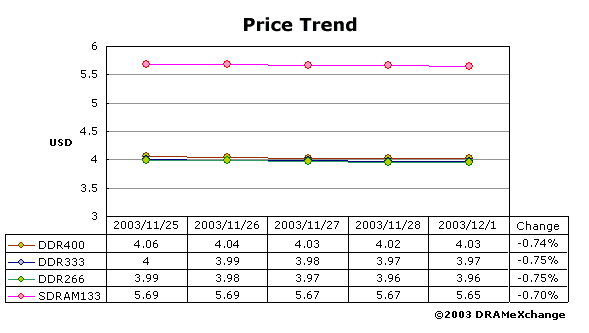
DDRs were down below $4.00, then get support from emerging demand
Heavy dumping of DDR 32Mx8/16Mx8 was happened in spot market last week, and 256Mb 32Mx8 400MHz/333Mhz/266MHz have been down below $4.00. One major maker proposed a bundle deal of nand flash IC and original modules to prompt the dumping. The agents supported the deal and dumped the original modules below the market prices to spot market, however, they offset the loss by gain from flash. From the beginning of December, the dumping pressure ceased and some traders/ channel distributors see this as a good entry point to accumulate inventory. Module houses get plenty of orders running from Europe market. Even USA is in Thanksgiving holiday, some traders still come to Asia market to look for parts. The Taipei computer show also plays a role to support the prices. However, we have heard 1H December contract prices down dramatically and this may have impact on spot prices soon.
SDRAM keeps down slightly
In contrast, SDRAM seems lost spotlight and prices keeps going down. 4Mx16 keeps at high level of $3.10 while 8Mx16 was traded at $3.35 to $3.5.
Nand Flash
Prices keep at high level due to tight supply. 128Mb(2808) is quoted $6.6 to $7.0.
256Mb(5608) is about $11.0; 512Mb(1208) is trading around $20 and 1G is about $33 to $33.2.
1H December Contract prices continues down as projected
Even the 1H December contract prices haven’t been finalized, what we have collected from major DRAM makers shows that the prices are down about 8% to 9% compared to the prices of 2H November. Same as the last term, some DRAM makers offer no premium between DDR400/333 as well as LONG DIMM / SODIMM. This signals the selling pressure do exist in DRAM manufactures. After passing the seasonal peak, most OEMs are lowering their inventory levels and cause DRAM makers hold less negotiation powers on contract prices. Since the end of October, the contract prices remained flat even though the spot prices kept going down and resulted in $1 premium between contract/spot prices at the end of November. Therefore, it's not surprising the DRAM makers get pressure to lower the contract prices to get close to the the downward spot prices.
The memory market watcher
About DRAMeXchange
DRAMeXchange is a global primary provider of future intelligences, in-depth analysis reports and advisory services on DRAM and Flash memory industry with coverage including current business, spot trading prices, and market trends, capital spending and wafer capacity trends, the impact of DRAM/flash memory products on the market, and other relevant PC industry information.
© DRAMeXchange ® Tech.Inc. All rights reserved.