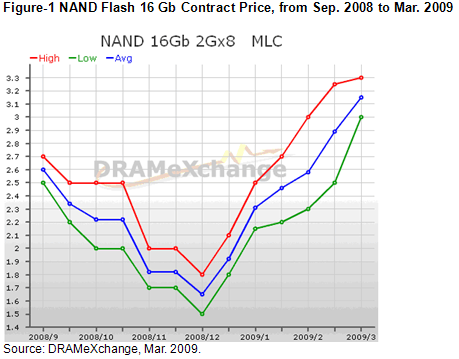
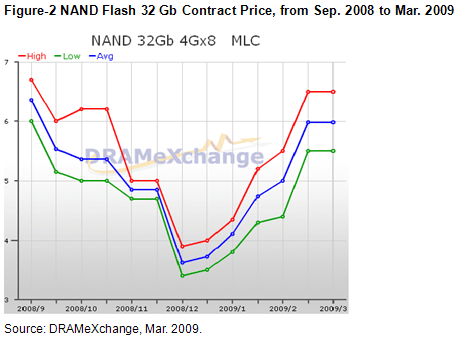
The NAND Flash contract price hit bottom at the end of 2008 and started to rebound. Taking the main stream 16 Gb and 32 Gb chips for example, the 16 Gb contract chip price was US$ 1.65 in 1H December 2008 and reached US$ 3.15 in 1H March 2009, with a 91% increase. The 32 Gb contract chip price also rebounded from US$ 3.62 in 1H December 2008 to US$ 5.98 in 2H March 2009, increased at 65%. To the NAND Flash vendors, both upstream and downstream, such rapid price change implied certain marketing strategic adjustment.
To the NAND Flash upstream suppliers, the NAND Flash price was in a continuous downtrend from mid 2008. Except macro economic situation was weakening the demand of NAND Flash related consumer electronics, the content per system of NAND Flash related products was already surpassed the consumers’ actual need. In 2H 2008, how to induce consumers’ purchasing intentions was a major topic of last year.
From the upstream suppliers’ point of view, even though the average profit was decreasing, the NAND Flash suppliers, on the whole, were stably profiting in the past few years despite of more competitors had entered the market. Gaining market share by increasing capacity in the cyclical downturn had become an essential issue. However, after 4Q08, the situation has dramatically changed. No matter Samsung, Toshiba, or Micron were all suffering from huge losses, and how to maintain profiting has become a key issue. Under this kind of atmosphere, the upstream vendors had consecutively adjusted their production plans and tried to stabilize or raise the price by decreasing the supply. This strategy had shown its effectiveness and somehow stabilized the price.
Currently, the upstream NAND Flash suppliers will suspend their new capacity expansions or gradually retire part of their 200 mm equipments to reduce utilization rate. Some will increase their NAND Flash supply bit growth by technology process migration to lower the impact of traditional slow season and global recession.
To the down stream vendors, facing the weak aggregate demand and the rapidly increased price of NAND Flash, there are certain pressure on the existing product and market planning. With the continuous price drop of NAND Flash last year, the down stream vendors gained cost buffer and were able to double the NAND Flash density to stimulate end consumer demand. It is not easy to see sudden surge of NAND Flash price this year, the growth of end product content per system will also slow down.
Although the NAND Flash market demand bit growth of 2009 is lower than 2008, it is expected that the demand bit growth of 2H09 will be higher than 1H09 due to the hot season effect. Well-adjusted supply growth of suppliers is also helpful to 1H09 oversupply condition, and the supply and demand will be more equilibrium in 2H09. With the hot season effect and the cost down driven by process migration, we expect the NAND Flash price to remain stable or gradually rise in 2H09.

The memory market watcher
DRAMeXchange is a global primary provider of future intelligences, in-depth analysis reports and advisory services on DRAM and Flash memory industry with coverage including current business, spot trading prices, and market trends, capital spending and wafer capacity trends, the impact of DRAM/flash memory products on the market, and other relevant PC industry information.
© DRAMeXchange ® Tech.Inc. All rights reserved.