Spot price up over 10% last week, 2H February contract price remains stable
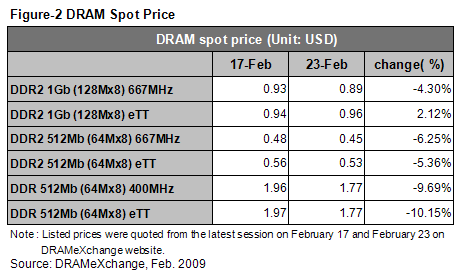
After Qimonda officially declared filing bankruptcy protection on January 23rd, with the Chinese New Year Holidays passing by, the DDR2 1Gb eTT chip price jumped from US$ 0.96 on February 2nd to US$ 1.2, with the upside range of 25%. But the high price only sustained for almost one week and later dropped all the way to US$ 0.87 in two weeks (2/6-2/19). Comparing to the high US$ 1.21 in February, the price plunged 28% and fell below the January DDR2 1Gb eTT average price US$ 0.98. Last Friday, the DDR2 1Gb eTT chip price once again quickly rallied and the chip price hit US$ 0.96 with a 10% price increase, and the DDR2 667Mhz 1Gb only slightly up 4.7% closing around US$ 0.89. The sharply increasing and decreasing of spot chip prices also reflect the uncertainties hiding behind the industry integration and chances that vendor may be forced out of the market (Figure-1).
Analyzing the spot market, since after the Qimonda bankruptcy protection, WW DRAM industry capacity may have chance to decrease another 10%, which is about 1 million wafer level. WW DRAM capacity decrease will be over 32% and reach the 2006 wafer starts level. The capacity cut degree of Taiwanese DRAM vendors even reach 50%. The current capacity of the spot market focused vendor PSC is now only 30 to 40 K left and Promos is less than 20K. These had driven the DDR2 1Gb eTT spot chip price rapidly surged to US$ 1.21 after the Lunar New Year Holidays. With the unsolved ECB issue of Promos, the traditional slow season of PC, and the contract price didn’t rebound high enough, the market went back to its fundamentals and the price quickly dropped to US$ 0.85 low. Now in the spot market, some participants think that the chip price is at a relatively low level, and the speculation buying is induced. The Chinese policy “Home electronics down to the country side” bids closing at the end of February also evoked the buying is another driving factor of the recent price rally.
On the contract market side, the spot chip price rallied over 25% in the beginning of February also drove the 1H February contract price up over 5%. The average module price of DDR2 1 GB and 2 GB were around US$ 8 and US$ 16. With the continue dropping spot price and some PC OEM had already negotiated the contract price for the whole 1Q, the 2H February contract price only remained stable and couldn’t barely rebound as the vendors expected. DRAMeXchange believes that only after the Taiwanese government’s DRAM bailout plan comes out, the directions of DRAM vendor integration or out of the market will be more definite. No matter it is Micron or Elpida, this will tug the future DRAM market geography.

China’s “Home Electronics Down to the Country Side” policy—The PC business opportunities
In order to expand domestic demand to compensate for the decrease of export, Chinese government started to advocate the policy of “Home Electronics down to the country side” in December 2007. Through purchasing the designated home electronics, the Chinese government will compensate 13% and encourage the farmers to consume. First is to decrease the gap between the cities and the country, second is to stimulate the domestic demand and compensate for the decrease of export, and maintain the economic growth momentum of the country.
Following the process of the policy, PC will be one of the designated products of the 2009 “Home Electronics Down to the Country Side” since the Chinese government is increasing the popularity of internet usage nation-wide, mobile phone and PC are the necessary device for access. Especially the Chinese government has been aggressively promoting e-mail, electronic information in the country, and enabling internet access in every village. Therefore, PC will be the next product to go into the country side after mobile phone.
According to the Chinese government data, the internet users of China reached 298 million in 2008 and the popularity is 22.6%, which was slightly higher than the global average 21.9%. By device, the number of broadband user reached 270 million and the number of mobile phone internet user was 112 million. The prior accounted for 90.6%. If sorted by population type, the number of country side user was 84.6 million, which was 28.5% of the total internet user population, but only accounted for 11.9% of the country side population in China.
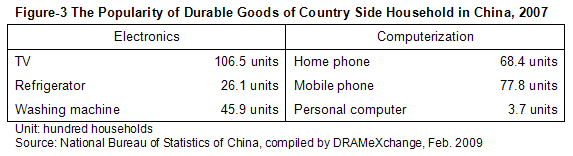
Severe computerization popularity (information popularity) lag exists between the cities and countries in China. The Chinese government has been aggressively improving the living quality of country villages to minimize the gap. According to the data of the National Bureau of Statistics of China, the country households have gradually stepped into electrical and informational era in the recent years. Back in 1978 there were almost no home electronics in the country families, but in 2007, the numbers of TV, refrigerator, and washing machine per hundred country side households reached 106.5 units, 26.1 units, and 45.9 units respectively. About the information products, home phone, mobile phone, and personal computer per hundred country side households reached 68.4 units, 77.8 units, and 3.7 units respectively.
No matter it’s the internet or PC popularity, the computerization of the country side is far lower than the costal cities. With the helping of high country side population and the government policy, the future PC market is full of potentials. The “Home Electronics Down to the Country Side” policy will last for four years this time, there is expected to be 6 million units of PC demand in 2009 with the production revenue of 12 billion RMB. The PC shipment will increase 16% while comparing to the 2008 number, and the production revenue will increase 5% (the unit price is estimated with the lowest of 2000 RMB). While facing the uncertainties of economy, such demand really gives vendors hope of business growth.

The memory market watcher
DRAMeXchange is a global primary provider of future intelligences, in-depth analysis reports and advisory services on DRAM and Flash memory industry with coverage including current business, spot trading prices, and market trends, capital spending and wafer capacity trends, the impact of DRAM/flash memory products on the market, and other relevant PC industry information.
© DRAMeXchange ® Tech.Inc. All rights reserved.