Low trading volume in the DRAM spot market, 2H January contract price is hopefully to remain stable
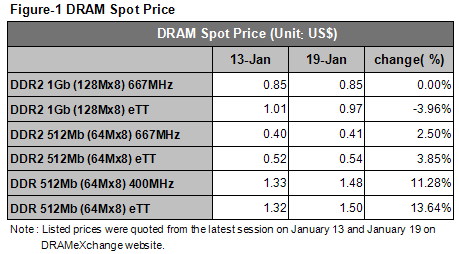
The spot market trading was slow last week, DDR2 1Gb eTT slightly dropped to US$ 0.97 with a range of 4%. The DDR2 667 Mhz 1Gb remained unchanged US$ 0.85. From the market perspective, since it is close to the Chinese New Year and the New Year inventory buying momentum has come to an end, the trading volume had shrunk. The spot market might wait after the Chinese New Year holidays end to see the trading volume to go up again. In the contract market with the unchanged 1H January contract price, which DDR2 667 Mhz 1GB and 2GB average prices were US$ 8 and US$ 16, also stopped the 7 month downtrend. Recently, it is said that certain Korean vendor is willing to cut 10% to 20% capacity. The contract price bottom is becoming firm. The January contract price is hopefully to remain stable and may start a real rebound in February and March.
The schedule of the DDR3 becoming mainstream product may delay to 2010
2008 is defiantly a devastating year for the DRAM industry. The overall oversupply situation and the severe 2H08 financial crisis not only the DDR2 1Gb eTT chip price dropped 73% from its high of US$ 2.15 all the way to US$ 0.59, the DDR3 chip price was infected by DDR2, for example, the DDR3 1066 Mhz 1GB contract price plunged from US$ 13 in October to US$ 8 in November, which is a 40% drop in 4Q alone. In December, its price was about the same as the DDR2 667 Mhz 1GB contract price. From the stand point of product generation migration, this is not often seen. Once again this shows the toughness that DRAM market is facing.
If we analyze from the product spec, comparing to the DDR2, DDR3 has the advantage of higher frequency and lower voltage, but there have always been obstacles for DDR3 to popularize. From the oversupply situation to the global recession, the schedule of DDR3 becoming mainstream item has been delayed again and again. Following are the DDR3 future analysis done by DRAMeXchange.
A. From the supply analysis, according to the statistics of DRAMeXchange, along with the cost down of DRAM vendors and 2009 CAPEX cut, the total expenditure of DRAM industry is estimated to be US$ 7 billion, which is a 50% decrease comparing to US$ 13.5 billion of 2008. This also means that the DRAM vendors has no extra money to invest in DDR3 capacity and only can allocate their CAPEX in the process migration of DDR2 chips. DRAMeXchange estimates that the DDR3 market share will reach 28% at the end of 2009, and DDR2 about 50%. The DDR3 will account for 17% average market share of the whole year 2009 and DDR2 about 60%.
B. From the demand analysis, under this recession environment, the Netbook may have chance to grow over 100% WW this year and the MB and NB will grow about -17% and -2%. The coming wave of Netbook not only decreases the DRAM content per system of PC but also puts a big stone in the way of migrating to DDR3. (See *1)
C. In the retail market, although the December DDR3 contract price is the same as DDR2, this price is between the DRAM vendors and the PC OEMs. In the retail market, the 1 GB DDR3 DRAM module price keeps in the range between US$ 20 to US$ 25, which still enjoys US$ 10 to US$ 15 price premium comparing to DDR2. In addition, the MB vendors price their boards with DDR3 support in the range of US$ 200 to US$ 300, which is US$ 70 to US$ 100 higher than the main stream DDR2 supported boards. In the retail market, the shipment was not well performed, said module houses. The DDR3 memory module shipment is still less than 1% of the total, which makes it harder to open the DDR3 market.
D. From the chipset aspect, the Intel X58 series sales was under expectation and may delay the planned termination of DDR2 support in mid 2009. Plus the DDR3 migration schedule of DRAM vendors has fallen behind, the DDR2 will still be the mainstream chip of the year. The time of DDR3 chip becoming the mainstream item will deferred to 2010. (See *2)
*1. Netbook can only be equipped with DDR2 533 Mhz 2GB memory modules due to hard ward limitations.
*2. Intel X58 series chipset supports the Intel new CPU i7, and only supports DDR3 memory.
Deceleration of supply growth and reviving 2H09 demand will help NAND Flash price stabilize & rise
Under the storm of global financial crisis, the traditional electronic hot season inventory re-stocking was way lower than the past experiences, the average NAND Flash price dropped over 30% QoQ in 3Q08 and 4Q08 due to the effects of under expected hot season and the downstream customers’ inventory clearance. Most NAND Flash vendors started suffering from loss in 3Q08. In September 2008, Hynix first announced retiring part of its 200 mm NAND Flash capacity. With the attitude toward the 2009 global economy becoming more conservative in 4Q08, IM Flash also announced that it will retire its 200 mm NAND Flash capacity and delay its new 300 mm NAND Flash Fab schedule from 4Q09 to 1Q10 in October 2008. Because some downstream leading electronic companies revised their 2009 shipment forecasts one after another, in December 2008, the Toshiba / SanDisk camp also announced it will cut NAND Flash capacity 30% MoM from January 2009. Meanwhile, Samsung will gradually retire its 200 mm NAND Flash capacity followed by its original schedule in 2009. It is estimated that the 1Q09 wafer output will decrease about 10% QoQ comparing to 4Q08.
While facing the global slump and under the difficulties of fund raising in financial market, in 2009, the NAND Flash makers’ supply strategies are mostly about retiring those less cost-competitive 200 mm capacities, pending the new 300 mm capacity expansion, and upgrading the current 300 mm capacity process technology to increase bit output, in order to reach the goals of lowering their CAPEX and decelerating the bit supply growth pace. Hence, we estimate that the 200 mm NAND Flash wafer production both will decrease 20% QoQ in 4Q08 and 1Q09, and the 1Q09 200 mm wafer capacity will be less than 20% of the total NAND Falsh wafer capacity. This will also drive the output of NAND Flash chips with the density under 8Gb MLC to decrease sharply. Meanwhile, along with the 4x nm will become the mainstream process technology in the 300 mm Fab in 2Q09, the portion of MLC with the density more than 16Gb will continue to increase. While the difficulties gets higher when the process technology narrows down, the 3x nm process technology portion will not raise significantly until 4Q09. Since there are many uncertainties about the macro economy and the NAND Flash market visibility is also unclear, most NAND Flash suppliers principally will adjust their production target according to the interval of market demand growth. The production plans will also depend upon how quickly the market demand revives. We forecast that the NAND Flash supply bit growth will decrease from 132.1% yoy in 2008 to 65.4% yoy in 2009.
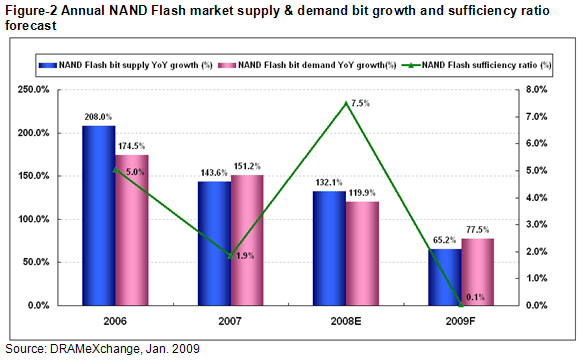
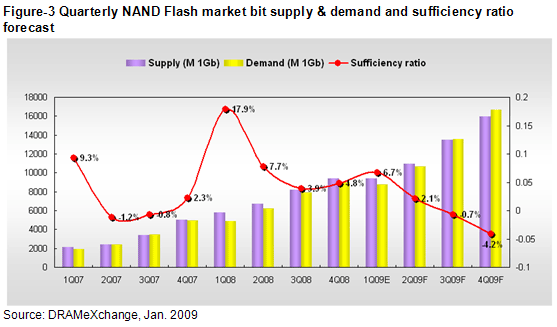
The shipments of the NAND Flash end applications in 2009 will slightly decrease from 2008 and the market size of SSD, which is the new killer application, is still in infancy. However, as the 2008 NAND Flash prices had plunged deeply, it will help drive up the memory content per system in most applications in 2009. Therefore the NAND Flash demand bit growth is expected to come down to 77.5% YoY in 2009 from 120% YoY in 2008. Under the impacts of slow season effect in 1H09 and the global slump spreading, although the NAND Flash suppliers had previously taken actions of capacity cut and annual maintenance, with the decreasing of both demand and supply sides, DRAMeXchange expects the NAND Flash market to still be in the oversupply situation in 1H09. Therefore, whether the sharply contract price rebound momentum before Chinese Lunar New Year can last into 1Q09 or not will depend on the recovery of market demand later. In 2H09, since the demand situation in the 2H08 base period was low, the NAND Flash related products are expected to perform better than in 1H09. If then the NAND Flash makers could control the growth speed of their capacity expansion, the NAND Flash market supply and demand may reach equilibrium or slight shortage in 2H09. The 2H09 hot season effect may activate the demand to drive up NAND Flash price and gradually rally.
2H January NAND Flash contract price review
NAND Flash contract price of 2H January, 2009, rebounded constantly, reflecting the fermentation effect of earlier upstream suppliers' reduction. Most suppliers also released 2H January contract price in order to response to the restocking demand before Lunar Chinese New Year. Though the demand for low-density products has shrunken, the average contract price of 4Gb MLC and 8Gb MLC products rose between 26 to 30%. The rise of price in 2H January reflected earlier upstream suppliers' reduction announcement that 20% QoQ of 200mm wafer production in 4Q08 & 1Q09 would be gradually phased out. The reduction mainly focused on 8-inch fab production; therefore, price of 4Gb and 8Gb MLC products rose with a large scale.
In addition, most downstream makers lowered their inventory to ordinary level in January. Starting from mid-January, they have started to fill their inventory back. Toshiba/SanDisk group earlier announcement on the reduction of 30% MoM 300mm production in January also helped to push the average contract price of other high-density MLC products from 5 to 15% along with market expected atmosphere. Most contract prices of SLC products whose demand has decreased also slightly rose.
Starting from 4Q08, most NAND Flash suppliers have either announced reduction or annual maintenance, and this is expected to decrease 10% QoQ wafer output in 1Q09. Reduction effect has encouraged NAND Flash market to rebound in 2H December, 2008. In 1Q09, both demand and supply for NAND Flash would decline, and the market is still under oversupply low season. The price has stopped declining and rebounded recently because of multiple effects from production reduction, healthier inventory level and restocking demand before Lunar Chinese New Year. In the short-term, the price would show stabilization. Currently the market expectation for 1Q09 slow season demand remains conservative. NAND Flash price stability after January, due to a glut concern, would depend on the recovery of market demand.
Netbook damages NB price more than NB market share
The hottest 2008 PC product Netbook, with its annual shipment of 10 million units, hasn’t reached 10% of the NB market share yet. The Netbook has more influences on the NB market value and its lowering pricing trend, than on the NB market share.
From the sales revenue announced by Intel in mid January, the 4Q08 revenue was US$ 8.2 billion, the operating income was US$ 1.5 billion, and the net income was US$ 234 million. The net income decreased 90% QoQ, and the revenue decreased 23% QoQ. These showed that the demand of the 2008 year end hot season had sharply shrunk.
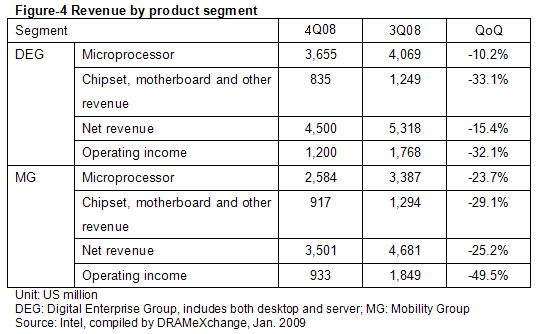
By product(Figure 4), the net income of the Mobility Group Decreased 25.2% QoQ, which was far more than the 15.4% decrease of the Digital Enterprise Group. In the 4Q08 PC market, the desktop PC shipment decreased 14% QoQ, but the NB shipment slightly increased. Under the circumstances of having 80% to 90% market share, the decrease ranges of price and quantity of the Digital Enterprise Group are very close, but in the Mobility Group, the price and quantity went opposite directions. It can be referred that the prices of the mobile CPU and chipset products had decreased beyond expectation or the low price product portion had sharply increased.
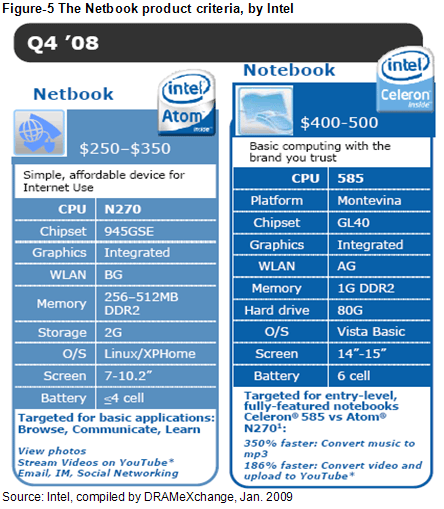
According to Intel’s financial reports, the revenue of Atom processor and chipset increased 50% in 4Q08 and reached US$ 300 million. While comparing the products of Atom platform to the products of mainstream NB (Figure 5), for example, Celeron 585 CPU, the price differences are about double. Therefore 4Q08 revenue of the Mobility Group decreased almost 20% while comparing to 3Q08 can be explained as the low price product portion increased. The causes might be—A. The hot season demand was weak and the PC vendors focused on their low priced products. B. The ultra low price Netbook will lower the consumer’s price recognition of NB from US$ 900 to US$ 600, or even lower. The existence of the latter made the PC vendors to compete with lower price products, and dragged down the revenue of the Mobility Group of Intel.
Under the slowing buying atmosphere in 2009, the Netbook will still be popular. This can be seen from the products PC vendors displayed in CES. It is estimated that the Netbook portion will increase to 17% of the NB market and bring the growing momentum to NB, but the damage to the NB price is a more difficult issue for the PC vendors to handle, even if Intel decreases the supply of Atom, it is very hard to bring up the NB price again.

The memory market watcher
DRAMeXchange is a global primary provider of future intelligences, in-depth analysis reports and advisory services on DRAM and Flash memory industry with coverage including current business, spot trading prices, and market trends, capital spending and wafer capacity trends, the impact of DRAM/flash memory products on the market, and other relevant PC industry information.
© DRAMeXchange ® Tech.Inc. All rights reserved.