WW DRAM capacity cut has surpassed 22% in January 2009, Spot chip price reached US$ 1 & contract price accumulates the momentum to rebound
The DRAM chip price has plunged since the beginning of 2007 and suffered from loss for almost seven consecutive quarters. WW DRAM vendors have lost US$ 10 billion in 2007 and 2008, and the Taiwanese vendors have lost US$ 4.2 billion. The main reasons were the optimistic view toward the memory demand and the huge 12 inch capacity expansion in 2006. The new capacity started production in 2007 consecutively resulted in severe oversupply, and has caused the DRAM price to drop quickly until now. According to the DRAMeXchange statistics, from 1Q07 to 3Q08, the WW 12 inch DRAM fabs had grown 56%, and 57% of the 8 inch Fabs had retired. The total average capacity had grown 21%. If we analyze this from another angle, along with the crashing DRAM chip price and the increasing penetration rate of Windows Vista among OEMs, even that OEM had considerably raised the DRAM content per system to over 2 GB among PCs in 2Q08, it still could not follow the speed of DRAM capacity expansion. When the economy quickly slowed down in 2H08, the financial crisis became the last straw that broke the DRAM vendors’ backs, and the vendors started capacity cut in September 2008. According to DRAMeXchange’s statistics, the number of new wafer in from last September to January 2009 decreased 22% world wide, and among this, the Taiwanese vendors’ capacity decreased most among all and has reached 55%. Obviously after the DRAM vendors announced capacity cut in September 2008, they still decreased their wafer in continuously even higher than the percentage they claimed. Furthermore, with the strategy of limited shipment, the spot chip price started to show signs of rebounding in December. First the spot DDR2 1G eTT chip price sharply rallied over 75% from mid December to now. The 1H January contract price first time showed signs of price stableness and stopped declining. After the PC OEM demand recovers, the price rebound is worth hoping.

In the spot market, the DDR2 1Gb eTT chip price fell below US$ 1 in mid November 2008 and hit US$ 0.59 bottom, after the effect of capacity cut and limited shipment strategy started, the chip price began to rally from mid December and once again reached US$ 1 in January 7th. Last week (Jan 6th to Jan 12th) the DDR2 1Gb eTT price started climbing from US$ 0.92 to US$ 1.01 with the range of 10% upside. The DDR2 667 Mhz 1Gb also rallied from US$ 0.78 to US$ 0.85, with the range of 9%. From the market observation, with the effect of capacity cut and the shipment control strategy, previous procurement wave has come to a halt as the Chinese New Year is approaching soon and is waiting for future developments in the spot price market.
In the contract market, the 1H January contract price remained stable, the DDR2 667 Mhz 1 GB and 2 GB average prices were US$ 8 and US$ 16. The 64% of price dropping from last July had stopped. From the market observation, with the coming Chinese New Year and the DRAM procurement demand in the E.U. and the U.S., and the DRAM vendors are willing to keep the chip price above US$ 1, the total market supply will be controlled, and incubating the 2H January contract price rally momentum.

Outlook of 2009 consumer electronics trends from CES; 1H January NAND Flash contract price showed both ups and downs
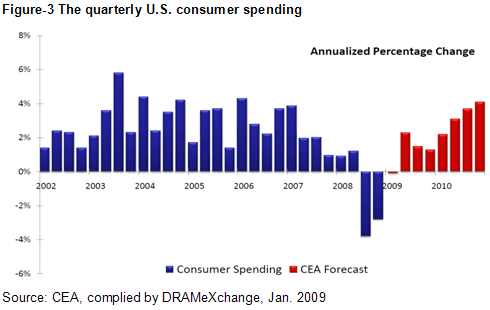
CEA (The Consumer Electronics Associations) earlier announced, according to the statistics of CEA, in December, 2008, the U.S. consumers’ confidence index kept sliding down due to the economic slowdown, which showed that the hot season effect had weakened. CEA-CNET index also showed that under the influence of sudden rise of the U.S. unemployment rate, consumers tended to lower their spending on consumer electronics and related hi-tech products. In 4Q08, the consumer electronics sales were not like the past few years that showed strong growth momentum. CEA estimates that the consumer electronics sales revenue of 2008 reached US$ 17.2 billion, comparing to 2007, the YoY growth was 5.4%. And the U.S. consumer electronics sales revenue will still reach US$ 17.1 billion in 2009, slightly decreases 0.6% YoY. CEA pointed out that the 2008 WW consumer electronics sales revenue was US$ 68.4 billion, and hopefully will slightly increase to US$ 72.4 billion in 2009.
For NAND Flash related applications, DRAMeXchange estimates the 2008 WW mobile phone shipment to be 1.228 billion units, and expected to grow to 1.162 billion units in 2009 due to the growing momentum from the emerging markets such as China, Middle-East, and other Asian developing countries. The 2008 WW NB shipment was 118.46 million units, and expected to be 116.42 million units in 2009. The emerging markets are still the major sales region.
Outlook 2009 market status, we conclude that there are some major developing trends of the WW consumer electronics market which worth paying attention. First, the growing momentum source will shift from developed countries to the emerging markets, especially the BRIC, which possess huge young consuming population. The spreading and application popularizing speed are now faster than before. Accompany with the online population rapid growth, the built-in internet related applications emerge quickly, and the digital content market become another shining market, which includes music, video, reservation service, information providing, and communication. In the sales channels, the information source has become more versatile for consumers. This makes it more challenging for the channel players. The green products are now more recognized by the consumers all over the world.
1H January NAND Flash contract price review
1H January NAND Flash contract price showed ups and downs, the 8 Gb MLC and 16 Gb MLC contract prices both strongly rallied about 19%, but the SLC contract price mostly declined. The main reasons were the 8 Gb MLC and 16 Gb MLC have plunged almost 90% from mid August 2007 to mid December 2008. Therefore, the NAND Flash vendors have lowered the production portion of those lower profit-margin 8Gb MLC and 16 Gb MLC and the prices had rallied since 2H December. The NAND Flash vendors consecutively announced that they will cut some 200 mm Fabs capacity about 19% QoQ in 4Q08 and 1Q09 stimulated the 8 Gb MLC price to rebound. The price of the 16 Gb MLC, which is majorly manufactured in the 300 mm Fabs, rebounded after the Toshiba & SanDisk alliance announced that it will cut 30% MoM capacity in January. Since some downstream customers’ inventory levels were down to the normal status of two to three weeks in early January, even though 1Q09 is still the slow season and under oversupply pressure, the short term some NAND Flash price is hopefully to remain stable or to rebound under the capacity cut effect and the Chinese New Year inventory re-stocking.
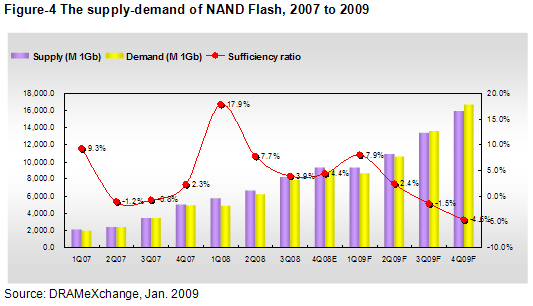
As the procurement demand for NAND Flash suddenly froze in November 2008, the market expectation of year-end holidays & 1Q09 sales continued to weaken. Although the NAND Flash vendors had announced capacity cut and annual maintenance plans in December 2008 to deal with the potential impacts of weakening demand and slow season, under the decrease of both demand and supply, we expect 1Q09 NAND Flash glut to be 7.9%. The capacity cut of NAND Flash vendors does improve the previous weak market confidence and help the price from sliding and became stable, however, the recent pre-warnings from some electronics companies’ under expectation 4Q08 financial results and the pessimistic outlook of 1Q09 outcomes, with the traditional slow season effect and global financial crisis aftereffect, the NAND Flash price might soften after January.

The memory market watcher
DRAMeXchange is a global primary provider of future intelligences, in-depth analysis reports and advisory services on DRAM and Flash memory industry with coverage including current business, spot trading prices, and market trends, capital spending and wafer capacity trends, the impact of DRAM/flash memory products on the market, and other relevant PC industry information.
© DRAMeXchange ® Tech.Inc. All rights reserved.